Category European

The Eagle and the Shamrock: Why Irish fans might soon take Albania into their hearts

ALBANIA’S got a special place in my heart. It’s the source of one of those strange drinking stories that are told in a spirit of humour despite the circumstances, the kind you laugh at but don’t dwell too deeply on. That tale’s located at an intersection of football, politics and poverty. Back in the spring of 2013, I went to Albania for an academic conference. I was staying in the capital Tirana and on my first evening there, I headed out to explore the city. On my travels, I went into a bar, where they were showing the Champions League semi-final between Real Madrid and Borussia Dortmund. Over a beer, I got gripped by the battle where Madrid, being 4-1 down from the first leg, attacked all-out, having nothing to lose.

Having a conference to attend in the morning, I left at half-time, heading back to my hotel. Getting there, they’d no televised access to the game so recommended another bar down the street. When I got there, the second half was just starting. After ordering a beer I sat down. Unbeknown to me I’d sat beside a group that included the bar owner and a Turkish barber with an attractive brunette teenager passed off as ‘his daughter.’ This group appeared delighted at having an exotic visitor. In their company, I soon learned that Irish and Albanians share a common passion for chat and for football. Put the two together, and we’d be joint World champions at conversing about the beautiful game.

We kept chatting, losing track of time as the game progressed in the background. Before I knew it, Real had pulled two goals back, almost denying Jurgen Klopp’s exciting Dortmund team the more romantic story of a first Champion’s League final. Thankfully the Germans survived the Spanish onslaught. The game ended in a 4-3 aggregate victory and when the football was done, the post-match analysis began. By then, the people in my company had bought me several bottles of beer. They kept coming, without me getting time to buy a round back, as the Irish always must.

Very soon, the pub had emptied. There was just me, three men and a daughter in denim shorts in a scene like Sky Studio meets Rovers Return, a couple of hours after a Manchester derby. It was at this point that a young barman came to sit at our table. Somewhere in the midst of discussing something such as Karim Benzema’s goal, this young man interjected into our conversation. Very directly, he asked me how much I was going to pay them to sleep with the girl, though not as politely. Assuming it was a joke at first, I sat blinking in the light. Never mind the moral objection to the idea, I was shocked that everything positive I’d seen so far had been knocked for six with this proposal.

I sat there dumb, as the young man stared with the intensity of soldiers from the early 90s when Yugoslavia’s fragmentation provided daily pornography of war on our screens. Staying composed, I protested that I was here for a conference. At this stage, the lad pointed out that I’d sat around drinking their beers, suggesting interest in something else. All westerners came to Albania for one thing apparently. Now, at this point, the sensible option would be to have apologised and hot-footed it out of there straight away. But incredibly, I hulked into a social scientist, giving them a lecture on the history and national self-confidence, citing Ireland’s 20th-century rise from the ashes. I then castigated them for being such poor ambassadors for a country with so much potential and playing up to stereotypes that gave Albania a bad press.

By now, the look on the three lads’ faces was that of thinking ‘of all the foreigners that had to walk into all the bars of Tirana on all the Tuesday nights of 2013, it had to be this Irish bollocks*.’

(*in Albanian, obviously).

There even came a point at which I went all WB Yeats on them, asking the actual price at which they were willing to sell the soul of their nation, in the metaphorical figure of the daughter in denim shorts. At this stage, they realised I could only have been set loose from an asylum or a university. They began to laugh and joke and went back to talking football. Shortly after midnight, I left and headed back to my hotel, but not before they’d invited me back for more banter the following evening when Barcelona were up against Bayern Munich. The next morning I woke up about half-past six, thinking ‘Holy Christ, did all that happen?’

I reckon it was supposed to be a sting before my twist in the tale. The whole thing had been more comedic than dangerous but still somehow sad, most of all for the young woman baited like that. I never went back to the bar and that group didn’t come to the conference where I gave a presentation on symbols and identities in Northern Ireland. Staying out of pubs for the rest of my time there, I wandered the streets on spring evenings, discovering a place like nowhere else in Europe. One evening, for example, I watched a world of people in Porsches held up at traffic lights by a farmer leading his sheep to drink on the banks of the city’s river. Albania’s still developing but it’s a place with a history shaped by its position on the map of Europe, standing at a crossroads between Empires. In Tirana, I found a multicultural city where centuries blend into one another with a combination of churches and coffee shops, mosques and menswear stores. It’s said that you find the best genes in such places where different races have met and mingled over centuries.

Maybe that’s why so many fine footballers have been born in this part of the world, extending out towards the former Yugoslavia. If Albania had a slightly different history in the 20th century or found a Jack Charlton of the 21st century, they might now have a very different lineup. Half the Swiss team appears to have Albanian ancestry, including Premier League stars Granit Xhaka and Xherdan Shaqiri. Then there are others such as Adnan Januzaj who plays for Belgium and Real Sociedad, having failed to make the grade at Manchester United despite a lot of youthful promise. Added to that, the Albanian team itself, at present, has a host of decent players starring in some of Europe’s top leagues. The country’s in line for membership of the EU too at some point in the next decade, alongside North Macedonia, so even more of its players are likely to filter through to the continent’s big leagues in Germany, Italy and Spain.

There’s a lot more to Albania than the impression created by those guys in the football bar who gave me a strange story for a souvenir. That place, those events and that girl are like pictures in a fridge magnet photo frame. Such things happen in developing societies, especially when the greatest road to opportunity lies on the way out of the country. Many people of Albanian ethnicity left their homelands in the late twentieth century because of political turmoil, ranging from dictatorship to the collapse of Yugoslavia. For a long time, the Irish were in exactly the same boat, or coffin ships in many cases. Thanks to EU membership and economic stability, Ireland changed from exporter to importer of people.

Some of those who migrated to Ireland have been Albanian or Kosovar. They have integrated into the society and brought up their families there. Those kids today are as Irish as Declan Rice, Jack Grealish and Harry Kane are English. They’re the face of the multicultural Ireland that has emerged out of Britain’s shadow. They’re as Irish as anyone whose parents were born in Cork or Connemara. At the same time, the Irish emigrant experience has created a unique psyche when it comes to the contentious question of where you’re from.’ Just as Jack Grealish or Declan Rice can be British with proud Irish roots or Joe Biden claims to be American and Irish, you can be Irish and proud of your roots elsewhere. And these Albanian-Irish lads might be part of a different Irish generation that puts the pride back in their country’s football team.

Recently, when the Republic of Ireland lost 1-0 to Luxembourg in a World Cup qualifier, it felt like a final nail in the coffin of where they’d once been. This was a far cry from the halcyon days of Jack Charlton taking his team to see the Pope in Rome or even Roy Keane in Saipan where he so memorably lamented Ireland’s lack of ambition. This was not even the Ireland of the 1980s that had the likes of Liam Brady and Frank Stapleton but never the organisation to actually qualify for anything. This felt like a slow descent into the anonymity of Europe’s lower ranks. But amongst the underage levels of Irish football, there are reasons to be hopeful.

The Irish U-17 team is one of the hottest prospects in Europe right now, with such young stars as Kevin Zefi and Rocco Vata at the heart of that. Recently, 16-year-old Zefi has joined Inter Milan’s youth system, partly as a lesser-known consequence of Brexit, where it’s now harder for underage players to cross the sea to England as so many used to do. That aside, there are echoes of Liam Brady in this lad’s move to Italy and his performances to date have echoes of a young Brady too.

Rocco Vata is plying his trade somewhere that might be seen as less exotic though closer to Irish hearts. In that regard he already has a head start anyway, being the son of Glasgow Celtic legend, Rudi Vata. He was one of Albania’s first footballing émigrés at Parkhead, where Rocco now too has signed up, playing in midfield. Justin Ferijaz, another midfielder, still playing in the domestic League of Ireland, is also of Albanian heritage. Leo Gaxha is another of the same heritage and indisputably Irish, a Kerryman who is a couple of years above these lads and already starring as a striker with Sheffield United’s youth academy. Self-styled in the mould of Robbie Keane, he’s one to watch out for in the next few years.

However, it’s not just young Irish players of Albanian heritage who are rising through the ranks. At underage levels, squads are composed of young players reflective of today’s progressive, multicultural Ireland. Where the country once relied on the children of Irish emigrants for a taste of success, today it’s partly relying on the children of its own immigrants. There’s still a lot to be done though. Some might say the governance of Irish football over these past few decades has had echoes of Albania too. But, having told the story of one lecture, I’m not going to attempt another. Suffice to say that Albania might soon have a special place in more Irish hearts than mine, and that’s something we can all buy into.

Paul Breen is a university lecturer and author of The Charlton Men and promises not to give you a lecture if you suggest purchasing his book.    
Hamburg: Their clock and the final countdown

Stop all the clocks, cut off the telephone,

Prevent the dog from barking with a juicy bone,

Silence the pianos and with muffled drum,

Bring out the coffin, let the mourners come.

(“Funeral Blues” – W.H.Auden)


‘Cause at 5 o’clock, they take me to the Gallows Pole,
The sands of time for me are running low.

(“Hallowed Be Thy Name” – Iron Maiden)


24 August, 1963. Just three years before, five scruffy Scousers had left their hometown and headed for the notorious Reeperbahn to try their luck on the local music scene. Similar in vibe to Liverpool, Hamburg would be their home for the next 26 months – an era that led to them turning from boys to men, redefining their image thanks to a local photographer and recording their first record. Stuart Sutcliffe decided to leave the band shortly thereafter and five became the Fab Four.

While August 1960 will be remembered as the date that the Beatles arrived in Hamburg, August 1963 will be remembered as the date that SV Hamburg were admitted to the new German Bundesliga. Before then, German teams played within five regional part-time professional Oberligen, the champions and runners-up of which then competed in play-offs to determine a national champion. But it was felt that the part-time nature of these leagues was driving German talent overseas and that a professional central league was needed to both retain talent and improve the German national team. Hence the Bundesliga was created in July 1962 with 16 teams being selected based on past success, economic criteria and overall country spread.

Surprisingly to present day readers, neither Bayern Munich nor Borussia Mönchengladbach – the two team who dominated the following 70s decade – made the cut. Bayern Munich were actually overshadowed by their neighbours; 1860 Munich. Teams that did make the grade included current powerhouses as Werder Bremen, Hamburg SV, Borussia Dortmund, FC Köln, Schalke 04, Eintracht Frankfurt and VfB Stuttgart.

Bayern Munich and Borussia Mönchengladbach were both promoted into the Bundesliga during the 1964/65 season and Bayern Munich have remained there for the 56 subsequent seasons – an amazing record. But they were absent on day one and so as long as one of the original 16 teams never got relegated, they could never claim to be the longest surviving Bundesliga team.

As time passed, members of the original 16 inevitably hit bumps in the road and had to suffer the indignity of relegation and time spent in the division below, however briefly. By the 1990s, four clubs had still evaded the drop – Hamburg SV, FC Köln, Eintracht Frankfurt and Kaiserslautern. 1996 saw both Frankfurt and Kaiserslautern finally get the chop together, with Kaiserslautern interestingly winning the DFB-Pokal and so qualifying for the following year’s Cup Winner’s Cup. And so there were two; SV Hamburg and FC Koln.

The 1997/98 season saw FC Köln get off to a poor start and by Matchday 20, they were rooted to the bottom of the standings in 18th, while SV Hamburg were only marginally better in 14th. A strong run followed for Koln, taking them all the way to 12th by Matchday 28 and seemingly safe with just 6 games remaining. At the same time, SV Hamburg went into a tailspin and sat in the relegation zone with 7 games remaining. It appeared that Hamburg could finally suffer the indignation of relegation

But one draw and four losses saw Köln slip back into the danger zone, ahead of a final day Rhine Derby at home to Bayer Leverkusen, while Hamburg grabbed four wins and two draws to take them to safety. 38,500 packed the RheinEnergieStadion to see Köln take a 2-0 lead before disastrously capitulating in the last final seven minutes and allowing Leverkusen to grab two late goals. At the same time, Borussia Monchengladbach snatched a 2-0 win at Wolfsburg and with that it was all over. Köln were down and SV Hamburg were the last original man still standing.

Hamburg’s golden period had been during late 70s/early 80s when Kevin Keegan and Horst Hrubesch terrorised defences to win three Bundesliga titles, one European Cup and one Cup Winners Cup. Since then, they had experienced only mid-table bleakness. So as Köln entered the Bundesliga 2, there was a sense of pride around the Volksparkstadion that SV Hamburg were now the only member of the original 16 that had remained in the Bundesliga throughout. The club felt that public recognition of this achievement should be highlighted.

But how to do so? How best to rub it into opposing fan’s consciousness that SV Hamburg had history that demanded respect from lesser mortals? They needed something that would highlight the achievement and better still if it could show how this achievement was continuing to grow – hour by hour, minute by minute and second by second.

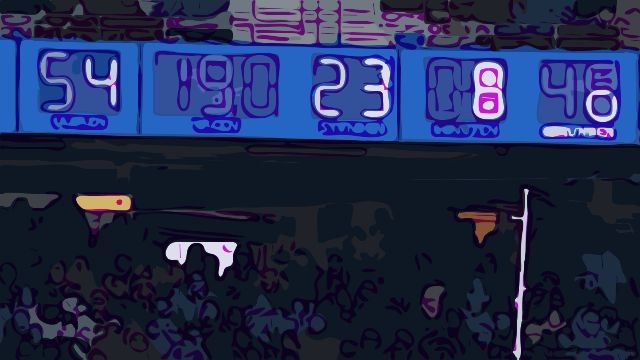
Yes, just what Hamburg needed was a huge clock, showing to the second how much time they had spent in the Bundesliga! And so in 2001, such a clock was installed in the north-west corner of the stadium, facing directly out onto the pitch for all to see. In the absence of trophies, Hamburg were determined to take pride in their history instead. The white, digital numbers showed the years, days, hours, minutes and yes, even seconds, that they had occupied the top tier.

While clearly a source of pride, it could also have been argued that by installing this clock, Hamburg were also attaching a millstone to themselves. After all, having anything that highlights how long you have avoided relegation is just tempting fate. Hamburg took the clock idea to extremes, even having one displayed on the front window of the team coach. Once you have a clock running, you need to keep it running, which it could be argued just adds pressure during a stressful season. And you just know that opposing fans would love to see nothing more than that clock halted. And what if you are relegated, what then? You now have a huge clock in your stadium with nothing to display. Was it really the best idea ever?

If the clock was not enough, Hamburg were also nicknamed Der Dinosaurier, which doesn’t need translation. Needless to say the nickname derived from having been around in the top division so long, although again it tempts fate with the obvious fact that the dinosaurs did eventually end up extinct.

But anyway, the clock was built, installed and started in order to record the march of time, and for the next few years, it all seemed a jolly wheeze as Hamburg recorded a series of strong seasons from 2003 to 2011, finishing continuously in the top ten and reaching the semi-finals of both the UEFA Cup and Europa Cup. The 2011/12 season did see a blip as Hamburg finished 15th, five points above the relegation zone but that was soon forgotten as Hamburg rose back to finish 7th the following year. The clock had now been ticking along for 13 years with little threat to its existence. But the 2013/14 season was going to see that finally under threat.

At the end of November, Hamburg stood in 11th place, before a seven match losing streak threw them into the relegation zone. Apart from only one weekend thereafter, Hamburg remained there and the final five weeks saw them lose all five games. They had ended the season in 16th, meaning that they would now be subjected to the stress of a two-legged play-off against the 3rd place Bundesliga 2 team – SpVgg Greuther Fürth.

Captained by the Dutch international Rafael van der Vaart and led up front by German striker Pierre-Michel Lasogga, Hamburg were held to a goalless draw in the first leg at their home of Imtech Arena, with commentators saying they were lucky to avoid defeat . That meant advantage Furth going into the second leg three days later down in Bavaria. A packed Sportpark Ronhof saw a mass of green and white flags cheering on the home side. Hamburg produced the early chances and in the 14th minute broke through with a Lasogga header from a Van der Vaart corner, giving them a precious away goal. The second half saw Furstner grab an equaliser for Fürth in the 59th minute and the Hamburg nerves began to jangle. But no further goals were forthcoming and The Dinosaur celebrated in front of 2,000 travelling fans. The sands of time continued to run.

Entering into the following 2014/15 season, Mirko Slomka remained Hamburg manager. However, if fans were hoping for some improvement over the previous season’s near-debacle, they were soon disavowed of that hope. Hamburg took just one point from their first three games, and Slomka was replaced with reserve team coach Josef Zinnbauer, resulting in Slomka slapping an E1.4M lawsuit against Hamburg, having managed them for only 18 games total. Zinnbauer lasted just six months until a 1-0 home defeat by Hertha BSC saw Hamburg back in the relegation zone and he received his marching orders. Peter Knabel, the Sports Director for Hamburg, took the reins for the next two until the appointment of Hamburg’s fourth manager of the season – Bruno Labbadia, who had previously managed Hamburg for just under a year in 2010 before being sacked. He started with Hamburg now rooted to the bottom of the Bundesliga, but three wins in their last five games pushed them up into the play-off spot for a second year running.

This time the opposition was Karlsruher, located just west of Stuttgart, who just two seasons before had been mired in the third league within Germany. The first leg was in Hamburg and got off to a disastrous start for the home team as Karlsruher scored after just four minutes. A 73rd minute equaliser from Ilicevic avoided home defeat but again, like the previous year, they went to the away leg with just a home draw and with Karlsruher having a vital away goal.

The second leg was a tense affair and was still goalless as it approached the 78th minute, giving Karlsruher the away goal advantage. Then a lovely chip put Karlruher’s substitute Yabo in on goal and his volley put the stadium into ecstasy. Hamburg then threw everything they had at the Karlsruher goal, knowing they had to score, hitting the post at one point, but Karlsruher kept clinging on as the game entered stoppage time. Finally fate was going to halt the Hamburg clock after 52 years.

Enter Marcelo Diaz. The Chilean midfielder had signed just four months previously and had not scored during that time. In the dying seconds, Hamburg got a direct free-kick just outside the penalty-box. Rafael van der Vaart, the captain, prepared to take the kick before Diaz told him “tomorrow, my friend” and took charge instead. Top corner, 1-1, extra time! 3,600 travelling fans were seriously bouncing. With five minutes of extra-time remaining, substitute Nicolai Muller ensured that once again Hamburg wriggled free of the clutches of the grim reaper. For a second year in succession, Hamburg had avoided the drop – this time by mere seconds. It seemed like the clock was fated to continue to tick indefinitely.

2015/16 ended up being a tame, relatively boring affair, although given the two previous play-off dramas, that may have been just fine by Hamburg supporters. Bruno Labbadia remained at the helm through the whole season and Hamburg literally sat right around mid-table for the whole 34 matches, finishing 10th. They did receive a 5-0 thrashing from Bayern and an embarrassing cup defeat in the first round at Carl Zeiss Jena, but that was about the height of the drama. Labbadia seemed to have corrected course and all now seemed calm sailing once again.

It couldn’t, and didn’t, last. 2016/17 saw Hamburg draw one and lose four of their opening five games and with that Labbadia’s second stint was terminated, replaced by Markus Gisdol, who had last managed Hoffenheim. Hamburg’s terrible start continued and after 12 games they had still failed to register a single win. February saw Hamburg receive their annual humiliation at the hands of Bayern – this time 8-0 including a Lewandowski hat-trick. A minor resurgence saw them briefly exit the relegation zone but with one game left in the season they sat in 17th, in relegation and one place below the play-off spot. It looked like this time there may not even be the option of a play-off miracle to save them.

The final game was home against Wolfsburg, who were also relegation candidates. The equation was simple – Hamburg had to win to stay up, something they had not managed to do during the five previous games. Both teams were playing for their Bundesliga lives.

On a glorious sunny day, Hamburg got off a bad start as Knoche headed Wolfsburg into a 1-0 lead after just 23 minutes – his first goal of the season. However, just nine minutes later, a midfield press saw Hamburg steal possession and a low cross was converted by Kostic to square the match up. But from then on, Hamburg couldn’t find the second goal they needed for survival as the match ebbed away. With just two minutes left, the game was still tied and Hamburg were heading down. Then a long ball out to the wing got behind the Wolfsburg offside trap. A cross towards the far post saw Waldschmidt sneak in and head Hamburg ahead – also his first goal of the season and producing immediate sainthood. Waldschmidt himself seemed amazed and his confused goal celebration mirrored this. Cue pandemonium, cue end of game pitch invasion. Cue the clock continuing. Hamburg had now cheated the drop narrowly three times – could their luck last another season?

The 2017/18 season saw Hamburg win their opening two games – and then the slump began. Eight losses in the next ten games saw them plummet to 15th and in December they entered the relegation zone for the first time. By Matchday 28 Hamburg were bottom, having gone 15 successive games winless. But then with six games left and relegation looking inevitable, Hamburg suddenly won three of their next five games, dragging them to 17th place and with a chance of survival going into their final match – at home to Borussia Monchengladbach. The math was that Hamburg needed to win and hope that Köln would travel to Wolfsburg and defeat them. Anything else and Hamburg would be automatically relegated in their 55th Bundesliga season. In desperation, Hamburg fans promised to send barrels of beer to Köln if they could win.

The Volksparkstadion was a sea of blue and white as 57,000 fans did their utmost to spur Hamburg on. After just nine minutes Hamburg had a penalty shout for handball – VAR confirmation followed and Aaron Hunt thumped home the kick. But Monchengladbach were playing for a European spot and just seventeen minutes later they were level through a counter-attack – the scorer being ex-Hamburg player Drmic. At half-time both Hamburg and Köln were drawing giving hope still to Hamburg fans. An amazing goal-line clearance saw Hamburg stay level and then on 63 minutes, Holtby rifled in a winner ensuring Hamburg had done all that they could. It was now all eyes and ears on the Wolfsburg game.

Unfortunately for Hamburg, Wolfsburg moved up a gear in the second half and put three goals past Köln to comfortably win 4-1. As the realisation of relegation percolated through the crowd toward the end, disappointment turned to frustration. Firecrackers started to be thrown onto the field during stoppage time and flares ignited behind one of the goals and the end was soon bathed in smoke. Riot police flooded onto the pitch as the smoke thickened and stood off and watched the increased level of pyrotechnics. The game was held up for 15 minutes before finally the players reemerged and play was finished. The final whistle in Hamburg saw tears amongst the players and fans as fate finally caught up with them.

And so it finally happened – 54 years, 261 days, 0 hours, 36 minutes and 2 seconds – the clock was stopped! Auf Wiedersehen Hamburg – the Dinosaur was finally extinct after 55 seasons. The 1978/79, 1981/82 and 1982/83 Bundesliga champions and 1983 European Champions now faced the Bundesliga 2 for the first time.

Both 2018/19 and 2019/20 saw Hamburg finish 4th and narrowly miss promotion by just one point in both cases – double heartbreak. And then this season saw the same story again – 4th place and four points off promotion. It feels like just a matter of time before Hamburg rejoin the promised land – but three years in the wilderness will have financial implications. But most would agree that Hamburg belong back amongst the elite and with their huge fanbase, they are a huge loss to the Bundesliga.

But what about the stopped clock? At first, it was changed to show how long Hamburg had been in existence – 130 years, 7 months, 3 days. Then, in July 2019, Hamburg confirmed that they had dismantled the legendary stadium clock and replaced it with the stadium’s GPS data. Chairman Bernd Hoffman said “We want to position ourselves for the future. A constant look into the rear mirror doesn’t help.”

The story of Hamburg and their clock is a lesson in tempting fate. Whilst rightfully proud of their record time in the top division, flaunting that to the rest of the country would appear in hindsight to have been asking for trouble. As we saw, they managed to cheat relegation by fractions a few times – and it seemed that maybe fate was smiling on them. But, as with all things in life, the party had to end eventually. Stop all the clocks, cut off the telephone – the sands of time had finally run out.

Sheriff Tiraspol: Who are these giant killers?

Every now and then, the football gods like to remind us why we love this game so much. And in recent times, the Champions League has thrown up some great examples of classic encounters, whether it be Tottenham eliminating Ajax in the last seconds or Liverpool managing the king of all comebacks against Barcelona. Despite all of FIFA’s best efforts to eliminate surprise and shock from the competition with the introduction of seedings, groups and eliminating the away goal rule, great storylines still occur. Adding to that list of historic moments, we can now include Sheriff Tiraspol’s incredible 2-1 defeat of the mighty Real Madrid, 13 times European Champions, in the Bernabeu.

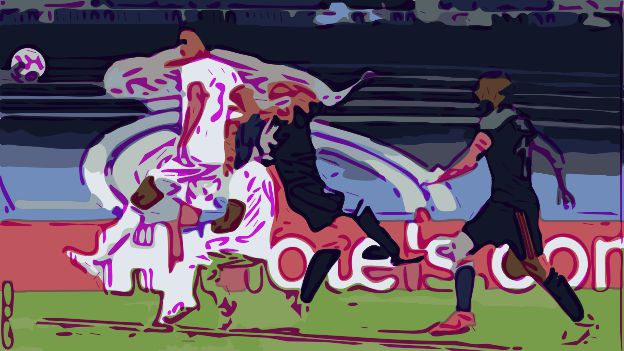
Now, to be fair to Real Madrid, it was one of those nights when it just seemed that everything went against them. On another day, with the number of changes that Real created, it could have been a landslide. Real Madrid had 30 shots on goal, 11 on target, 13 corners and 67% of the possession – and yet their only goal came from a penalty that needed a close inspection on VAR to determine. Sheriff meanwhile had 3 shots on target and not a single corner – yet those three shots on goal yielded two goals – a header from Jasurbek Yakhshiboev and an 89th-minute screamer from Sebastien Thill, the first player from tiny Luxembourg to score a Champions League goal. One can discuss “ifs and buts” all day – all everyone will really remember is that Sheriff Tiraspol came to Madrid and walked away with a historic victory. Of course, there is also the inevitable storyline of Real Madrid’s president Florentino Perez and his push for a European Super League – a possible example of the football gods inflicting justice for his hubris.

So it is likely that when you are having a drink with friends in the pub or getting changed for a five-a-side game, someone is going to pipe up with “how about that Sheriff team beating Real Madrid…I mean, I don’t even know who they are! I couldn’t find Tiraspol on a map if I tried.” So who exactly are they, where are they from and how did they even get to this position of playing the mighty Real Madrid? Let’s try to answer some of those questions so you can impress your friends with your knowledge of obscure European teams and earn their admiring looks.

Let us begin with where Tiraspol actually is – and it gets pretty interesting almost immediately. The first thing to know is that Tiraspol is the capital city of Transnistria, which sounds like something out of a Disney fairy-tale or a bad soap opera. Just go and try to find Transnistria on a map – you may be struggling. But exist it does.

Firstly find Moldova – it will be a small country wedged between Romania and Ukraine in Eastern Europe, whose capital city is Chisinau. It used to be part of the USSR until the dissolution of the Soviet Union whereby it declared independence in 1991. Shortly after, it received official recognition as an independent state at the United Nations. Moldova ranks as the second poorest country in Europe by GDP per capita.
Closer inspection of the country shows that a number of rivers flow through it from north to south, eventually emptying into the Black Sea. The most significant of those is the Dniester in the far east of the country, near to the border with Ukraine. There exists therefore a slither of
land that sits between the Dniester and the Ukrainian border, which consists of inhabitants of predominantly Russian and Ukrainian descent. It is this area that declared itself as the Pridnestrovian Moldavian Soviet Socialist Republic in 1990, with its capital based in Tiraspol, basically a self-declared breakaway state. It is more commonly known however as Transnistria. This breakaway has caused violent clashes in the past and so is now managed by a three-way peacekeeping force of Russian, Transnistrian and Moldovan personnel. It is unrecognized by the international community.

While not officially recognised, Transnistria uses its own currency, the Trans-Dniestrian rouble, which cannot be exchanged anywhere else in the world. It, unfortunately, has a reputation for organized crime, smuggling and corruption. Tiraspol itself still clings to its Russian roots, existing almost frozen in time within the communist era. Russian is the predominantly spoken language and buildings still display the old hammer and sickle, as well as the national flag, while a huge statue of Lenin remains outside the parliament building. Transnistria also has a national football team but again without receiving recognition from either FIFA or UEFA.

Now that we understand where Tiraspol is, let’s turn to look at Sheriff Tiraspol itself. Transnistria’s capital has two football teams – Sheriff Tiraspol and FC Tiraspol – which while part of Transnistria do play in the Moldovan league. Sheriff Tiraspol is by far the more successful of the two and has dominated Moldovan football in recent times. In line with Moldovia only coming into existence after the dissolution of the Soviet Union, Sheriff has only been in existence since 1997, yet won the Moldovan double in 2001, the first of 20 titles in 22 years.

Its name and success come from sponsorship by the Sheriff company, formed by two former KGB officers, which operates a host of industries in Transnistria, and it is their backing that ensures that Sheriff Tiraspol has hugely more financial clout than any other Moldovan team. The Sheriff company also has close ties to the local government which is protected and funded by Russia and have provided Sheriff Tiraspol with the only country’s only modern stadium, which holds 12,746 fans. No other Moldovan team even owns its own ground. So within Moldova, Sheriff Tiraspol has unparalleled advantages over any rivals and have therefore dominated to a ridiculous degree.

Following each of their many league titles, Sheriff earned the right to compete in the Champions League as the Moldovan representatives. For eight seasons in a row from 2002 to 2009, they were eliminated in the second qualifying round. 2010 and 2011 did see them reach the play-off round, the final step ahead of the valuable group stage, but they fell to Olympiacos and Basel respectively. Then began another run of second and third qualifying round eliminations. It appeared that a Moldovan team would never be able to reach the holy grail of the group stage. But all that finally changed in the current edition.

Going into this year’s competition, Sheriff is managed by Ukrainian Yuriy Vernydub, who took the role in December 2020 and then led them to the Moldovan championship. His previous experience consisted of managing the Ukrainian team Zorya Luhansk for several years, who
played Manchester United in the 2016-17 Europa League. Key players include goalkeeper Giorgos Athanasiadis, on loan from AEK Athens, and striker Adama Traore (no relation of the Wolves winger of the same name), signed from Metz earlier this year and a Mali international. In total, ten new players have been added over the previous 12 months. The squad hails from a range of countries including Ghana, Brazil, Malawi, Uzbekistan, Luxembourg and Peru. Interestingly, however, no member of the starting Sheriff eleven against Real Madrid was in fact Moldovan – although also interestingly, no member of the Real Madrid final eleven at full-time was Spanish either.

So how did Sheriff Tiraspol end up playing at the Bernabeu? Well, back in July, the first qualifying round of the Champions League was played. Amongst the 16 ties, Sheriff was drawn against Albanian champions Teuta. The first leg saw Sheriff travel to Albania and come away with a 4-0 victory, almost ensuring progress to the second round which was confirmed by a 1-0 home victory. And so on to Sheriff’s nemesis – the second qualifying round.

The second qualifying round threw up a trip to Armenia for Sheriff, travelling to its capital Yerevan to face FC Alashkert, winners of the Armenian Premier League. As in the first round, Sheriff came away with an away win – this time 1-0 – which was then consolidated with a 3-1 home win. Sheriff were moving on to the third qualifying round.

The third qualifying round contained some serious competition, with the likes of Malmo, Rangers, Olympiacos and Dinamo Zagreb. When the draw was complete, Sheriff was looking at two legs against one-time European champions Red Star Belgrade. For the third successive time, Sheriff played the away leg first, travelling to Serbia in early August. In front of 24,000 rabid Red Star fans, Sheriff took the lead from a Castaneda free-kick after 33 minutes. Red Star equalised in added first half time but Sheriff then held on through the second half to come away with a credible draw. A week later, in front of just 4,950 home fans, Arboleda scored off another Castaneda free-kick just before half-time and that was enough to send Sheriff to within touching distance of the promised land. Twelve teams competing for six spots in the converted group stages of the Champions League. Two games away from the big time.

Sheriff was then pitted against Dinamo Zagreb, Croatia’s dominant league team. This time would see Sheriff play at home first and so on August 17, 5,281 fans showed up to see if the impossible dream could occur. On a warm night, Sheriff blew Zagreb away, putting on a fine first-half display – rewarded with an opening Adama Traore goal – followed by an exceptional second-half rampage. Kolovos’s volley was superb and almost unstoppable, then Traore terrorised Dinamo’s defence yet again, producing a cool finish for a third. Coach Vernydub dropped to his knees at the final whistle as Sheriff were now favourites to become Moldova’s first ever team to reach the Champions League group stage.
As expected, Dinamo Zagreb came out with all guns blazing in the second leg needing to overcome their significant deficit. But an inspired display by the man of the match Sheriff goalkeeper Giorgos Athanasiadis saw Sheriff hold Zagreb at bay and come away with a goalless draw. Sheriff had done it – Moldova had its first ever representative in the group stages.

26 August saw the group stage draw made. Sheriff Tiraspol was the lowest-rated team amongst the 32 teams, just ahead of VfL Wolfsburg. Not surprisingly, this placed them into pot 4. Group 4 started to develop, with Inter first out from pot 1 followed by Real Madrid from pot 2. Between them, both teams have won the European Cup/Champions League an impressive 16 times. Ukraine’s Shakhtar Donetsk came next and then finally Sheriff saw themselves added to the mix. 12 games which will see two teams move on the knockout stage. The group has Inter and Real Madrid written all over it.

But the first two sets of games have shown that reputation is no guarantee of success. On September 15, Sheriff hosted Ukrainian neighbours Shakhtar to begin their group stage odyssey. Their tiny stadium saw 5,205 fans watch a slice of history. After 15 mins, a cross from Cristiano was superbly volleyed in by who else but Adama Traore. Just to add confusion, Shakhtar also fielded a player by the name of Lassina Traore, whose shot after 30 minutes was well saved by Athanasiadis. Shakhtar continued to press and dominate possession but the Sheriff defence held firm. Then, against the run of play, yet another cross from Cristiano after 62 minutes found an unmarked Momo Yansane, who had just come off the bench, and he buried the header for 2-0, before being mobbed in jubilant scenes. And so the game ended, with Cristiano deservedly named man of the match for his two goals assists. With Real Madrid winning 1-0 in Milan, Sheriff was top of the group after just one game.

Of course, that was all supposed to be temporary. Of course, with Sheriff travelling to Madrid next, normal service was expected to resume and Sheriff would find out what group stage football was really all about. But it wasn’t to be. And so, after two games each, Sheriff proudly sit top of their group, with a maximum of 6 points, 3 points ahead of Real in second and 4 points ahead of Inter in third.

All eyes will now turn to October 19 when Sheriff travel to the fabled San Siro to take on Inter. They couldn’t get back to back wins in both the Bernabeu and San Siro, could they? Well, if they can, then they would really fancy their chances of sitting in the top two come early December. Stranger things have happened in football. But whatever fate awaits them over their next four games, the night that they felled the 13 times European champions in their own backyard will live on in the memory of a whole generation.

Sheriff Tiraspol – thank you for showing that football is more than just mooted Super Leagues and money.

Luch Vladivostok: The world’s hardiest away day

For football fans who habitually travel to away matches as well as their team’s home fixtures, there are certain rituals which will seem familiar. The pre-dawn gathering to board a coach which will be on the road for several hours. Scoping out the best places to get food and drink prior to entering the stadium. Trying to out-sing the home crowd and mocking their apparent solemnity through song. Cheering a goal for your team in a corner with your fellow brethren while the home fans sit silent, or possibly ring out the boos if things are especially unsatisfactory. The return journey home, which may be boisterous or funereal depending on the result. Arriving back home at an ungodly hour, wondering why you put yourself through this all the time but knowing that you’d badly miss it if you didn’t.

If your club is playing at a national level and based on the geographical periphery of your country, there may be some rather long journeys to undertake, particularly if you’ve been handed a raw deal with a midweek kick-off in the 8pm time range. It’s a dilemma with which supporters of the likes of Carlisle, Newcastle, Hartlepool, Portsmouth, Brighton and Exeter, to name but a few, will be all too familiar.

Those 700-mile round journeys can be tiring, no doubt, so try for a moment to comprehend what a round trip of 8,000 miles would be like. For supporters of FC Luch Vladivostok, or other Russian clubs who would travel there for away days, they don’t need to imagine. When you experience something like that, it tends to stay in the memory.

Even since the dissolution of the Soviet Union, Russia remains the world’s largest country by land mass, transcending no fewer than 11 time zones. Football fans who travelled there for the 2018 World Cup and bounced between cities will have some idea of its sheer enormity, yet that tournament was concentrated entirely within the western third of this incomparably vast nation. So too are most of its top-flight football teams, but at certain periods during the 1990s and since, there was one very notable exception.

FC Luch are based in Vladivostok, a city in Russia’s far east which geographically hangs not far over Japan. Despite being in the same country as Moscow, it is closer as the crow flies to cities such as Darwin in Australia and Anchorage in Alaska. Likewise, the Hawaiian capital of Honolulu is closer to Vladivostok than the Russian metropolis of Sochi. That puts the journey from Cumbria to Devon into some bit of perspective.

Understandably, the city’s flagship football team played within regional Soviet confines for much of its history, but earned promotion to the country’s top flight in 1993. They were swiftly relegated and returned to regionalised divisions for a period before getting back to a nationwide level with promotion to the second tier in 2003. Two years later, they were back among the big time, winning the Russian First Division with an impressive haul of 92 points under Sergei Pavlov. The promotion charge was propelled by Dmitry Smirnov, who made a name for himself not so much for his surname’s likeness to a well-known vodka but rather for the 19 goals which shot Luch-Energiya, as they were known at the time, back into the Premier League.

Another player who formed part of that squad, Jur?is Pu?inskis, became a trivia buff’s best friend at Euro 2004 when he was named among Latvia’s 23-man squad for the tournament, which was held in Portugal. It ensured that he would have by far the longest distance to travel for the finals and, despite that being a tournament solely under UEFA’s jurisdiction, he would have had a much shorter journey to the preceding FIFA World Cup in Japan and South Korea had his nation qualified for that competition.

While Luch-Energiya may have taken many by surprise with their ninth-place finish in the 2006 season, it would come as no shock that 35 of their 41 points were won at home, with Spartak Moscow and Rubin Kazan among the teams who faced a thankless trek back from Vladivostok following defeat. Perhaps the most memorable home match of that campaign, though, was one which the eastern natives lost 2-0 to Zenit St Petersburg.

Three hardy Zenit supporters made the 15,000-kilometre trip to Vladivostok…in a 20-year-old Honda. Their satisfaction at witnessing the team collect three points, with Andrei Arshavin among the scorers, was quelled by what happened after the game. Shortly after beginning the arduous trip home, their vehicle broke down, forcing them to take the Trans-Siberian Railway all the way back to St Petersburg, which lies not far from the borders with Finland and Estonia and took them almost a full week to reach. Upon hearing of the trio’s film-worthy adventure, Zenit generously bought the loyal supporters a new car, their old one later being preserved in the club’s museum. Suffice to say that Zenit had the energy-induced wealth to more than cover the expense.

Not long after that result, Luch-Energiya were even pushing for a UEFA Cup spot, but mercifully for supporters of clubs who ultimately did qualify for the competition (most notably Icelandic outfit Keflavik, the most westerly team who took part), Pavlov’s side fell short in the final weeks of the season. 

The 2007 campaign was much harder as the Vladivostok side only avoided relegation courtesy of a better head-to-record than Kuban Krasnodar, who tied with them for points and even had a better goal difference. The standout result was undoubtedly a 4-0 home thrashing of champions CSKA Moscow, who had won the UEFA Cup just two years previously. CSKA goalkeeper Igor Akinfeev, who was well-travelled given his status as long-serving Russian number one, angrily declared afterwards that Luch-Energiya should be forced to play domestic football in Japan, to whom they are much closer geographically.

Pavlov, the most successful coach in the club’s history, left at the end of the season and their fortunes declined thereafter. Neutrals would not have been sorry to see them finish bottom of the Premier League in 2008, ending their three-year stay in the top flight; while financial difficulties forced a fire sale of their best players, a scenario which significantly lessened their once-sizeable home advantage. Three years later, they went back down to the third tier, although they won promotion at the first attempt in 2012.

While opposition players such as Akinfeev publicly expressed their disdain for Luch-Energiya’s presence at national level, some of their own players also bemoaned the enormous amount of travelling involved in representing the east Russian outfit. Croatian defender Matija Kristi?, who spent four years at the club, made the valid point that while Luch’s opponents only had to travel to Vladivostok and back once per season, they were forced to undertake pan-Russian away trips multiple times in a single campaign, a scenario which clearly became exhausting.

Luch-Energiya spent the bulk of the last decade in the second tier of Russian football but never truly threatened for promotion. The 2017/18 campaign was a particularly arduous one, with the team only spared from relegation due to other clubs failing to obtain a league licence. Midway through the season, their players staged a match-delaying protest to voice their disgruntlement over deferred wages and living conditions. The squad went four months without being paid and some were even evicted from their accommodation as a result, with a few relying on the benevolence of a supporters’ group to provide their meals.

The club was renamed FC Luch the following year and its death knell in the upper echelons of Russian football came about from global circumstances rather than club mismanagement. In the early throes of coronavirus in April 2020, the government of Primorsky Krai, the federal region in which Vladivostok is located, revoked all professional contracts with sports clubs in the region in order to divert funds towards combating the rapidly escalating pandemic. FC Luch duly dropped back to the amateur ranks.

In the UK, away days have finally returned, with Boris Johnson’s government relaxing the bulk of COVID restrictions. Football fans who yearn for a return to those weekend (and sometimes weekday) mornings of rising well before dawn to traverse the length and breadth of the country, all in the name of the club to whom they have pinned their loyalty, now have back one of their most treasured traditions.

Perhaps the 400-mile trip home after a 4-0 shellacking in the freezing January rain might not be the stuff of dreams, but at least on these shores, the football faithful will never have to worry about mulling over such a result at the hands of FC Luch on the way back from the extreme UEFA-affiliated outpost that is Vladivostok. Let’s just say it would take more than one filling station stop-off for nourishment and a toilet break to make that particular journey somewhat bearable.

Summer transfer window: The market closes as European divide stretches

When the stadiums shut last March, football was allowed to pause for once. The time away from the pitch and terraces temporarily gave football a moment to breathe and reflect. People concluded football needed a reset, and this was the moment to enforce it.

“Coronavirus in itself will change the face of football economically,” Gary Neville examined in March last year.

“But outside of that clubs want real action. They want to reset the game. This is not going to be pleasant for players and agents in the next 12 months, 18 months, or two years.”

Neville’s analysis came from a genuine belief that football had to change. We need to remember that it was a popular, view before we use hindsight to call out Neville’s naivety.

That is because it made logical sense. When the sport was, for so long, speeding off a cliff due to its instability, the crisis could have become an unlikely solution to finally stop the inevitable train crash.

Rightfully there were plenty of fears of clubs collapsing, but it did offer a reality check. The environment was shifting radically. There was nowhere for football to hide this time. The sport, it was believed, needed to adapt to survive.
This meant stopping the endless financial instability and backdoor deals. Ensure the untouchable elite are touchable. Firmly address how fans and the sport’s governing bodies admire and promote oligarchs and abusive governments. Fix the broken administrative mechanics. And change the sport’s never-ending pursuit for more at the cost of everything.

It turns out these ideas will stay ideals in the long run. The past 18 months have radicalised the problems that have rooted themselves as football’s modern foundations. Football needs the transfer swagger. The money men. The diversion of interests. The eternal lust for ultimate glory, no matter what that said glory is.

The sport was thought to be under recession when Premier League clubs spent £1.3bn on transfer fees alone last summer and concluded their business with a net spend of £1bn (the next highest in Europe was Serie A who did not pass the £100m mark).

The recession was the narrative again when this summer’s window began. These views heightened because austerity fears caused Project Big Picture and the Super League, France’s TV crisis, and Serie A’s and Bundesliga’s TV rights value reducing. La Liga’s personal civil war increased further when their deal with CVC Capital Panthers was struck, and the fallout began.

It became apparent these were precursors to the type of summer transfer window. An opportunity presented to stretch the gulf between the poor and the rich further.

Unsurprisingly then, we have seen the European divide open further as different leagues work with different templates. And the best place to start with this is the second-tier of English football.

The Championship template

Often the gun-slinging league in England, the Championship is renowned to have an eat or be eaten ethos. Clubs typically splash the cash in pursuit of the Premier League money. And this is just not on transfer fees, but wages too.

Using the data football financer @SwissRamble worked out, four out of the 23 clubs who have published their 2019/20 accounts, only three made a pre-tax profit and Barnsley cut even.

Sticking to the pattern, every Championship side made an operating loss, and the vast majority were spending more on wages than their turnover could handle. Fulham topped the operating losses with £73m and Reading had the largest wage to turnover ratio with 211% (for every £1 they gained they spent £2.11 on wages).

While these accounts consider the original impact of Covid-19 on the clubs, they show the state many clubs find themselves in. This, of course, meant very few Championship clubs could look to the Premier League for recruitment if they were selling a player for no less than £5m as they would do in the past.

There was only one Premier League to Championship transfer for a proportionate fee: Harry Wilson to Fulham for £12m. Wilson’s transfer fee was the only double-figure in the division and was twice as much Fulham’s other big signing, Rodrigo Muniz from Flamengo, and Middlesbrough’s Martin Payero.

The vast majority of Championship business was either small transfer fees (even they were few and far between), free agents, and loans. Exuberant unsustainable spending was squashed. This summer, the league spent £35m collectively. In 2019, it was £160m.

Now, the Championship is a second division. That cannot be forgotten. You cannot expect them to meet the financial demands of out-of-favour players who are not required by the top tier. Likewise, you cannot expect players to be lining up to drop down a division.

However, what is important is their template and philosophy. The reality is they could not commit to the merry-go-rounds we are accustomed to. And that was the climate across Europe. To put it bluntly, teams simply did not have the money.

According to Deloitte’s figures, the Premier League has greatly pushed ahead of the other major European leagues. It is a divide that is symbolic. England’s top tier is working within its own world in comparison to elsewhere. The Bundesliga is the most impressive example as they are the only league to have a positive net spend in a covid affected market.

Despite this, the reduction to stabilise the template came with consequences that were perhaps foreseen. Those that can still afford to make losses in this environment would be the ones to take advantage of the vulnerable clubs.

The Premier League’s success and struggle

Whilst Europe reduced their transfer expenditure as a result of the pandemic’s impact, the Premier League got out of third gear and capitalised knowing they had secured the domestic TV money for the coming years.

The league managed to roll over their current deal, meaning there was no threat of a similar circumstance happening to them as it did with Ligue 1, Serie A, Bundesliga, or La Liga. For once, there was a bit of broadcasting stability.

Therefore, the gung-ho approach continued for the division. The top tier hit £1.1bn this time around. It was as if their apparent austerity never existed, albeit this is the second consecutive year the league’s spending dropped.

The circumstance was summarised by i’s Chief Football Writer, Daniel Storey. “While European football licks its wounds, the Premier League continues its voracious hunt of new imports”, he wrote on Deadline Day.

For Premier League fans – and perhaps even journalists – they will enjoy seeing these incomings as they are the next big thing to be talking about. Jadon Sancho, Rafael Varane, Cristiano Ronaldo, Romelu Lukaku, Boubakary SoumaréSaúl Ñíguez and Ibrahima Konaté all stick out by name alone. In the drive for endless content, the arrivals will contribute their fair share.

Nevertheless, what cannot be scratched over is the peculiar lack of outgoings to Europe. Only Tammy Abraham, Rui Patrício, and Fikayo Tomori were significant departures from the Premier League. Toby Alderweireld, Moise Kean, and Felipe Anderson never made an impact and left either on a loan or a small fee.

What it shows are two things: the Premier League can allegedly afford to bring more expensive stock in despite the financial climate, and their unwanted or other occupied stock was close to impossible to move on for their value.

On one side you have big players wanting to leave their respected clubs, but the club’s valuations ensure they cannot. Four Manchester City star players asked to leave the club during the window, but none were sold because nobody could afford to meet their demands.

One of the alleged players, Bernardo Silva, was valued at £60m. Only a Premier League club with money to burn, Paris Saint-Germain or Real Madrid could have purchased Silva. Nonetheless, it is unlikely City would have been willing to sell to a Premier League side. PSG were busy with Messi and their other star recruits. Real Madrid were busy elsewhere too.

Even Raheem Sterling was allegedly on the market. Again, no one had the capabilities of buying him. If these sales were feasible, then maybe City would have felt more inclined to pay Daniel Levy what he wanted for Harry Kane.

Spurs’ record signing Tanguy Ndombele fell under the same remit. The midfielder asked to leave, preferably to a European giant, but his £60m price tag found no suitors. After three windows of attempting to move Serge Aurier on, Spurs only managed to do this because both parties agreed to a mutual termination.

Elsewhere, Chelsea had to settle again for loan moves for Danny Drinkwater (to Reading of all teams) and Tiemoue Bakayoko. Jesse Lingard stayed at Manchester United because no club valued him at – or could afford to meet – the reported £30m price. Arsenal’s Lucas Torriera went on loan again while the majority of their squad ended up on the market at some point. Cenk Tosun and James Rodriquez are still at Everton and Newcastle ended their business with ten classified midfielders.

In summary, no matter how desperate clubs were, this was not the summer to sell unwanted or want-away players. Raising finance by selling players overseas, or to the second-tier, was either incredibly difficult or not worth it.

Consequently, the internal Premier League deals attracted greater focus. For Chelsea, it forced them to sell a collection of their academy star players (albeit not all to English sides) to make up the difference in the Lukaku fee and open the gates for Saúl to join. They hoped the departure of Kurt Zouma to West Ham would have allowed them to secure Jules Koundé, but talks stalled and broke down with Seville.

Certain sections of the market were closed-off for good. If your name was not Paris Saint-Germain in France, the deal was going to be hard to conclude. It got to a point for Lyon where they decided to put numerous first-team players on the market and Burnley were one of the teams to pounce.

While Europe was looking to balance its spending more vigorously, the Premier League was seeking to capitalise regardless of their outgoings roadblock.

As a result, an even bigger financial divide opened this summer. Regardless of the outgoings roadblock to Europe, the Premier League sought to capitalise rather than navigate similarly to their colleagues.

While they were not alone, they were ready to take advantage of situations and the starkest was the return of Cristiano Ronaldo in Manchester.

A power shift

At the beginning of the summer, it was believed Manchester United were willing to purchase one marquee player. That player was Jadon Sancho for £76m. But as we see with this volatile market, situations change fast. Suddenly, Rafael Varane was available for a discounted price and the Manchester club did not want to pass on the opportunity.

With each passing day, United fans became desperate to see a defensive midfielder arrive at Old Trafford. To balance their solid starting defence and attack, it made sense. That issue was put to one side once Ronaldo was reportedly on his way to the blue side of Manchester. As we all witnessed, his former club caught the bait.

Whether Ronaldo had every intention of going to Manchester City or he simply wanted to get United’s attention is a matter of discussion. What is important is what these signings represent. Manchester United bought three high calibre players from three different clubs.

Sancho’s move was planned and expected well in advance as Borussia Dortmund promised the player they would sanction a deal this term. On another note, the club needed it after posting a €44m loss for 2019/20 and a €72m loss for 2020/21.

Similarly, Juventus and Real Madrid needed to sanction the sale of their key assets for financial reasons. The Turin club realised a rebuild was in order and it was difficult to conduct it with Ronaldo. Meanwhile, Real Madrid’s debt stands at around €900m.

However, Madrid’s situation was more complicated as president Florentino Perez is “obsessed” with Kylian Mbappe. For the last two years at least, Perez has built a Mbappe fund to contribute towards his signing. Their desperation resulted in a final €200m bid on deadline day, which was ignored by the Parisians.

Whilst their rivals were financially vulnerable, United understood this was the right time to catapult themselves back towards the top. To do so is priceless to the fans, Ole Gunnar Solskjær, and the Glazers.

On another note, the non Mbappe deal showed a power shift between two European giants. Typically what Perez wants he gets. Despite the final bid being ludicrous in every sense, placing such a deal on the table ensures Perez sets himself on a win-win course.

Out of all the major transfers this summer, the Mbappe non-deal was perhaps the most symbolic of the power shift in Europe. PSG could calmly reject an enormous fee for a player who is out of contract in 12 months. That is because, of course, money is not valuable to PSG, and keeping Mbappe to team up with Neymar and Lionel Messi is. It is significant to the club, their project, and Qatar.

Normally the same can be said of Manchester City, but for whatever reason, they were twiddling with their thumbs for the majority of the summer after the blockbusting Grealish transfer. How costly their lack of movement for Kane, Ronaldo, or another striker will be determined in the next 12 months.

However, it shows the state of the game when a club can spend £100m on one player during a financial crisis and it can be discussed as not enough.

On the other hand, Barcelona worked to cut as many costs as possible. There is little doubt they will be left behind at the top of the game. The journey back will be long and painful, but their case will be one for other clubs to consider before they sanction expensive transfers on an enormous scale.

The power shift between Europe’s elite and the domestic leagues highlight that to no end. With the market now closed, Europe braces itself for an extension of the divide that was already bare to see.

A nation born: The development of Kosovan football

Kosovo. Yugoslavia. Miloševi?. Exotic, intriguing, but ultimately historic clash of titans, a very recent conflict that eventually led to the creation of the small country of Kosovo in 2008. Kosovo is located in the East of Europe, in between Albania, Serbia, Montenegro and North Macedonia, and its history is crazy. As we watched them pick up a few medals at the Tokyo Olympics this summer, it is now time to look at how this small nation that was officially affiliated to UEFA in 2016 became a serious contender to qualify for Euro 2020. Diving into a tragic recent history, all the way to the union of a passionate crowd behind a growing nation in European football, this is the controversial story of Kosovan football and its recent development.

 Political turmoil, Serbia and genocide

Part of Serbia from 1912, then part of Yugoslavia for most of the 20th Century, this nation went through a lot before becoming independent. It started with a story of religion, with the Albanian Muslim community of current Kosovo wanting independence from Serbia. A logical path for them when 95% of the country was represented by the Islamic religion, the final 5% being Albania Catholics, which would eventually side with the current rulers of Serbia. A key figure to know in this conflict is the president of the Serbian communist party, a political movement that was still powerful at the end of the Yugoslavian era, in the name of Slobodan Miloševi?. When the news of independence rose to the ears of the Serbian president, Ivan Stamboli?, he sent Miloševi? to speak to Serbs living in the Kosovan area in April 1987. However, instead of trying to ease tensions, settle peace between the territories and move forward together, the envoy rallied what he considered was the oppressed population to join him in regaining full power over Kosovo and create a bigger Serbian nation. He would later create the anti-bureaucratic revolution, at what point he would ally with neighbours Montenegro, Vojvodina and the Serbs of Kosovo and push all his friends and himself to power. He eventually became president of Serbia in 1991, at a time when Yugoslavia was crumbling to pieces and its resulting independent nations were scrambling to gain a maximum of power and territories in the area.

While Miloševi? was gaining power, the wind of independence was blowing throughout Kosovo and the people were rallying together to reach their goal of separating from Serbia. To gain their freedom, they created the Kosovo Liberation Army (KLA), later classified as a terrorist organisation by the USA, but still supported by the Americans who saw them as a chance to crush communism in Eastern Europe. They wanted to gain independence through force. In light of this, Serbia responded by sending in police troops into Kosovo in January 1999, a move that resulted in the murder of 45 Albanian Kosovans in the small village of Racak.

The pit of bodies brought not only the attention of the local politics, but it also brought the attention of international organisations such as NATO and the media from around the globe. The coverage helped the world realise the early stages of this crime against humanity which would further develop in days to follow. The Serbians progressively started sending in more and more troops, executing 15,0000 Kosovans within 78 days, a war which was ended by NATO’s military intervention. This came a few years after the Bosnian genocide (1992-1995), a war which saw over 8,700 Bosnians executed. The Serbian surge led to hundreds of thousands of families fleeing Kosovo to neighbouring countries. While some had fled in the early 1990s, such as Liverpool’s winger Xherdan Shaqiri’s or Arsenal’s Xhaka’s parents, who fled to Switzerland in 1992, many other families left after the increased Serbian military presence in Kosovo. Between March and April 1999, 262,000 people left the country, for Albania, Switzerland, Montenegro and more neighbouring countries. A total of 400,000 people left within that year.

Although peace conferences were held for many years (1999-2007) after the war had ended, the positions would not budge. Serbia still wanted to keep Kosovo within its country, considering it was always part of it and its inhabitants belongs to the great nation of Serbia, while Kosovans were clearly not only seeking refuge after the trauma of the war, but also continuing their movement towards independence. It took the intervention of ex Finish president and UN special envoy, Martti Ahtisaari, to settle the debate around this war. His proposition was the following: if Kosovo were to get independence, they would be allowed to rally with Albania at a later date, reinforcing the power of Serbia’s political rivals.

After months of discussions, a deal was struck and the conflict ended, at least officially. While Kosovo might be free from Serbia, the political tensions in the regions still exist, more so between Albania and Serbia. The final issue for Kosovo is getting international recognition as a fully independent state; half of the world have agreed to recognise it, which includes Albania, France, Turkey or the United Kingdom. The other half however still create issues, with Serbia, Russia, China and Spain notably failing to see this new nation as fully independent. As we will see later, this creates not only geopolitical issues but also issues in sport. Kosovo is independent as far as we are concerned, but understanding their political history is essential to understand their footballing history as well.

Football, a political and conflicted story for the Kosovars

Being independent as of 2008, the Kosovan Federation was officially created in its new form that year, a year which also saw them apply for the first time to be part of FIFA/UEFA nations, enabling them to compete in international and continental competitions. And like many other moments of Kosovan history, this was no easy task. Guided by the late president of the federation, a central figure in their application process, Fadil Vokrri, they applied to FIFA first to become a recognised footballing nation in May 2008. Unfortunately, Kosovo were denied by the institution on the basis of Article 10 which says “independent states need to be recognised by the international community” in order to be fully accepted by FIFA, something Kosovo were clearly not able to fulfil. For years, this went back and forth between FIFA and Kosovan Federation, not managing to settle for an agreement. One day, the football governing body accepts that they play friendlies, the next they are refused to play any form of football in an official setting, a decision which followed pressure from then-UEFA President Michel Platini and – you guessed it – Serbia. Eventually, 2016 was the happy ending Kosovo had been hoping for nearly a decade, when they were granted full affiliation to FIFA and UEFA, enabling them to compete in World Cup 2018 qualifiers and any further international official matches.

So, before we dive into the nit and grit of the pitch, it is also important to comprehend that for many more years, and even before their full affiliation, Kosovo has had geopolitical issues within the realm of football. Yes, politics have had a big say in their history, but this followed into the world of football. This nation and conflict created an even stronger rivalry between Serbia and Albania, which followed inside the stadium. In October 2014, during a Euros qualifier that had both nations in Belgrade, a fixture that hadn’t taken place in 50 years, things got a bit out of hand. Deep into the first half, a drone made an appearance in the stadium, holding a flag for the whole crowd and players to see. Controlled by Ismail Morina, an Albanian fan and patriot, the drone was flying a flag covered in Albanian symbols, including a map of the ‘Greater Albania’, a congregation of territories that would unite ethnic Albanians together. This map depicted Serbia and Montenegro being part of this new association of territories. A clear provocation towards the Serbian crowd but was, in his mind, not an instigation of violence within the stadium but simply a way of getting back at Serbia in this difficult relationship between the nations.

As the drone flew closer to the pitch after parading for a few seconds inside the stadium, one Serbian player grabbed the flag aggressively. Whatever his intentions were with this flag, this did not please the Albanians inside the stadium, whether they were on or off the pitch. Crowd invasion of the pitch followed, with punches and shoving unleashing between the two sets of fans and the players. Stewards in the stadium were clearly not good enough to hold back the infuriated crowd, security of the players was at risk and both captains, Lorik Cana and Branislav Ivanovi?, tried their best to protect their players but chaos had unleashed. The investigation that followed put Ismail behind bars (in Croatia notably to avoid Serbia getting their hands on him), in addition to an imposed 3-0 defeat and a three-point deduction to Serbia. Albania then went on to qualify for Euro 2016, while Serbia didn’t, adding further fuel to the fire. As of today, both Serbia and Kosovo are trying to join the European Union, a Union that was built, in part, to avoid further conflicts within Europe after the World War. An ongoing conflict such as Serbia with Kosovo will not look good on their application to join the EU, therefore both countries are trying their best to meet on common grounds, decrease tensions and try, somehow, be somewhat friendly in order to both join the European Union.

Further issues, with other European nations, have arisen in recent years, with a notable incident of Kosovo refusing to play Spain in 2021 while being in their qualifying group for next year’s World Cup in Qatar. Spain, as a political country rather than its football association, have not recognised Kosovo as a country yet. Playing them in the qualifiers was therefore an issue of the highest political instance. The main issue was the fact Spain implied they would not expose any official sign in reference to the newly formed country, whether that be their name, flag or anthem. Luis Enrique announced his list of players for the game in a press conference where he stated they would be playing the “territory of Kosovo” rather than simply Kosovo. The Spanish government opposes any independence movement, as seen with the Catalan example recently, but also Gibraltar, a nation the Spanish cannot play in football due to the everlasting conflict between the two. This, like other games that are prohibited by UEFA such as Russia/Ukraine or Kosovo/Serbia due to political unrest, is another case of football and politics meddling. It was however not expected that Kosovo would encounter more footballing issues intertwined with politics on the other side of the continent, out of the Balkans. Another instance of this small nation being belittled by other more powerful nations.

Football, a story of mass immigration

When discussing the war earlier, there was an important point made about the mass exodus of populations from Kosovo and Albania away from the area, to avoid persecution from Serbia. Amongst those immigrating was Shaqiri and Xhaka, who both feature regularly in the Switzerland national team. Their performances were remarked against Serbia in the Russian 2018 World Cup, which saw them both score against the Serbs. Their subsequent celebrations were the main talking points though, with both imitating the Albanian eagles with their hands, another provocation towards their parents’ past persecutors. While the players were both charged, as FIFA have very serious feelings towards politicising football, the celebrations for the Swiss victory back in Albania and Kosovo were certainly wild, an additional wound for the Serbs after their defeat.

Immigration from Kosovo has led further players to compete for other European nations while Kosovo were going through administrative turmoil for years in order to get UEFA/FIFA affiliation. Players who were born in another country but were eligible to Kosovo include Sociedad’s Adnan Januzaj (Brussels, Belgium), Wolfsburg’s Admir Mehmedi, who plays regularly for Switzerland although being born in current North Macedonia, and more. Meanwhile, players like Valon Behrami or Valdet Rama were born in today’s territory of Kosovo but play for other nations, in their case Switzerland and Albania. Ex-Albanian captain, Lorik Cana, was born and raised in the Kosovan capital Pristina, he was even a fan of the local club, before moving in 1992 to Switzerland.

On the other hand, some players switched nationals sides when FIFA ratified the Kosovan federation. Norwich’s new recruit Milot Rachica was born in Vu?itrn (Kosovo) first chose Albania, before changing for Kosovo when he was eligible for a switch. Many other younger players were born after their parents’ immigration and have now chosen to represent their ancestors’ country. This is the case for numerous Kosovan internationals who were born in Switzerland, Germany or in Valon Berisha’s case, Sweden. Currently playing for French side Reims, the Kosovan international played his youth international football for Norway, even getting 20 caps for the senior squad. The later affiliation of Kosovo enabled him to switch sides later on and represent the country of his parents who had moved to Sweden then Norway to flee the war. Bit by bit, the Kosovan federation is gaining traction from players who were born post-immigration and creating a team that is continuously progressing.

Football, a source of happiness and more drama

So, where does that leave football in all of that, the pitch, the beautiful game? Football has brought a lot of joy throughout the world, in developing countries, in war-torn countries and poor countries. It is fair to say, Kosovo falls in those categories to an extent, and football has certainly brought hope and joy to the people. I spoke to a few people from Kosovo who would help me understand better the impact of the beautiful game in the country, the views people have about the game and more importantly how do these people relate to the national team, when most of them are from Albania descent and that the Kosovan diaspora is so spread out following the mass exodus in the 1990s. It is fair to say, not everyone sees it the same way.

First of all, we talked about the national side on the pitch. The team played poorly to start with when they were invited to participate in the 2018 World Cup qualifiers, a set of 10 games which resulted in a single point and nine losses, leading to the departure of the local manager Albert Bunjaku. Although he and the federation had done well to find players of Kosovan descent who could be eligible to play for the national team, the quality of the players was not always up to standards throughout the team, but more importantly, the tactics were not right. In addition, FIFA were not authorising Kosovo to play at home, making ‘home games’ a whole new difficulty, with matches played in Albania instead. A new coach came in, the Swiss Bernard Challandes, in addition to a ratified agreement that Kosovo could finally play home games in the capital of Pristina, was a real boost for a young team who were slowly growing in confidence and in quality. They went on to be unbeaten for 15 games after the disaster of the World Cup qualifiers, only to be beaten by England in September 2019.

While some of the unbeaten games were friendlies, many were part of the Euro 2020 qualifiers campaign as well as the Nations League, a competition in which they did brilliantly. Unbeaten throughout the latter competition, they moved up a division and qualified for the play-offs which could see them qualify for the European Championships in case the regular qualifiers did not work out. However, they lost to North Macedonia in that game, a game many feel they should have won but was unfortunately impeded by the absences of 8 players who were not released by the clubs due to isolation protocols during COVID-19. Without fans, a crucial part of the success of the team, and with the squad selection issues, the supporters were still hoping for a better result but recognise that North Macedonia were the better side.

Other than the disappointment of not qualifying for the Euros, the people saw real progress under the management of Challandes. His tactics were better, with a rigid backline helping to keep a team balance while still using exciting attacking football, an interesting cocktail as put a fan. Challendes’ expertise reassured players who were hesitating before choosing to play for Kosovo. The process of recruitment of players was a lot harder than expected, with players negotiating playing time with Albania and other nations for which they were eligible for. Progressively, however, players started joining and with FIFA’s accords, 16 players changed national squad after playing official games for their previous national side, as we saw with Berisha earlier. The federation has actively tried finding players in Scandinavia, Switzerland and Germany, where most families fled to. While making huge ‘signings’ in the last five years, they were less lucky with players such as Brighton’s Andi Zeqiri who flirted with Kosovo before choosing Switzerland instead. Challandes has added more talented players, changed the direction of the team and made what Kosovo is today said one supporter, who did however praise the groundwork made by Bunjaki.

Football, a source of pride and national unity

If you’ve ever watched a European Cup night involving an away game for your club in a Balkan country, you’ll know, at least visually and audibly, that it will be intense. The flares, the chants, the flags, the topless fans, Balkan countries know how to support their club and country when it comes to sports and football in particular. They always put on one hell of a show and Kosovo is no different. While the fans I talked to feel it is still a complicated relationship with the national team, as many people living in Kosovo feel closer to the Albanian team, there is definitely a growing interest in the Kosovan team. Yugoslavs were always fans of football; the passion has stayed and the Kosovans continue to show their passion. They watch football daily, with a lot of support for Liverpool FC apparently, and they are definitely up for a match of the national team. Certain fans in the country, like in many other countries around the world, consider football like a religion. It is no surprise to see the passion in the stadium when England came to visit in 2019. The national team is a national symbol and it brings the whole country together, something that Kosovo cannot take lightly after years of separatism.

Club football is progressing, with Drita nearly eliminating Feyenoord in the Conference League playoff, but more needs to be done to develop the league and the clubs in order to support the national team, where real progress was made. A stronger league would enable the federation to rely a little (or a lot) more on this system rather than the diaspora, which comes with its upsides and downfalls. The support from the people has helped and has definitely changed the mindsets of players who were hesitating to play for Kosovo or another nation they (or their family) migrated to during the war. The results are not perfect, the disappointment of not qualifying for the Euros through the playoff against North Macedonia is still there, but there is hope for better things in years to come.

The team is young, it is constantly changing and in reality, is truly progressing with a group of talented players joining the team with Challandes leading a great project ahead. The federation is working with UEFA to create a national academy similarly to Clairefontaine in France in order to produce a lot more talent in the future, a promising project for the future of Kosovan football. The government is also investing, in stadiums, training coaches and football related staff, an investment in the overall sport which showed good things at the Olympics Games, particularly in judo. The objective is to be competing soon with neighbouring nations like Serbia, Bosnia & Herzegovina, Slovenia but particularly nations like Croatia, who has 4 million inhabitants compared to Kosovans’ 1,8 million, a reasonable objective for a nation issued from the same Yugoslavian empire. If you are looking for a new hipster national team to back, Kosovo certainly checks everything on the list: interesting story, a passionate crowd and a new exciting group of players who can certainly aim for qualification for an international tournament in the very near future. There is so much more to say about this new nation, but for now let’s wish them the best of luck in their World Cup qualifiers, that they will be mostly playing against countries that have not recognised them as an independent state. More drama ahead for the Kosovan national team.


Thank you to Kosovo Abroad (https://twitter.com/KosovansAbroad), Becks (https://twitter.com/BEKIMBEKA) from Kosovo Fans (https://twitter.com/KosovoFansFC), Luan (https://twitter.com/morinaluan), Kosovans Football (https://twitter.com/kosovanfooty_EN and Football Kosovar (https://twitter.com/FootballKosovar) who helped me massively with their insight.

When English clubs dominated Europe: Aston Villa

The late seventies and early eighties are most memorable for fantastic music, questionable outfits and Margaret Thatcher becoming Prime Minister. However, the period also heralded a new dawn for English football in Europe.

Manchester United and Celtic had triumphed in the European Cup in the late sixties and English clubs continued to emerge as a European superpowers throughout seventies resulting in English football dominating the European Cup by the end of the decade. From 1977 to 1982 the European Cup was retained in England. Inconceivable to ever happen again to such an extent, this truly was the time that English clubs dominated Europe and one of those teams that rose to European glory were Aston Villa in 1982.

Aston Villa’s remarkable story was masterminded by Ron Saunders. The no-nonsense manager had impressed at Norwich City before getting his big chance at Manchester City in 1973. The Englishman’s tough management style was reportedly not supported by the more seasoned professionals at City, and despite leading them to the League Cup final, poor league form led to Saunders being dismissed after less than six months in charge.

Saunders became boss at Villa Park the following June and was tasked with guiding the historic club back to the First Division.

Aston Villa were one of the biggest sides in England. By 1974, they had won the First Division seven times, the FA Cup seven times and the League Cup once, and were respected as a big club by all. However, after a period of turmoil in the late sixties, they were left languishing in the Second Division upon Saunders’s arrival.

The man from Birkenhead managed to promote Aston Villa back into the First Division in his first season at the club. The Villains also triumphed in the League Cup that season and the appointment of Saunders seemed like shrewd business by ‘Deadly’ Doug Ellis, the then-chairman of the club.

Villa’s revival would be based around young players. Perhaps because of his time at City, Saunders did not trust the more experienced professionals at Villa, so adopted a ruthless approach when it came to moving them on and replacing them with younger players that he felt he would be able to trust.

Signings were a pivotal part of Villa’s rise to European glory and in 1975, Saunders made two of his most important, signing Dennis Mortimer from Coventry and Andy Gray from Dundee. Gray formed a formidable partnership with Brian Little, which proved crucial in Villa scoring 76 goals and finishing fourth in the 76/77 season and winning the League Cup for the second time in three years.

Villa were still missing some important pieces of the jigsaw, and these came in the form of defenders, Allan Evans and McNaught and goalkeeper, Jimmy Rimmer, who would all become the backbone of Villa’s team. In the next three seasons, Villa stabilised themselves in the top ten, with two eighth place finishes and one seventh place finish.

However, the club were anything but stable off the pitch. Doug Ellis’s passion and desire to be involved with running the club meant that he had a strained relationship with Saunders, who did not appreciate his interfering. Therefore Saunders would have been quite pleased when Ellis was ousted from the board in 1979.

(Ellis did return to the club in 1982, but he missed out on being closely associated with club’s most successful modern period.)

However, despite the turmoil in the boardroom, Villa grew from strength to strength on the field and the 1980/81 season saw them reach the pinnacle of domestic football. Gray’s departure one year before and Little announcing his retirement due to injury at the start of the season meant that Peter Withe was signed to complete Saunders’s side.

Sir Bobby Robson’s Ipswich Town side proved to be Villa’s closest title contenders, however their other commitments in cup competitions meant that Aston Villa pipped them to the title by four points, winning the First Division for the first time in 71 years.

The oldest player in the team was Rimmer at 30, and because of Saunders’s belief in youth many of their players like Gary Shaw, Colin Gibson and Gary Williams were youth graduates and the remarkable feat was fulfilled with Saunders using just 14 players all season. The tight-knit group of players personified Saunders’s ethos of hard work, and for Villa the adventure had only just started.

The Villans had played in the UEFA cup twice before under Saunders – qualifying through winning the League Cup – however, their title win meant that they would play in the European Cup for the first time. Villa began their European adventure against Icelandic side Valur. Villa coasted to a comfortable 5-0 win in the first leg at Villa Park and won the away leg 2-0 courtesy of a brace from Shaw. European giants like Liverpool, Bayern Munich and Juventus were all potential opponents in the next round, but luckily Villa avoided them all and drew Dynamo Berlin.

In the first leg of the tie, in East Germany, Tony Morely was the hero, scoring two fantastic goals as Villa fought to a 2-1 victory. The second leg would prove to be even more nail-biting as they conceded an early goal but managed to prevent the East German side from scoring again to go through on away goals to progress into the quarterfinals.

Despite Villa’s European run, tensions were rising off the field and compounded with the poor domestic form, Saunders made the shock decision to quit on 9 February 1982. Whilst the reasons why Saunders left are relatively vague, it is believed to be because of a disagreement with the board.

To rub salt into Villa wounds, Saunders stayed in the city and took over at their rivals, Birmingham City. Villa fans could have been forgiven for feeling angst at what appeared to be a clear betrayal. However, they instead directed their anger at the Villa board.

Tony Barton, Saunders’s assistant manager and trusted friend, was the man tasked with taking over. Barton needed to balance improving Villa’s league form alongside continuing their European adventure. Their success had been built by Saunders and Barton was clever enough to change very little upon becoming manager.

Barton’s first European game was the quarter-final against Dynamo Kyiv, who were strongly favoured to progress. Villa drew the first leg 0-0 away in Simferopol before the return leg at Villa Park a fortnight later. The Villans triumphed in front of their fans, courtesy of first-half goals by Shaw and Ken McNaught, as they progressed into the semi-finals where they would face Anderlecht.

Liverpool’s surprise defeat against CSKA Sofia meant that Villa were the only side left flying the English flag and by the time of the semi-final,  Barton had impressed enough to be permanently appointed as manager on a two-year deal.

The home leg was officially his first game in charge and a goal from Morely meant that Villa took a 1-0 advantage into the second leg in Brussels. Villa produced another typically solid performance in Belgium and the scoreless draw meant that they were going to play in the European Cup final. The incredible occasion was sadly marred with crowd trouble, however, for Barton, it did not matter, the somewhat accidental manager would lead Villa out against Bayern Munich in Rotterdam.

Villa had been the underdogs throughout their European cup run, however, that was nothing compared to the final.

Villa’s dramatic season would take one last turn just nine minutes into the final, as goalkeeper Rimmer had to be replaced due to a neck injury. His replacement was youth graduate, Nigel Spink, who had only previously played one senior match for Aston Villa. The occasion did not overawe the 23-year-old, however, and he produced a fantastic performance as he thwarted Bayern attack after attack.

It looked as though it would only be a matter of time until Bayern scored, however when the deadlock was broken in the final it was not a goal for the German side.

Cue Brian Moore’s iconic commentary: “Shaw, Williams, prepared to venture down the left. There is a good ball in for Tony Morely. Oh it must be and it is! It’s Peter Withe.”

Villa’s shock lead perplexed the German side and Villa’s dogged determination and organisation that Saunders had integrated so vigorously at the club was on show for all to see as Villa shocked Bayern in Rotterdam to become European champions.

Tony Barton had been in charge of the club for just 56 days when he led Villa to European glory and stunned the world.

In 1974, Villa were in the Second Division. However Ron Saunders oversaw a promotion, two league cup wins, and a First Division title triumph. It was a shame, then, that when Villa completed their remarkable rise by becoming champions of Europe, Saunders was not there to take the acclaim.

Villa could not sustain their success and Barton was dismissed in 1984, before in 1987, just five years after winning the European Cup, Aston Villa were relegated back to the Second Division. However, their incredible story of how they shocked Europe will truly never be forgotten.

The FA Cup 2021/22: Every Journey Starts With a First Step

Charlie George falls onto the ground, spread-eagled and exhausted, Ricky Villa slaloms back and forth and Stevie Gerrard rifles a thunderbolt – the FA Cup Final has supplied many iconic moments over its storied history. The end of season Wembley showdown has been a fabric of British life since a white horse helped crowd control back in 1923 – with finals being played since The Wanderers overcame The Royal Engineers 1-0 at Kennington Oval in 1872 in front of 2,000 supporters. Speak to anyone over fifty and they will regale you with tales of watching Its A Knockout, the teams travelling to Wembley and how the game was an all-day event. With only a few games shown live during a season, the FA Cup took on special significance that made it an occasion that even non-football fans tuned into.

Of course there are arguments that the FA Cup has been devalued over the past couple of decades. Most people making that argument will point towards a couple of specific events. Firstly there was the 1991 North London derby semi-final that was moved to Wembley as a one-off but subsequently opened the way for all semi-finals to be played there from 2008 onwards, effectively devaluing the glamour of a Wembley final appearance. Then there was Sir Alex Ferguson’s controversial decision to pull Manchester United out of the 2000 competition, due to their place in the 2000 Club World Cup in Sao Paulo – a decision that he has since expressed regret about.

It is also said that the bigger teams do not take the trophy seriously, although that can be countered by a look over the winners over the last 20 years, which include Arsenal (7 times) and Chelsea (5 times). The only non “big 6” teams to win the trophy over that period are Portsmouth in 2008, Wigan in 2013 and Leicester in 2021. So the “big 6” still dominate, even if occasionally resting some first teamers.

The real spirit of the FA Cup however has always rested with the underdog story. Smaller teams who traditionally would never get to play one of the Premiership teams can get the opportunity and as we all know, anything can happen over just one game. Competitions like the Champions League use group formats and two-legs to lessen the effect of a shock result but the beauty of the FA Cup has always been that it has embraced the upset narrative. History can look back on memorable moments such as Sutton defeating Coventry, Hereford eliminating Newcastle and Wrexham besting Arsenal. Such feats live on with the clubs for decades – mention Sutton or Hereford to any football fan and most will immediately mention the earlier games as their first word association.

Linked with the beauty of the shock upset and the little guys getting their moment in the sun, is that the FA Cup is open to hundreds of small teams who most fans would never have even heard of. If you are the fan of a major team, you probably think of the FA Cup as that competition which begins on a freezing afternoon sometime in January. That is actually officially known as the “Third Round Proper” and represents the moment that teams from the Premiership enter the draw. But there are in fact eight rounds – yes, really, eight rounds – before the Third Round Proper. For example, if you consider the upcoming 2021/22 FA Cup, the rounds are as follows:

Extra Preliminary Round – Saturday August 7
Preliminary Round – Saturday August 21
First Round Qualifying – Saturday September 4
Second Round Qualifying – Saturday September 18
Third Round Qualifying – Saturday October 2
Fourth Round Qualifying – Saturday October 16
First Round Proper – Saturday November 6
Second Round Proper – Saturday December 4
Third Round Proper – Saturday January 8
Fourth Round Proper – Saturday February 5
Fifth Round Proper – Wednesday March 2
Quarter-Final – Saturday March 19
Semi-Final – Saturday April 16

So if you are a Chelsea fan, you can effectively forget about the FA Cup until January and then worry about the six game route that could you crown you as Champions. However, if you are a passionate follower of West Allotment Celtic, then you have just been preparing for a trip to Billingham Town ahead of the other thirteen games that you will have to win to make history.

And that is the true beauty of the FA Cup – it does offer a dream to tiny, amateur teams that just once, maybe just once, they could reach the Third Round Proper and play at Old Trafford or Anfield. For such players who get lucky, it is a tale that they can tell for the rest of their lives. Which made me think – who are these teams who enter right at the start? Will I even recognise them? As a fan of a major team (well, West Ham so maybe “major” is pushing it somewhat) I have never even looked at the Extra Preliminary Round. Until now…

So apparently there are a staggering 348 teams who just played in the Extra Preliminary Round. And like all great competitions, there is prize money on offer for both winners and losers. Winners receive the princely sum of £1,125 while losers have to settle for £375 – so a little different to the Champions League. The teams are selected from Level 8, Level 9 and Level 10 of English football, which includes such divisions as Hellenic League Division One and North West Counties League Division One North. They are part of the National League System which comes under the direct jurisdiction of the Football Association. Technically all these teams are part of the leaguepyramid system meaning that they are eligible for promotion onwards and upwards with the sky the limit.

August 7 threw up 174 games and there were some wonderfully named teams throwing their hats into the ring. It all kicked off on the Friday night with Whickham hosting Consett AFC and 173 games later it ended on Sunday night with Baldock Town playing Wembley. Sadly Wembley do not play at the eponymous stadium but instead host opponents at nearby Vale Farm with a capacity of 2,450, which they share with Cricklewood Wanderers FC.

I grew up in England and I have to admit that I would be hard-pressed to tell you where the majority of the clubs in this round are on a map. But my curious side is dying to know. How can any football fan not be curious to learn more about Hemsworth Miners Welfare, Romulus and Leicester Nirvana? And on entering that rabbit hole it appears that Hemsworth Miners Welfare are part of the Toolstation Northern Counties East League, are based in West Yorkshire, resemble Chelsea in an all-blue kit and play at the Fitzwilliam Stadium (capacity 2,000 with 100 seated).

It should be noted what a great service many of these teams do for their local communities. Just using Leicester Nirvana above as an example, a visit to their website shows their mission statement as “At Nirvana, we see ourselves as more than a football club. We are part of our community and we will always advocate for it always”. They identify as “A real local community club for the whole city, especially for parents and their children from inner city backgrounds, Leicester Nirvana Football Club (Nirvana) nurtures talent from the age of 3 years (Nirvana Nippers) up to under 18’s and seniors, providing a clear pathway for young players to develop in to men’s football.” Leicester has a large Asian population and one press release states how one of their players, a practicing Sikh, was wearing a black bandanna during a game as part of their religious beliefs. A match official refused to allow him to start, Leicester Nirvana refused to play and informed regional league management. The game was eventually played with the Sikh, who then went on to score both goals in a 2-1 victory. Just one example of how these lower league teams rally around their communities.

There is also a lot to celebrate within non-league football that should give it a special place in a football fan’s heart. It is football stripped down to the bare essentials, all hype and razzamatazz removed. As shown earlier, it is usually very community driven and inclusive and often powered by very passionate supporters and volunteers. It is not uncommon to see a crowd of 250, braving all weather, often with their pet dogs beside them. Whatever away fans arrive are welcomed. League rules for promotion mean that all grounds have to have seating for at least a hundred fans, creating the sight of tiny stands that literally hold that number. And if you are not in that hundred, you are standing, just like you were at big grounds back in the 1980s.Many grounds back directly onto natural hazards, meaning that balls may need to be retrieved from rivers or you get the situation that many saw when Marine hosted Tottenham last year where people are watching the game from their back garden, wine and snacks in hand. And yes, you are perfectly entitled to have a drink by the pitch without being harassed by security. Also, you won’t be bombarded by constant ads from betting companies but instead see boards that have a good old-fashioned local feel – maybe the town plumber, butcher or double glazing firm. Anyway, I don’t want to sound like some hipster spouting about “realism” and “being authentic” – but I am pointing out that there is a lot of charm to be found at this level.

So I would encourage us all to take a moment and look at the scores of the Extra Preliminary Round that just occurred two weekends ago and witness the start of a 10 month odyssey through the world’s oldest cup competition. After seeing that first round of scores, maybe adopt a team and chart their progress, with the next round coming up this weekend. Visit their website and explore where they are and what they stand for. I for one decided to pick a game at random in the last round and dive into it post-match and to then continue to watch the winners in the next round and see who they play and learn about their next opponents too. Football is big business but in these times of mooted Super Leagues and £400K a week salaries, it is refreshing to remember that, for thousands of players, football is a Saturday afternoon ritual to be enjoyed with friends before a crowd of locals, perhaps accompanied by their dogs. No expensive tickets, no crowds, no prawn sandwiches, no burdensome travel.

My random number generator from 1 to 174 selected 166; Shepton Mallet AFC v Andover New Street.

It appears that Shepton Mallet is a quaint market town in the Mendips District of Somerset, noted for its cider production and the closest town to the Glastonbury Festival. Alcohol and music – Shepton Mallet you have my attention already. They play at The Playing Fields – a certain neatness about that – and made it to the First Round Qualifying last year, their furthest progress to date, eliminating Torrington and Willand Rovers before cruelly losing to Swindon Supermarine 3-0, thus ending their FA Cup dream. Their home kit most resembles Newcastle.

Andover meanwhile is another small town located in Hampshire not too far from Winchester Cathedral and Stonehenge. They play at Foxcotte Park and their highest ever attendance was 240. Their home kit is definitely distinctive – black vertical stripes on top of a green background – so also like Newcastle except that the Newcastle shirt got washed with something green.

So on August 7 I kept a look out for this game on the BBC website. While the season curtain raiser saw Leicester defeat Man City in the FA Community Shield, and Jack Grealish make his £100M debut, Andover travelled to my newly adopted Mallets and took away a goalless draw. Hmmm, maybe not the ideal first game to ever follow at this level but that is the FA Cup for you – unpredictable. But reading over the match report on the Wessex League website gave some fascinating insights. For example, Andover were clear underdogs having got into this First Round Qualifying by being a “lucky” Step Six Club and Shepton Mallet had just won their first two games of the season by a combined 13-0. Andover also had the challenge of playing the first half “playing up the slope” – words you rarely read these days.

Andover held out for the draw and the match report includes the following classic quote:

Two small moans. The language emanating from the home bench, with the volume control turned to the maximum, was unpleasant, and sadly ignored by the Officials, who otherwise had a good game, and the home side’s black and white quartered shirts were very smart but the gold numbers on the back totally unreadable”.

The replay occurred just three days later and this time my newly beloved Shepton Mallet came away easy 4-0 victors, in front of 187 fans, with their opening goal being a corner that beat everyone.

And so as a reward, Shepton Mallet enter the Preliminary Round this weekend, where they travel to Melksham Town. Another place I have never heard off but in the spirit of continued learning, I have discovered that it is a village in Wiltshire and that Melksham Town play at the Oakfield Stadium, having been founded in 1876. Their all-time record attendance was 2,821 back in the 1950s. Melksham Town did not have to endure the tension of the Extra Preliminary Round and so this represents their FA Cup debut this season.

So on Saturday, as Leeds entertain Everton and Man City and Liverpool enjoy home games, I will cast an eye at 4:45pm to see whether Shepton Mallet can continue their glorious run. After all, if they win this game, it is only 11 further victories to Wembley! Until then I just have to go online and buy myself a Shepton Mallet shirt, get in some cans of cider and blast some pre-match Oasis at Glastonbury 1994. Come on you Mallets!

The Football Pink Podcast- When Dragons soared: Welsh clubs in the European Cup Winners’ Cup

The European cup Winners’ Cup, which ran from 1960 to 1999, has been associated with some pretty glamorous names over the years, with its list of former winners including the likes of Paris Saint Germain, Barcelona, Parma and Everton. Perhaps less well known is its association with Cardiff City, Wrexham or Borough United – but for decades these Welsh clubs could gain entry to the elite competition through winning the Welsh Cup. Host Roddy Cairns (@RoddyGCairns) is joined by James Bolam (@JamesBolam) and Liam Togher (@liamtogher88) to look back on the days when Wales’ lower league legends were mixing it with some of Europe’s most prestigious side’s.

Listen for free on Spotify here

Listen for free on Apple Podcasts here

The Football Pink Podcast- War minus the shooting?: Dynamo Moscow’s 1945 British Tour

In the modern age, when football from across the globe can be streamed straight into our eyeballs with ever greater ease, it is easy to forget that things were not always this way. There was a time when foreign teams were the stuff of legend and imagination, of short newspaper reports and staccato radio bulletins. In 1945, there were few teams more exotic to the anglophone football fan than Dynamo Moscow, a team shrouded in mystery from behind the Iron Curtain. Host Roddy Cairns (@RoddyGCairns) is joined by Kirsty McLeod (@kmcleodr) and Pete Spencer (@irishpete67) to recount the story of how that side toured the British Isles in the aftermath of World War II – and the profound legacy they left.

Listen for free on Spotify here

Listen for free on Apple Podcasts here

The Football Pink’s Greatest: Season

With the new season underway in the Football League, and with the Premier League starting on Friday, we asked some of our contributors to tell us what they believe to be the greatest ever season. Whether it is because it was full of trophies, defeats of bitter rivals, or just brings back wonderful memories, please enjoy below some of examples of writers came up with.

Pete Spencer- Liverpool 2000/01

No team before, or since, has achieved what Liverpool did in 2000-01. They won every cup tie. Entered into three cup competitions they won them all.

The League Cup (or Worthington Cup, as it was known) was secured first in March 2001. They’d beaten Chelsea (2-1), Stoke (8-0), Fulham (3-0) and Palace (1-2, 5-0) to meet Championship side Birmingham City in the Final, at Millenium Stadium in Cardiff. The cup was won on a penalty shootout, Sander Westerveld making the decisive save from Andy Johnson.

Their FA Cup run saw them beat Rotherham (3-0), Leeds (2-0), Man City (4-2), Tranmere (4-2) and Wycombe (2-1) to take on Arsenal in the Final, again in Cardiff. Two late goals from Michael Owen won it, after going a goal down.

Four days later they travelled to Dortmund to take on the Spanish side, Alaves in the UEFA Cup Final. They’d reached the Final after seeing off teams like Roma, Porto and Barcelona. Another thrilling game was won 5-4 with Delfi Geli heading into his own net from a Gary McAllister free-kick in extra time. Under the golden goal rule, it was the last kick of the match.

The game went down as the greatest European Final ever. That was until Istanbul ’05 came along.

James Edginton- 1977/78

Nottingham Forest had scraped promotion from Division Two in 1976-77 by the skin of their teeth with a measly total of just 52 points.

Their team consisted of underachievers, journeymen, and untested youngsters. The consensus amongst most pundits was that Forest would struggle in the First Division. However, if anyone could perform miracles with this Nottingham Forest side, it was Brian Clough and Peter Taylor.

Their achievements with Derby County were phenomenal as they turned an average Second Division side into First Division champions. However, despite Clough and Taylor’s magic, to replicate that success in their maiden season in the First Division with Forest would simply have seemed unplausible.

But Clough and Taylor had defied expectations before and were more than happy to do it once more. Their summer signings of Archie Gemmill, who had been part of their Derby County title-winning season, and Peter Shilton, who was widely regarded as one of the finest goalkeepers in the country, showed Clough and Taylor’s intent to have a successful first season in the first division. However, it was the signing of Kenny Burns from Birmingham City, a notorious ‘wild man’ or put more simply ‘thug’, that epitomised Forest’s success. As Clough and Taylor converted him from a centre-forward to a centre-back and by the end of the season, Burns had proved all his critics wrong and had been voted footballer of the year.

Forest began their campaign with three consecutive victories to top the table and confound their doubters from the outset. A 3-0 defeat against Arsenal ended their 100% record but Forest would bounce back with three more victories and ended September second in the table and level on points with leaders Manchester City. However, at the beginning of October, their crushing 4-0 win over Sir Bobby Robson’s Ipswich Town restored their place at the top of the table. Despite this, many so-called experts felt that Nottingham Forest’s fine start to the season was a fluke. After Forest’s win against Ipswich, BBC pundit Bob Wilson wrote off Forest disregarding them as a ‘bubble that will soon burst.’ A line that has become truly iconic in hindsight. Forest remained in top spot for the rest of the season.

A slight blip in November saw Forest lose to Chelsea and Leeds United in quick succession. But there was no suggestion that this would burst Clough’s bubble and Forest went unbeaten in the remaining 26 league matches of the season. The performance that made everyone truly believe in Forest came in December when they travelled to Old Trafford and produced a stunning performance – dumping the 1968 European Cup winners 4-0 in their own backyard.

Nottingham Forest’s imperious league form meant that on 22 April, they only needed a point against Coventry City to be crowned First Division champions. A 0-0 draw sufficed to complete Forest’s miraculous season. Clough and Taylor’s side became the first team since Ipswich in 1962 to become champions directly after promotion from the Second Division and Brian Clough became the first manager since Herbert Chapman to win the Football League championship with two different clubs.

Forest were also victorious in the League Cup that season beating Liverpool over two games in the final to complete a shock double-winning season. The unlikely league triumph laid the foundations for Forest’s back-to-back European Cup triumphs of 1979 and 1980. They played with style, with courage, and with bravery and their 1977-78 title-winning campaign is a fine example of believing in yourself and proving the critics wrong and there was no one better at proving people wrong than Brian Howard Clough.

Graham Hollingsworth – Ipswich Town 2000/01

Ipswich Town’s first Premier League stay is remembered by most for the 9-0 thrashing they suffered at the hands of Manchester United in March 1995. After being relegated that year, they had a few flirtations with promotion via the playoffs, before finally sticking the landing in May 2000, after defeating Barnsley 4-2 in the last domestic game at the old Wembley.

The pre-season predictions weren’t kind to George Burley’s side; most pundits predicted they were ill prepared for life at the top table, and would be sent back to the Championship at the earliest possible opportunity. As a 9 year old, none of this mattered to me. I was beyond excited to see the likes of Michael Owen, David Beckham, Dennis Bergkamp and Jimmy Floyd Hasselbaink do their thing down at Portman Road.

The first home game was against United, who were the reigning Premier League champions. Instead of cowering, Ipswich rose to the challenge, taking a 1-0 lead through right-back Fabian Wilnis. United through all their big guns on, eventually grabbing an equaliser through David Beckham. The side from Suffolk held on for a valuable point, and in doing so showed everyone that they weren’t to be taken lightly.

A number of other impressive results from that season included a 1-1 draw with Arsenal, a 1-0 at Anfield against Liverpool, a 2-1 victory over Leeds at Elland Road, a 2-2 draw with Chelsea and a 3-0 win over Tottenham. With a few games to go, they weren’t fighting for their lives to avoid relegation, they were vying for a third place finish and a Champions League spot.

Ultimately they had to ‘settle’ for a 5th place finish, with the final home game of the season a comprehensive victory over Manchester City, who themselves were set down to the Championship. Players such as Marcus Stewart (who finished second in the golden boot race) Matt Holland, Richard Wright and Martijn Reuser had the season of their lives, played out of their skin to give the Portman Road faithful some unforgettable memories to cherish. While recent seasons have become increasingly hard to watch, those nine months between August 2000 and May 2001 will always be cherished

James Bolam- Bristol City 2014/15

In 2008 Bristol City lost the Championship play-off final and then went into a slow decline after. Following several seasons of struggle and several managers, the club was relegated to League One in 2013. The next season saw the continuation of bad results and the club found themselves in a mess when Steve Cotterill was appointed in December much to the disappointment of the fans. How wrong we were

.It looked like we were staring relegation in the face but eventually, Cotterill steadied the ship and we finished in a final position of 12th. Ashton Gate was about to be redeveloped and so relegation to League Two would have been catastrophic. In the close season, Cotterill made some interesting signings, after a chance meeting in a Gym in Dubai Arron Wilbraham joined on a free. He finished top scorer with 21 goals. Sam Baldock departed but Kieran Agard came in. Luke Freeman, Luke Ayling, Wade Elliott, Mark Little and Korey Smith all joined.

City pretty much looked like champions from the first game. Away at title favourites Sheffield United, City completely outplayed the Blades and won 3-1 live on Sky. Even when going behind, the belief in the side was so strong that as a fan I almost always knew they would come back and win the game.

Captain Wade Elliot gave the ball away at home to Deli Ali’s MK Dons, who were also flying high and his mistake led to the equaliser. From kick-off, like a man possessed, Elliot picked the ball up in midfield slicing through the dons to score the winner. It was as if he decided to atone for his mistake by being the hero, not the villain and that no one could stop him.

City went into the Westcountry derby against Swindon unbeaten in the first 16 league games. Swindon was also at the top of the table. Wade Elliott was sent off following some awful theatrics after only three minutes. The captain couldn’t believe it and nor could the fans. Despite a gallant fight with ten men, Smith scored the winner on 78 minutes. Swindon celebrated like they had won the title there and then. Nathan Thompson ran to the packed away end and goaded the City fans. There were also scuffles in the tunnel. It was an awful display and a complete lack of respect from Swindon, but revenge would be sweet at the business end.

Before that, though the FA Cup 4th round was reached losing 1-0 to Premier League West Ham despite playing well, and in March City won the Football League Trophy for a record third time. It was then that sights were set on making it a double with some of the teams also fighting for promotion to come. City faced Swindon in the revenge match at Ashton Gate on 7th April. Despite one end of the stadium now resembling a building site, the atmosphere was electric.

City dispatched Swindon easily 3-0 and damaged their promotion hopes. Those celebrations back in November now looked rather silly. Nathan Thompson was regularly asked for the latest score from the crowd. At the end of the game former Swindon defender Aden Flint, now a key member of the City side was asked if he hoped if his old club could go up with City as the Swindon fans chanted dogs abuse at him. He responded with ‘Just listen to them. No no no’. He got his wish. Swindon lost the play-off final

.A point was secured at promotion rivals Preston that meant that City went to Bradford on 14th April needing a win to secure promotion. They gave an emphatic performance and a 6-0 win with the goals coming from six different players. The title was secured the following Saturday, after a 0-0 draw at home to Coventry. The last game of the season was at home to Dean Smith’s Walsall. A day to receive the trophy and just enjoy the occasion whatever the result. We won 8-2 with Aden Flint getting a hat-trick one of which was a rabona. A hat-trick from a centre half and one of them a Rabona. You just couldn’t make it up.

City hadn’t won a title since the 1950s. Sure we had won promotion a few times but had never won any division since then. I’d seen so many sides run away with the league before both home and abroad and had no idea how that felt until that season. I knew we were going to get promoted in October of that season. I’ve never had that feeling before or since and that’s why for me it was the greatest season. Ever.

Pete Spencer- QPR 1975/76

QPR’s greatest league season saw them come within five minutes of winning the title.

Manager, Dave Sexton, had assembled a squad of youth and experience. Their talisman was the outrageously talented Stan Bowles. Frank McLintock (ex-Arsenal) and Dave Webb (ex-Chelsea), with a combined age of 65 gave them strength and nous at the back.

They were lead by Gerry Francis, strong and combative in midfield, he captained England eight times. Dave Thomas, socks around his ankles, prowled the wings providing ammunition in the air for Irish striker, Don Givens.

The full-backs, Don Shanks and Ian Gillard dealt with opposition wingers turning defence into attack. In goal, they had Phil Parkes, who would go on to become the most expensive goalkeeper in the world.

They began the season in style, with a 2-0 win over Liverpool. Francis’ opening goal was bettered by no one as it was voted goal of the season.
They were top of the table by September and never out of the top five. After losing at West Ham at the end of January, they won 11 of their next 12 to lead Liverpool by a point.

An Easter defeat to Norwich saw them lose their advantage. But wins over Arsenal and Leeds had them top again by a point. Liverpool’s UEFA Cup Final meant their last league fixture was delayed. Rangers had a nervous 10 days to wait before Liverpool travelled to Wolves.

A goal down early, they didn’t level things till 75 minutes. Liverpool had to win, and with five minutes remaining, they were still level. But John Toshack and Ray Kennedy broke Rangers’ hearts and Bob Paisley had his first league title.

This Second place remains QPR’s highest finish in their history.


May 29, 1999: The most dramatic final day in Bundesliga history

In this life

You’re on your own

And if the elevator tries to bring you down

Go crazy

(“Let’s Go Crazy” – Prince)


If you ask most people who they think of when you mention Bavarian football, the inevitable answer will be Bayern Munich. And quite rightly so, given that Die Roten have lifted 30 German championships and six European Cup/Champions League trophies. They are by far the most successful and well-known club within Germany and one of the leading clubs globally.

But the state of Bavaria does not just start and end with Munich. While Munich is the Bavarian capital, sitting proudly in the south near the Alps, the state extends north of this. And it is to the north of Munich sits the second largest Bavarian city – Nürnberg.

Any discussion about Bavarian football should therefore not overlook Nürnberg and its football team – 1. FC Nürnberg. In fact, if you were having this Bavarian discussion just prior to the formation of the Bundesliga in 1963, you would end up discussing FC Nürnberg in much more detail than Bayern. Because, contrary to what many may think, German football did not start with the formation of the Bundesliga. Competitive football had been played in Germany since the early 1900s, although seriously impeded by two world wars and the rise of Nazism in the 1930s. But following on from the devastation of World War One, there was one dominant team in Germany – FC Nürnberg.

From July 1918 to February 1922, FC Nürnberg went 104 games unbeaten. That level of dominance was translated into winning five of the eight national titles held after World War One (1920, 1921, 1924, 1925 and 1927). And not a goal was conceded in each of those five final wins. On top of that, FC Nürnberg played Hamburg in the 1922 final – a game that had to be cancelled due to darkness after over three hours of play at 2-2. This was followed by a replay that also went into extra time and also had to be cancelled when FC Nürnberg were reduced to just seven players, substitutes not being allowed in that era.  In a strange form of compromise, the German FA awarded the trophy to Hamburg provided that they then renounce the title as a show of “good sportsmanship”. And so no trophy ended up being awarded in that year.

Such success earned FC Nürnberg the nickname “Der Club”, reflecting their dominance of domestic football at the time.  Bayern Munich meanwhile had to wait until 1932 to claim their first national title – five years after FC Nürnberg lifted their fifth. It was clear during the 1920s who the dominant power was in both Bavaria and Germany as a whole.

FC Nürnberg continued to enjoy some success during the subsequent Gauliga and Oberliga periods before the Bundesliga, claiming three more German championships. Given their status and renown, they were included in the original teams to form the new Bundesliga in 1963 and lifted their one and only Meisterschale in 1968. Incredibly, they followed that championship win by being relegated in the very next campaign and the following 26 seasons saw them yo-yo between the top two divisions, never reaching any higher than 5th in the Bundesliga.

The mid-nineties saw things go from bad to worse for Der Club. The 1993/94 season saw them relegated down to the Bundesliga 2 and then just two years later drop for the first time ever into the Regionalliga Sud, playing teams such as TSF Ditzingen, KSV Hessen Kassal and, ironically, a Bavarian derby against Bayern Munich II. Luckily, FC Nürnberg were only to spend one season in third tier purgatory before returning straight back to the Bundesliga 2 as regional champions. A then relative newcomer to the world of management – Felix Magath – was brought in a coach and oversaw a second successive promotion. In just two seasons, Nürnberg had gone from an all-time low back to the top table. Now they just had to ensure they stayed there.

Which brings us nicely to the 1998-99 season.

Going into this season, Kaiserslautern were the surprise defending champions, having pipped Bayern Munich by just two points.  But this was a Bayern Munich squad boasting famous names such as Oliver Kahn, Markus Babbel, Bixente Lizarazu, Lothar Matthäus, Steffen Effenberg, Mehmet Scholl and Giovane Elber – they were never going to let themselves fall to a repeat of second place. They opened a clear gap between themselves and the rest early on in the season and never looked back, eventually claiming the Meisterschale by an impressive 15 points ahead of Bayer Leverkusen. This campaign was going to have to look to the relegation fight in order to provide any end-of-season excitement.

Remembering that the Bundesliga has 34 matchdays, after Matchday 30 it was looking pretty clear that Borussia Mönchengladbach and Eintracht Frankfurt were heading for the drop. But the third relegation spot was a developing struggle, with VfL Bochum in that 16th spot with 29 points, only six points behind Schalke in 10th. A number of teams could get dragged into the dreaded 16th spot over the final four games, each looking nervously over their shoulders.

Matchday 31 saw Schalke win while Eintracht Frankfurt won at Werder Bremen to give themselves a chance of starting a great escape. 16th spot was now down to five teams separated by just five points – Eintracht Frankfurt (28) VfL Bochum (29), Werder Bremen (32), FC Nürnberg (33) and VfB Stuttgart (33) with three game remaining.

Matchday 32 and over 44,000 fans packed into FC Nürnberg’s Max-Morlock Stadion for the Bavaria Derby against the rampant Bayern Munich. A win could all but guarantee safety for Der Club. Although the game was only 11 days ahead of Bayern Munich’s infamous Champions League final against Manchester United, their team still started Babbel, Matthäus, Effenberg and Scholl. But perhaps with the final in mind, Bayern seemed to hold back somewhat and FC Nürnberg claimed a vital 2-0 victory. But the same weekend saw Eintracht Frankfurt continue their revival, beating Borussia Dortmund, to claim the 16th spot from Bochum and keep the relegation battle tense.

Matchday 33 – an incredible game at Parkstadion saw Eintracht Frankfurt go down 2-0 to Schalke after just 14 minutes before turning the game around and claiming their third successive win 3-2 – the great escape was now definitely in full flow.  Bochum were thrashed by Bayern to finally join Borussia Mönchengladbach on the journey downwards. FC Nürnberg meanwhile were playing a “six-pointer” away at Hansa Rostock and with six minutes left, Rostock led a tense game 1-0. Then up stepped Heiko Gerber whose header leveled the scores to all but guarantee FC Nürnberg Bundesliga survival. A huge sigh of relief went around north Bavaria as they moved up to 12th place with four teams below them in danger of final day relegation – they were almost mathematically safe. Almost.

Bundesliga going into Matchday 34


  1. Werder Bremen -5 goal diff                  38 pts
  2. FC Nürnberg      -9 goal diff                  37 pts
  3. VfB Stuttgart      -8 goal diff                  36 pts
  4. SC Freiberg        -9 goal diff                  36 pts
  5. Hansa Rostock  -10 goal diff                 35 pts
  6. E. Frankfurt        -14 goal diff                 34 pts (Relegation spot)
  7. VfL Bochum 29 pts (Relegated)
  8. B. Mönchengladbach 21 pts (Relegated)


Relevant Matchday 34 fixtures

FC Nürnberg v SC Freiburg

Eintracht Frankfurt v Kaiserslautern

Stuttgart v Werder Bremen

Bochum v Hansa Rostock

Matchday 34 – the most exciting relegation day in Bundesliga history. A day for watching your team’s game with your ear glued to a radio. A day of terrace rumours swirling around. A day of playing safe, then having to push forward, then playing safe again as news filtered through to benches and onto the pitch. Definitely not a day for the faint of heart.

Minute 6:  Stuttgart 1 – Werder Bremen 0

Stuttgart draw first blood on the day as Bobic heads his eighth goal of the season.

Minute 28:   FC Nürnberg 0 – Freiberg 1

Nervousness at Nürnberg as Ali Gunes shoots Freiberg into the lead. Still, even an FC Nürnberg loss would require the other four teams below them to get results and so no need to get too stressed yet.  But still…

Minute 35:   FC Nürnberg 0 – Freiberg 2

Ali Gunes heads a second for Freiberg, who have leapfrogged Stuttgart and FC Nürnberg and look to be heading for Bundesliga safety. Frustration for FC Nürnberg fans as they start to realize that this game could be escaping them and that they need to rely on results elsewhere. But Frankfurt and Rostock are still tied so not too traumatic yet.

Minute 37:   Bochum 0 – Hansa Rostock 1

Oliver Neuville grabs his 14th goal of the season and suddenly they have a vital lifeline. FC Nürnberg fans groan into their radios as they realise that now they have slipped from 12th to 15th. The gods seem to be conspiring against them but at least Frankfurt are still goalless.

Half-time:

FC Nürnberg 0 – SC Freiburg 2

Eintracht Frankfurt 0 – Kaiserslautern 0

Stuttgart 1 – Werder Bremen 0

Bochum 0 – Hansa Rostock 1

Half-time live table

  1. VfB Stuttgart -7 goal diff                 39 pts
  2. SC Freiberg -7 goal diff                   39 pts
  3. Werder Bremen -6 goal diff            38 pts
  4. Hansa Rostock -9 goal diff              38 pts
  5. FC Nurnberg -11 goal diff               37 pts
  6. E. Frankfurt -14 goal diff                  35 pts (Relegation spot)
  7. VfL Bochum 29 pts (Relegated)
  8. B. Mönchengladbach 22 pts (Relegated)


Minute 47:   Eintracht Frankfurt 1 – Kaiserslautern 0

Drama at Deutsche Bank Park!! Chen Yang’s shot suddenly puts Frankfurt ahead and equal on points now with FC Nürnberg. Suddenly goal difference has become a focus as fans work out that the current scores mean FC Nürnberg still have a two goal advantage.

Minute 68:   Eintracht Frankfurt 1 – Kaiserslautern 1

A quiet 21 minutes is broken by a penalty decision in Kaiserslautern’s favour. As the other four teams’ fans listen intently, Michael Schjönberg buries it and a collective cheer of relief sweeps around FC Nürnberg fans.

Minute 70:   Eintracht Frankfurt 2 – Kaiserslautern 1

Just as FC Nürnberg fans began to relax, another whisper starts around the terrace. It turns out that Frankfurt have immediately struck back and regained the lead through a Thomas Sobotzik header. Still, only 20 minutes left and the two goal cushion remains.

Minute 71:   Bochum 1 – Hansa Rostock 1

Just as FC Nürnberg fans absorb the reversal from Frankfurt, another beacon of hope arises. Stefan Kuntz equalizes for Bochum with a header from a corner and so now Rostock have slipped a point below FC Nürnberg and Frankfurt. No more sweating over possible goal difference permutations.

Minute 74:   Bochum 2 – Hansa Rostock 1

It is all happening now – more good news for FC Nürnberg and Frankfurt fans as Rostock appear to be falling apart. Peter Peschel puts Bochum into the lead with just 16 minutes left with a beautifully taken free-kick. What a difference three minutes can make!

Minute 77:   Bochum 2 – Hansa Rostock 2

The Bochum game is starting to resemble a basketball game!  A third goal in the space of six minutes sees Rostock equalize through Victor Agali from a tight angle. But with thirteen minutes now left, Rostock still need to find another in order to jump above both Eintracht Frankfurt and FC Nürnberg.

Minute 80:   Frankfurt 3 – Kaiserslautern 1

Another goal at Frankfurt courtesy of a fantastic piece of skill from Marco Gebhardt! They are securing a victory while closing the goal difference gap by one more against FC Nürnberg – now just down to a one goal cushion. Frankfurt are looking safe as long as Rostock don’t score in the remaining 10 minutes.

Minute 82:   Frankfurt 4 – Kaiserslautern 1

The third goal in 12 minutes for Frankfurt, this time from Bernd Schneider and suddenly FC Nürnberg fans pay attention. Having felt safe for so long, despite losing, they now realize that Frankfurt have equal goal difference to them and equal points, and have scored more goals during the season to give them the advantage. With the fourth goal, Frankfurt are now above FC Nürnberg! But Rostock are still tied and in the drop zone.

Minute 82:   Bochum 2 – Hansa Rostock 3

Just as the FC Nürnberg fans do the mental arithmetic described above, drama!! Slawomir Majak heads Rostock into a lead! They have come back from 2-1 to get two goals in five minutes. Horror hits the FC Nürnberg fans as they realise that the Frankfurt goal and the Rostock goal, scored at practically the same time, have thrown them two places down into the relegation spot for the first time today.  They need a goal desperately!

Minute 85:   Nurnberg 1 – Freiburg 2

It called for a hero – and one stepped forward. As FC Nürnberg frantically seek the goal to get them back above Frankfurt, Marek Nikl gets it with a header from a corner.  Pandemonium in the Max-Morlock Stadion – FC Nürnberg’s time in the relegation zone lasted just three long minutes. Five minutes left and FC Nürnberg have saved themselves, so long as Frankfurt can’t grab one more. And they couldn’t score yet again – could they?

Minute 89:   Frankfurt 5 – Kaiserslautern 1

After hearing of FC Nürnberg’s goal, cruelly dashing those brief thoughts of safety, Frankfurt throw everything at Kaiserslautern. And then it happens – with just one minute left, a breakaway sees the ball bobble out to Jan Aage Fjörtoft who has the composure to slide it past the onrushing keeper. Frankfurt fans embrace each other while the news filters through to Nürnberg. Disbelief amongst Der Club faithful. They now need another goal again, or for Kaiserslautern to score, or for Bochum to score. 10 goals around the grounds in the last 21 minutes – unbelievable swings in emotion.

FC Nürnberg craft one final chance – Marek Nikl hits a long-distance shot that the Freiburg keeper can only parry onto the post. Two FC Nürnberg players rush to the ball – this is the moment – but they shoot tamely straight at the keeper.

The final whistles blow around the four respective games and realization starts to sink in. What seemed almost impossible at the start of the day has happened – FC Nürnberg have been relegated. 12th ninety minutes ago, with a three point cushion, they now sit 16th. And they were only in the relegation place for four minutes of the ninety. Football can be a cruel mistress at the best of times, but she was in a particularly sour mood this afternoon in Bavaria.

FC Nürnberg did rejoin the top table a couple of seasons later, but have been a yo-yo team for a number of years now – too good for the Bundesliga 2 but not quite good enough for the Bundesliga. This means that their fans have experienced a constant diet of thrills and spills, which it could be argued is preferable to just being a consistently mid-table Bundesliga team. But I doubt that any time on that roller-coaster ride will ever match the afternoon of May 29, 1999. If ever someone needed a large, cold stein of Bavarian beer, it was a Nürnberg fan on that evening. A reminder that a relegation battle can be every bit as exciting as a title race and of the importance of having relegation as a risk in a season – take away relegation (European Super League – are you listening?) and take away half the excitement of the game we love.

The Physio : Life in the Camp

During a tournament, the presenter will often say we will be going live to the England camp, or any of the other home nations who have qualified, in this case Scotland and Wales.  This may when they are at the team hotel, or at the game itself.

Being a member of the FA Medical Society, I have attended many post World Cup or European Championship tournament de-briefs by either former physio’s Gary Lewin, Fred Street and team doctors Vernon Edwards and John Crane. I thought I would give some insight on life of the medical staff at a major tournament.

FIT FOR KICK OFF

Broad preparation and planning would have been going on since qualifying matches started two years ago. That planning, coupled with experience and knowledge gained from participation in previous tournaments is aimed at providing a comfort blanket allowing players to perform to the best of their ability.

THE MEDICAL TEAM

The Football Association, via its many departments provides and organises the facilities that are required for the squad and leave nothing to chance.  There are back-up and contingency plans for everything that might or might not be needed.

The fine tuning of the day-to-day detail is of course in the hands of the manager. In order for him to plan efficiently, he needs feedback from his coaching, training and medical staff. The team doctor, physios and fitness coaches are responsible for the daily availability of as many fit players as possible to train, reporting back on the general health of players, and observing any other points that may be relevant to the well being of the group.

These are the terms and reference under which all teams will operate for national matches. The difference in a tournament is that they are together for a few weeks instead of a few days, with the problems that travel, foreign food and  unsual climates can super impose on the usual caseload of ‘running repair’ injuries and the ever present threat of serious injury.

To minimise the hazards of the wrong food, travel problems, climate etc, the doctor takes all the usual sensible preventative measures and advises the players long before they arrive,so they can play in keeping fit and healthy. They will carry every possible medication to facilitate all situations and requirements, then feedback from all members of staff (and players’ observations) is used to monitor the most important factor.

TEAM SPIRIT

The treatment of injury is in many ways no different from the training and playing of any other international match. The main difference is that they are together for a series of matches, and can only use 26 named players for the whole tournament. Therefore, a national team party takes on a club like attitude to the injured player.

“One-off” national team games have players selected from a fit squad. Any serious injuries and the player is  returned to their club and a replacement is bought in. This means that in practice only injuries under treatment are “running repairs”.

This is not possible in a tournament and rehabilitation of players becomes part of the scene. Players can be left out of training and games as part of treatment regimes and bought back in for later games or to cover injured players.

As I have said, it becomes like a club, where you are trying to have as many fit players available for the manager to choose from, for both training and playing. This involves discussion on a daily basis with the manager about players training too hard, too long or if at all, and even late fitness tests, which again are more of a club feature than a routine international.

SETTING UP CAMP

In order to provide this sort of back-up service to the manager and players, the doctor and physios set up a base at the hotel and at the training camp (often a facility of a local professional side with the equipment needed).

They take all their own machines, ultrasound, pulsed shortwave, interferential and all the usual strappings and dressings that are familiar in any injury unit.

The room they convert in hotels tends to be the engine room of the party, where everyone gathers. It is a crossroads of gossip, information, supplies of kit, medication, a chat with the doctor, usually with a recreation room  and TV/DVD room next door.

You will have gathered that they are ‘on the road,’ a familiar scene to any club footballer and anyone who has worked in football at a professional club.

The job is a tracksuit job, with as much time spent on the pitch and the gym as in the treatment room. As well as maintaining some fitness with injured players, there are other players who may not have played in the last game and need to do some work. Those who have played would be involved in a recovery session, which may include some non-contact work in the swimming pool followed by massages. The injured players would obviously receive treatment whilst those that did not play, would train.

There is also morale and boredom to deal with – ‘killing time’ is the name of the game, although it is a little bit different for players nowadays with internet, mobile phones lap tops etc. Maintaining  a Wi-Fi connection will always be a priority for staff. In the modern age. Things like, tennis, golf and cycling can be used to ring the changes, especially during the two three weeks acclimatisation period in the run up to the finals.

ALL HANDS ON DECK

A major tournament is not all about treatment and academics, but is all about joining in. A former England doctor who was seen cooking breakfast with a chefs’ hat and apron on took a lot of leg pulling from the players as he served them baked beans. An hour later he would be taking blood tests for altitude and acclimatisation tests. All this was done without any loss of professional dignity or integrity. A neat balancing act that not everyone is equipped to perform.

The aim of all this is to field a team on match days with players who are as fit and healthy both physically and psychologically as possible. The analysis of who or what makes the most contribution to this end is both unrewarding and undesirable. What is important though is everyone is pulling on the same rope in one direction.

For a medical staff, a tournament can sometimes be defined not so much by results as injuries. Examples are Gordon Banks in 1970, Kevin Keegan and Trevor Brooking in 1982 and Brian Robson in 1986 and 1990. Wayne Rooney in 2004 and Michael Owen 2006 are other examples. As we build up to this year’s tournament , Gareth Southgate named an initial 33 man squad, considering the usual injury doubts. Similar concerns applied during the build up to Euro ‘96 with striker Alan Shearer a fitness concern as he was recovering from a hernia operation. The England Physio at the  tournament Alan Smith worked seven days a week, often using a school playing field in Rotherham in the weeks leading up to the tournament.  Terry Venables called his physio to his office as he had to submit the squad to UEFA. The question -’Do I select Alan Shearer as he hasn’t played 90 minutes in the warm up games?’ Alan replied positively ‘Yes he will be fit. He then joined in with the squad, continuing his rehabilitation and being named in the starting line up to face Switzerland in the opening game. Shearer would go to be the tournament’s top goal scorer winning the Golden Boot award.

Look at what you could have won: The alternative reality of England’s Euro 92

The summer of 1992. I have to admit, my memory of this time is far hazier than of the summer of 1990, for example.

I would have been 13, coming up 14 in the October. I suspect Championship Manager was in my life. I am almost certain Sensible Soccer would have been out by then and being hammered on my Commodore Amiga. As I’ve said often, as a Surrey-based kid with a Dad who hated football, my interaction with the game outside of playing for my local team was via my computer screen rather than being at any professional match.

Why do I remember Italia 90 so vividly and Euro 92 so little?

The obvious answer is that “England were pretty rubbish, weren’t they!” and there is certainly something in that – but, I then remember us failing to get to USA 94 in absolute minute detail and it could be argued that we were even worse by then (if we can step away from the Englishness of believing we were absolutely done in Rotterdam and actually recall how utterly abject we were the majority of that qualifying campaign).

I would love to say one of the reasons this footballing summer passed me by was because I was now a teenager – girlfriends, puberty, rock-and-roll were not on my agenda, however. I suspect my belief that I could play in goal for England in France 98 might have gone by now, but it certainly hadn’t been replaced by the traditional plights of a newly teenage lad.

I put a lot of the reflective apathy down to it felt like football was in a bit of a no-mans-land at this point – through my own eyes, anyway.

Italia 90 had, of course, boosted the popularity of the game itself – England had become borderline continental in employing a sweeper but all that was in the distant past by the time Graham Taylor was firmly in place and we were rewedded to 4-4-2.

The First Division had completed its final season before the advent of the Premier League. My team, Luton Town, had voted for the new competition and then finally slipped through the relegation trapdoor, still yet to grace the top-flight they believed was the future. I suspect I was a bit down due to that.

Leeds United had won the league, employing the classic up and at’em style under Howard Wilkinson that feels impossible to recall when you remember they had Gordon Strachan, David Batty, Garys McAllister and Speed in midfield – plus the soon-to-become-cult Eric Cantona dipping in and out.

The FA Cup Final was the first one that I’d found boring having been spoiled by Coventry shocking Spurs in 87, Wimbledon’s Crazy Gang seeing off Liverpool’s Culture Club in 88, Merseyside rivals Liverpool and Everton having a ding-dong in 89, Fergie’s first trophy for United in 90 and, of course, Gazza’s implosion in 91. After all that, Liverpool easing past Second Division Sunderland in 1992 summed everything up really, dull.

Football was about to change forever with the Premier League starting in August and (thank you Denmark) the new backpass rule coming into force – so, in many ways, it could be thought of as the darkness before the dawn.

The excellent englandmemories.com site summed up 1992 to this point perfectly in this single paragraph;

“1992 seemed to be a year where so many saw their dreams suddenly slip away with the end in sight: Labour in the General Election; England in the Cricket World Cup; Manchester United in the First Division title race; Portsmouth in the FA Cup semi-final; Jimmy White at the Crucible; Colin Jackson in the Olympics. And so on. But perhaps topping the bill was Gary Lineker, England’s captain and eternal goalscorer. From looking a certainty to become the first man to make it to 50 England goals, he cut a frustrated figure as the record slipped away from him. He would no doubt join Her Majesty in viewing 1992 as an annus horribilis.”

Ah, yes – that Lineker penalty at Wembley. That didn’t help my love of football. Mind you, I think I was on the verge of jacking in my love of snooker too after White lost again – not to mention that sinking feeling after Pakistan beat England in the cricket. Sport, dammit.

Now, we are not here to review how bad England were in the Euro 92 Championship – my good friend Pete Spencer does a far better job of that here for By Far The Greatest Team. We can certainly spend some time looking at this through the lens of “and here’s what you could have won” as the late Jim Bowen would have said.

Let’s consider the alternative reality – Graham Taylor was not the England manager. That was not the England squad (I can’t change the injuries though, we’ll have to roll with those).

Who could have got the gig at that point could be an entire article in itself, but the semi-obvious shortlist included Terry Venables, David Pleat, Brian Clough, Ron Atkinson and Howard Kendall. I’ve plumped for Venables because Clough was past it, Big Ron had just been relegated, Kendall didn’t want it and Pleat was in Division Two with Leicester. Oh, and El Tel was rather good, even if the FA hated him.

http://gty.im/1150970325

Let us not forget, England changed in the summer of 1990 – we didn’t have to play a rigid 4-4-2 anymore, we’d seen the light. We had the players to be a bit different and by appointing Venables to replace Bobby, we chose to continue going forwards, not backwards.

It is worth remembering that before England set sail to Sweden, they had only been beaten once under Taylor – defeat to West Germany in a friendly. Actually, that’s worth forgetting as it was the footballing definition of a false positive.

Under Venables, already a winner of La Liga playing a style of football that was well-appreciated in Spain, England would have started to look much more like the shape of Euro 96. Exciting, right? Especially when you consider the players he would have actually picked – rather than leave them at home on the sofa as Taylor did.

Now, don’t forget – Gazza was still a crock after his Wembley madness in 91. John Barnes ruptured his Achilles. If you were English and a right-back, you were injured. 

But I think we can all agree, even with that in mind, Venables’ squad might have looked a little different to this:

England Euro 92


By now, I think everyone other than Taylor himself had realised that there was a reason Chris Woods hadn’t usurped an ancient Peter Shilton in the preceding years. Woods wasn’t actually that good – just ask Anders Limpar. Woods would not have been on the plane and David Seaman would have been established as the first-choice by now.

El Tel’s goalkeepers: David Seaman, Nigel Martin

No right-backs? No problem. El Tel would be employing a 3-4-2-1 by now, meaning no place (or need) for Keith Curle. In comes Tony Adams, crazily left on standby and unable to be brought in after Mark Wright told a few porkies about his fitness. And what about the small matter of the PFA Young Player of the Year, Gary Pallister? No room at the inn for a defender who can play a bit as well? Not in Taylor’s world, maybe – but Terry wants a bit of Pally and he’s in ahead of Mark Wright (injured, he was injured – he just forgot to tell anybody, OK?)

http://gty.im/1093919854

Imagine not picking the Young Player of the Year…

El Tel’s defenders: Stuart Pearce, Martin Known, Des Walker, Gary Pallister, Tony Dorigo, Tony Adams

The midfield was exactly what you’d remember a Graham Taylor midfield to look like – though I still stick by my claim that Carlton Palmer could have been England’s Marcel Desailly if played in a different style (have I killed all credibility of this article in one fail swoop there?)

Andy Sinton and Tony Daley on the plane ahead of Chris Waddle (in his pomp at Marseille) and Peter Beardsley (doing bits for Everton)? I think not. Don’t forget our lack of right-backs, though – so we need some hard-working right midfielders who can play as a wing-back. It’s almost as George Graham was working in cahoots with El Tel – David Rocastle, please. He goes ahead of Neil Webb, obviously.

http://gty.im/1093787332

Sorry, Mr Sinton – you’re not El Tel’s number 11.

El Tel’s midfield: David Platt, Trevor Steven, Carlton Palmer, Paul Merson, David Batty, Chris Waddle, David Rocastle

In the striking department, Taylor was pretty blessed and still managed some curious calls. Ian Wright was the First Division top scorer ahead of Gary Lineker yet Alan Smith (a top pro but not really an El Tel type of striker) was on the plane. 

Lineker, despite being on the decline and on the way to Japan, did get 28 in his final season, so whilst hindsight says he was pretty much done (even Taylor suggested England played with ten men when they lost to Brazil in the game Lineker screwed the chance of levelling Sir Bobby Charlton’s record), he was still banging them in for an average Spurs team.

http://gty.im/1093787228

Lineker in a rare goalscoring opportunity

Alan Shearer was certainly worth his place in the squad, Venables would have agreed.

Given El Tel would have been playing with one frontman and two supporting, he’d have been safe enough taking Lineker, Wright and Shearer as his out-and-out frontmen. After all, the supporting cast wasn’t bad.

El Tel’s forwards: Nigel Clough, Peter Beardsley, Ian Wright, Gary Lineker, Alan Shearer

And, then, the twist – and we all love a twist.

Carlton Palmer falls curse to the injuries – he must have said he played right back at school or something.

What does Venables do? Pick another English central midfielder to do English central midfield things? Of course not – we still have Batts to win the ball back.

Down in Wiltshire, a certain Glenn Hoddle was making playing sweeper look a little bit easy and El Tel had a dream where the Hod was talking Adams and Dessie through keeping Dahlin and Brolin quiet. Hoddle was back, the final piece of the jigsaw.

http://gty.im/677799010

Hoddle: The final piece of the jigsaw in place

El Tel’s final squad for Euro 92;

David Seaman, Nigel Martin; Stuart Pearce, Martin Known, Des Walker, Gary Pallister, Tony Dorigo, Tony Adams; David Platt, Trevor Steven, Glenn Hoddle, Paul Merson, David Batty, Chris Waddle, David Rocastle; Nigel Clough, Peter Beardsley, Ian Wright, Gary Lineker, Alan Shearer

What would Terry have picked as his starting XI, though? I agree, with that squad, would it have really mattered? We’d have done better just by picking any of those names out of a hat. But, let us indulge ourselves.

Seaman; Adams, Hoddle, Walker; Steven, Batty, Platt, Pearce; Waddle, Beardsley; Lineker (c) 

Subs (I think it was three from seven, I am probably wrong): Martyn, Shearer, Wright, Keown, Rocastle, Dorigo, Merson

Tell me that team would have left Lineker stranded on 48 goals!

Would it have won Euro 92? Honestly, probably not – we might have got a spectacular semi-final defeat on penalties or something. But it would have categorically been better than what Taylor served up in Sweden over that summer of 1992.

Ah, I remember now – I was getting into tennis. Thank you Andre Agassi. Mind you, had El Tel been in charge of England that June I might not even know your name.

England and Ireland at Euro 88: The Making of Two Managerial Legends

Towards the end of the 1980s, Ireland qualified for the European Championship and World Cup finals for the first time under the leadership of the late Jack Charlton, and on both occasions, were drawn in the same group as Bobby Robson’s England.

The first of the two tournaments was the 1988 European Championship finals held in West Germany. England and Ireland were joined in their group by the much fancied Holland, who were undergoing a renaissance at the heart of which were Ruud Gullit and Marco van Basten, and the ever dangerous Soviet Union. It wasn’t an easy group, but England were expected to progress given their form in qualifying, and were one of the pre-tournament favourites.

Bobby Robson’s men topped their qualifying group though didn’t secure their place in the finals until the final game when they won 4-1 in Yugoslavia, a game I remember fondly. The match kicked off at 3.45 pm our time, and so my friend Richie and I ran from school to his house – he lived closer to school than me – in order to watch the game. Our post-lesson sprint was worth it as England went 4-0 up inside the first 25-minutes thanks to goals from Peter Beardsley, John Barnes, Bryan Robson, and Tony Adams.

For Ireland, simply qualifying for the finals was an achievement in itself given that it was something that they’d never achieved before, and this during the era in which just eight nations qualified. Jack Charlton built a solid squad of players, many of whom weren’t exactly household names, scouring the English leagues for players with Irish heritage, with players like Mick McCarthy, Ray Houghton and John Aldridge slotting in alongside the likes of Paul McGrath, Frank Stapleton and Packie Bonner.

The neighbouring nations were paired together in their group’s opening fixture, and although this was all about the football, it inevitably raised other matters given we were at the height of the Troubles at the time.

Ireland went into the tournament as 50-1 outsiders, and the fixture with England as underdogs, something that Charlton and his players seemed to relish. Both sides were facing Holland and the Soviet Union in their following fixtures, and so it was a game that they both needed to win, or at least avoid defeat.

If Ireland had any pre-match nerves they were soon settled when Liverpool’s Ray Houghton put them in front after just six minutes. England on the other hand were lacklustre and looked all over the place, and despite enjoying the majority of the possession, never looked like breaking down a resolute Irish side. It didn’t help England’s cause that their big players failed to perform, most notably Gary Lineker who had seemingly left his shooting boots in Barcelona.

The Irish were ecstatic, and rightfully so, with Jack Charlton booming, “somebody once told me fortune favours the brave and God, our lads were brave this afternoon”, while centre-half Kevin Moran pondered on how the celebrations would be going back home saying, “I’d love to be down in Kerry tonight”.

The same evening, the Soviet Union beat Holland by the same scoreline, meaning that Ireland were joint top of the group, and England had some serious work to do if they were to qualify for the semi-finals. Next up for England were Holland, while Ireland faced the Soviet Union.

Sadly for England, the Dutch clicked into gear in that next game, running out 3-1 winners, inspired by Marco van Basten who bagged a hat-trick. The result eliminated England ahead of the clash between Ireland and the Soviet Union, which finished in a 1-1 draw. This meant that England could potentially help Ireland through to the semi-finals by beating the Soviets.

The final round of fixtures saw England pulled apart by the Soviet Union in a 3-1 defeat, a result which meant that they would finish bottom of the group and saw the Soviets qualify for the semi-finals as group winners. At the same time, Ireland knew that a point would be enough to see them through, and it looked like they were going to pull it off. They went close to taking the lead ten minutes from time when Paul McGrath struck the post with a header, but just two minutes later, Wim Kieft broke Irish hearts when he scored what turned out to be the winner. Holland joined the Soviets, hosts West Germany, and Italy in the semi-finals.

England headed home in disgrace after a very poor tournament, thus beginning a horrific 2-year campaign of abuse from sections of the tabloid press towards manager Bobby Robson.

Ireland on the other hand were treated to a heroes reception on their return, with Jack Charlton and his players feted wherever they turned.

Holland went on to meet the Soviet Union again in the final, beating them 2-0 thanks to a Ruud Gullit header, and a spectacular volley from Marco van Basten, a goal that ranks amongst the best in the competition’s history. Yet Ireland were just eight minutes away from putting them out.

The 1988 European Championship was the start of the building of Jack Charlton as an Irish legend for obvious reasons. He built a team that not only didn’t look out of place on the international stage; his team demonstrated that it could compete with Europe’s best. And he repeated the trick two years later, leading his team to the 1990 World Cup finals in Italy where they advanced to the quarter-finals – incredibly without winning a game – before losing 1-0 to the hosts.

And it was also the start of the building of the Bobby Robson legend, although it certainly didn’t seem like it at the time. The abuse that Robson began to receive in the press led to a closing of the ranks and the development of a strong bond between the management team and the players, and a siege mentality. This led to a strong qualifying campaign, and a very good tournament, ironically where England, Ireland and Holland were all drawn in the same group once again, as England and Ireland faced each other in the first group game. England saw the emergence of the likes of Stuart Pearce, David Platt, and of course Paul Gascoigne, while Gary Lineker rediscovered his goalscoring touch, and went on to reach the semi-finals. The rest of course, is history.

Euro 88 was a memorable tournament for both England and Ireland, for very different, but in the end, similar reasons.

Euro 2000: Toldo’s moment in the limelight

The moment

You own it, you better never let it go

You only get one shot, do not miss your chance to blow

This opportunity comes once in a lifetime

(“Lose Yourself” – Eminem)


We all like to think that success in life is a product of hard work and study – and in most cases, both of these attributes definitely help. But as we all also know, sometimes you need a dash of luck, and that can mean just being in the right place at the right time. The key is taking full advantage of that moment when it arises and milking it to its full potential. In sports, more maybe than any other profession, success can come down to a few key moments and an everlasting legacy can be created in the spur of a moment.

Succeeding at football is of course fraught with difficulties bearing in mind how many harbour the dream. And within the football world, one of the hardest positions to break into has to be the Italian national goalkeeper. Italy is famous for producing a fine line of world-quality keepers – think Stefano Tacconi, Walter Zenga, Sebastino Rossi and the indomitable Dino Zoff. Zoff kept goal for the Azzurri over the course of 15 years, earning 112 caps while rarely missing a game. He also had his moments of glory at European Championships, making his senior debut in the 1968 championship and ending up as “goalkeeper of the tournament” as Italy triumphed in Rome. In the 1980 championship, when it again returned to home soil, he kept three clean sheets and again earned “goalkeeper of the tournament”. Zoff’s final appearance was also a European Championship qualifier – a 2-0 defeat in Sweden on May 29 1983.

In 1998, Dino Zoff took the role of Italy manager, placing him in charge of qualification for the upcoming 2000 European championship being held in Belgium and the Netherlands. Italy were placed into a qualification group alongside Denmark, Switzerland, Wales and Belarus. 15 points from 8 games saw them narrowly top the group, one point ahead of both Denmark and Switzerland, therefore earning automatic qualification. The goalkeeper for the qualifying games was none other than a young Gianluigi Buffon – a man who would arguably go on to be Italy’s greatest goalkeeper of all time.

Although young, Buffon had already stacked up impressive credentials. He represented Italy at all levels from under-16 to under-21. The 1993 UEFA European Under-16 Championships saw Buffon save two penalties and even score one in a quarter-final shootout over Spain before saving another three penalties in the semi-final shootout. Performances such as this saw him earn his first international cap in October 1997 at the age of just 19 years and 9 months, which lead to him being taken as backup goalkeeper to the 1998 World Cup finals. Qualification for the 2000 Euros had then seen him promoted to the number one spot – a position it turned out he kept for a very long period thereafter – in fact, 176 times until retirement in 2018.

In preparation for Euro 2000, Italy played some warm-up friendlies – one of which was against Norway just eight days ahead of the opening game. An in-swinging cross was met by John Carew who powered one of his trademark headers into the corner away from Buffon’s outstretched hand. As Norway celebrated, the cameras focused in on Buffon lying prone in the goal, clutching his hand above him. In trying to stop the header, he had collided his hand with the post and broken it. Italy had lost their first choice keeper and would need to turn to their number two to take his place. That number two should have been Angelo Peruzzi, but he had pulled out of the Azzurri squad in protest of being beneath Buffon. So now they would have to look to their third string understudy.

Francesco Toldo had made a name for himself as the Fiorentina goalkeeper since joining them in 1993. During that time, he had helped Fiorentina earn promotion to Serie A, while also winning the Coppa Italia twice and reaching the semi-finals of the Cup Winner’s Cup in 1997. He had a reputation for being a penalty-saving specialist and, fittingly, his role model had always been the now Italy coach, Dino Zoff. Up to this point in his career, he had made just 6 appearances for the Azzurri, all back in 1995 and 1996, as he then watched Buffon establish himself. But now perhaps had come Toldo’s dash of luck – he was now in the right place at the right time just eight days ahead of the finals. It would just be a matter of whether he could take full advantage.

The Euro 2000 draw had placed Italy alongside co-hosts Belgium, Sweden and Turkey. On the afternoon of June 11, Italy kicked off their tournament against Turkey – a team that included the prolific Hakan ?ükür and who had finished second in qualification just two points behind Germany, having beaten them 1-0 in Bursa, before advancing to the finals on away goals in a play-off against the Republic of Ireland. As Toldo made his first senior start for four years, a 60 yard intended pass from midfield almost beat him – he managed to turn it for a corner, so narrowly avoiding a nightmare start. He settled somewhat for the rest of the first half, which ended goalless. Early in the second half, Antonio Conte opened the scoring for Italy with a close-range overhead kick. But then just nine minutes later, Toldo came out to punch a free-kick and was beaten to it by Okan Buruk – a foot shorter than him – who headed in the equaliser. Luckily for Toldo, Filippo Inzaghi converted a penalty on 70 minutes and Italy came out of their first game with a win. However, it had definitely been a nervy start for Fiorentina’s number one.

Next up for the Azzurri was a trip to Brussels to face hosts Belgium, who had also gained three points in their opener against Sweden. Italy opened the scoring early to silence the home crowd through Francesco Totti and then, in what some might call typical Italian fashion, they absorbed Belgian pressure before grabbing a second goal in the second half. Belgian captain Lorenzo Staelens came close to scoring, but Toldo managed to touch his shot around the post, before then making a fine stop from a Luc Nilis free-kick. The final whistle saw a more confident performance from Toldo, a clean sheet and Italy through to the next phase with two wins.

Last up was Sweden who, needing a win, took the game to Italy. Early on, Magnus Svensson broke into the area but his shot was well saved by Toldo using his feet. Luigi Di Biagio snatched an opener against the run of play and the second half saw more heroics from Toldo as he saved from Anders Andersson at close range. After those first match nerves, Toldo was beginning to grow more and more into the position. However, even he could not stop the equalizer when Henrik Larsson sprung the offside trap and cleverly took it around Toldo before rolling into an empty net. There was no shame in conceding to such an outrageous piece of skill and it was of no consequence anyway as Alessandro Del Piero wrapped up a third successive Italy victory in the 88th minute. Three group games, three wins and only two goals conceded – Italy and Toldo were moving on to the quarter-finals.

The 1994 World Cup had seen the emergence on the global stage of Gheorghe Hagi, the mercurial Romanian talent. While already a known star within Europe thanks to his performances for Steaua Bucharest and Real Madrid, “The Maradona of the Carpathians” really shone during that tournament, guiding an exciting Romania team to the quarter-finals including a magnificent 3-2 victory over Argentina. However, by 2000, Hagi had moved beyond his peak, as had the whole Romanian team, although he always maintained the ability to produce a moment of magic at any time. Romania had finished second in their group to reach a quarter-final clash with Italy, courtesy of a famous 3-2 defeat of Kevin Keegan’s England – a game that Hagi was suspended for and that England had needed a point to qualify.  The match appeared to be heading for a draw until the 89th minute, when Phil Neville upended Viorel Moldovan for a penalty. Hagi was the Romanian penalty taker, but in his absence, Ioan Ganea stepped up and became a hero.

Unfortunately the Italy v Romania game would be best remembered for Hagi’s dismissal in the 59th minute, just four minutes after picking up a yellow card.  Totti had scored an opener but Hagi had almost equalised in the first half, lobbing Toldo but seeing the ball come back off the post. Inzaghi put Italy 2-0 up at half-time and as Romania fell apart, Hagi butchered Conte to earn a yellow card, which could easily have been red, before then getting a second yellow for a dive. The red card ended up being a sad finale to an amazing international career, as Hagi retired from international football after the tournament, this having been his final match.

A fourth successive win for Italy and still only two goals conceded by Toldo. The third-string keeper was growing into the role and proving once again Italy’s deep strength in this position. But now came Toldo’s first really serious test – a semi-final match-up against the Netherlands in their own Amsterdam stadium. A Netherlands team that had got through the previous round by massacring Yugoslavia 6-1, including a Patrick Kluivert hat-trick. A Netherlands team that had also won all its group stage matches, including beating France 3-2. Two teams that had won all four games to date – someone’s 100% record had to end. Luckily the game lived up to the hype and one of the classic European Championship games was to unfold.

A wall of Oranje awaited the Italians as they stepped out into the Amsterdam ArenA and faced a lusty rendition of the Dutch national anthem.  Holland took the game to Italy from the offset, with Dennis Bergkamp orchestrating every move, until a low drive of his beat Toldo but crashed off the post. As Italy grew frustrated at being pinned into their own half, Gianluca Zambrotta brought down Boudewijn Zenden for a yellow card, followed shortly after by a yellow card for Mark Iuliano – two yellow cards in the first 17 minutes. Wave after wave of Netherland’s attacks came, but little that actually troubled Toldo. Then on 34 minutes, Zenden once again beat Zambrotta, who once again brought him down.  As if the first half-hour had not been bad enough, Italy were now down to ten men to the enormous pleasure of over 50,000 Dutch fans.

A Holland goal seemed inevitable, and just four minutes later a ball played into Kluivert saw him pulled back by Alessandro Nesta. The referee had no hesitation in awarding a penalty and it seemed the breakthrough had finally come. Toldo’s first action was to get himself a yellow card for protesting – before then turning Frank de Boer’s penalty around the post. The penalty specialist had seized his first moment under the spotlight.

And so Italy managed to get into the half-time break still level, despite Holland having all the play, an extra man and a vociferous home support.

A similar pattern emerged in the second half with the Dutch probing and the Italians defending staunchly. Then, on the hour, a ball into Edgar Davids just outside the area saw him control it with his chest and then sweep into the area, before being obviously tripped by Iuliano. Holland had a second chance from the penalty spot and this time responsibility was handed to Kluivert. His shot to the left sent Toldo the wrong way – but came back off the post and was cleared. The Dutch must have been wondering by now what they were going to have to do to score. Even Pele was shown in the crowd holding up two fingers in amazement to a colleague.

The Dutch continued to attack and attack but were repeatedly repelled by a blue wall, rarely penetrating through as far as troubling Toldo.  Full-time came and went – then extra time came and went – and still the Italian defence gave a masterclass in catenaccio. The game was going to be decided by penalties.

Italy won the toss to shoot first and Toldo obviously had a psychological advantage over the Dutch in having saved one penalty in normal time. On top of that, the Dutch had to cope with the knowledge that they had already missed two penalties thus far. The question was whether they could put that out of their minds now in front of a stadium full of their supporters. It is usually supposed that goalkeepers have the advantage in penalty shoot-outs – the player is expected to score and so the pressure is all on him. In general, the goalkeeper can only be a hero. And so the experienced Edwin Van der Sar was up against the third-string Toldo.

Di Biagio stepped up first for the Azzurri and placed his penalty sweetly into the top corner. Next up came Frank de Boer – the captain taking responsibility despite having seen his earlier penalty saved by Toldo. His first penalty had been struck to Toldo’s left – this time he chose to go down the middle and Toldo once again saved it. Advantage Italy and now three penalties all missed by the Oranje, with Toldo saving two.

Gianluca Pessotto calmly scored the next Italian penalty before Jaap Stam belted his into the top stands. Holland were experiencing a complete breakdown from the spot. Italian confidence was flowing now and Totti had the nerve to place a Panenka past Van der Sar to put them within touching distance of the final. Kluivert stepped up for his second penalty of the game and this time got it right. Paolo Maldini had the chance to finish things off but saw his kick saved by Van der Sar to give the Dutch a glimmer of hope, providing the next taker Paul Bosvelt could convert. But down went Toldo, glove on ball, and Holland’s misery was over. They had taken six penalties throughout the game and seen Toldo save three, missed two and only converted one. Toldo was swamped by his grateful teammates while the Dutch were left to rue what might have been. Italy were in the final and Dutch manager Frank Rijkaard resigned immediately. Fittingly, Toldo was named Man of the Match.

So with five wins out of five now under their belts, Italy were off to the final, where they would face a strong France team who had triumphed over Spain and Portugal in the knock-out stages. A French team including the likes of Fabien Barthez, Lillian Thuram, Patrick Vieira, Marcel Desailly, Didier Deschamps, Youri Djorkaeff, Zinedine Zidane and Thierry Henry. The game was to be played in Rotterdam and needless to say after the Dutch semi-final defeat, most of the Rotterdam inhabitants were rooting for the French. The first half was notable for very little and drifted to a goalless half-time. Early in the second half, Zoff brought on Del Piero for Stefano Fiore – a move that would nearly bear fruit.

Just after the substitution, a sublime Totti back-heel started the move that saw Marco Delvecchio opened the scoring for the Azzurri. Suddenly Italy were awake and Del Piero twice had good chances to put the game beyond France, but squandered both. Still, that didn’t look too concerning for Italy as the game entered the third minute of stoppage time – they were almost home and dry. A final attempt by France to get something saw Barthez punt a long, hopeful free-kick into the Italian penalty box. David Trezeguet got a head on it and it broke wide to Sylvain Wiltord, whose shot was on target but lacked power and Toldo seemed to have it covered. But, in seemingly slow-motion, he only got part of his glove to the ball and it trickled agonizingly into the far corner.  Toldo held his head in his hands as pandemonium broke out amongst the French, despair amongst the Italians and extra-time with the golden goal rule in place.

The Azzurri were spent and, as Robert Pires commented afterwards, “The Italians were dead, I saw their faces. The right side of their defence was burned”. France surged forward and a Henry follow-up to a Toldo save saw the keeper receive a bloody nose for his troubles. And so it proved as 13 minutes into extra time, Pires reached the byline, pulled the ball back to Trezeguet who slammed it into the top corner.  Toldo collapsed to the ground as the French wheeled away in celebration. Allez les bleus.

As the days passed and events cooled, many realized just what a fine competition Toldo had played. The pre-tournament third string keeper had grown in confidence during the schedule and had almost single-handedly dragged Italy through the seismic Holland semi-final. A rare chance had been gifted to him through firstly the fit of pique of Peruzzi and then the broken hand of Buffon – and he had grasped the opportunity. His reward was an inclusion in the Team of the Tournament. He even kept his Azzurri starting spot for the start of the 2002 World Cup qualifiers, although eventually when Buffon returned from injury he once again reclaimed that role. But Toldo’s heroics will always live in Italian hearts – his jersey from the competition hangs proudly in Florence’s Football Museum. After 335 appearances for Fiorentina, he moved on to Inter Milan in the summer of 2001 and enjoyed another 232 starts for them over eight seasons before finally hanging up his gloves in 2009. Unfortunately, he only ever played for the Azzurri 14 more times post-Euro 2000 – his final appearance being in February 2004 against the Czech Republic. But his 28 caps will always be remembered for the Euro 2000 run – and in particular the night when he defied the Dutch in Amsterdam. The opportunity came once in his lifetime – and he did not blow it

Sixty years: The development of the European Championship

On June 11th, EURO 2020 will kick off with 24 teams battling it out in 51 matches across 11 different host countries in 31 days. The tournament, delayed by a year due to the Covid-19 pandemic, will celebrate 60 years since the first European championship finals in 1960. However, the spectacle that we are set to witness this year, will be a stark contrast to the inaugural finals, which failed to gain interest and paled into insignificance compared to the World Cup. As the years have gone by, the tournament has grown and developed into one of the biggest events of the football calendar.

The idea of a continental competition was thought of by Henri Delaunay, the secretary of the French Football Federation, in 1927. This idea won little support, however, Delaunay returned to the proposal upon becoming the first General Secretary of UEFA in 1954. Delaunay’s death in 1955 could have ended any such plans, however, Delaunay’s son carried on the work of his father and in 1960 the very first European Championship finals took place. The competition has since developed from a four-team tournament into an eight-team competition. It has since been expanded to a 16-team format before finally into the 24-team tournament that will take place this year.

Over the years, the Euros have provided us with breathtaking goals, incredible games, and historic moments. They have offered hope, joy and ultimately disappointment – if you are unfortunate enough to support England that is! So, let us look back at every single one of the 15 previous tournaments, as the Euros, with the help of some unforgettable moments, slowly developed into the competition that it is today.

1960

The first European Championship finals took place in 1960, with the competition then known as the European Nations’ Cup. In honour of Henri Delaunay, the tournament was held in France and the trophy was named after him.

Four teams figured at the inaugural finals, after only 17 entered qualifying; England, Scotland, Wales, and Northern Ireland were not interested, while Italy, the Netherlands and 1954 World Cup winners West Germany also declined. The entry fee for teams wanting to enter was just 200 Swiss Francs.

The final tournament phase consisted of semi-finals, a final and a third-place game, with the final being won by the Soviet Union, who beat Yugoslavia 2-1. However, despite the tournament still boasting the highest-scoring game in European Championship history, with Yugoslavia beating France 5-4, it failed to spark the interest of the rest of the world.

1964

Unlike the inaugural edition of the European Championships, 29 teams entered the qualifying stage for EURO 1964. The four teams that qualified for the tournament, though, were the hosts Spain, along with Hungary, Denmark, and the Soviet Union, who had been triumphant in 1960. Denmark were the surprise package in the finals, with the team still an amateur side making their qualification for the competition quite the underdog story.

Spain knocked out the Danes to set up an intriguing final with the Soviet Union. Spain had pulled out of the tournament in 1960 because of General Franco refusing to let his side play the Soviets. The final was a largely dull affair and did not live up to expectations with Spain beating the Soviet Union 2-1.

UEFA had decided to stick with the same four-team format that had been used four years before and compiled with the dull final, it meant that fans would have to wait a little longer until the competition really hit its stride.

1968

EURO 1968 was the first European Championship finals that England qualified for, with Sir Alf Ramsey’s World Cup winners being joined by Italy, Yugoslavia, and the Soviet Union. It was this year that the tournament changed from the European Nations’ Cup to the European Football Championship, which it still remains today.

It was also the first year that the format changed, with two-legged knockout qualifying matches being replaced by qualification groups. However, in the finals, themselves, the format remained the same.

On paper it was set to be an interesting tournament, however, in reality, it was incredibly poor. Italy and the Soviet Union’s semi-final was decided on a coin toss after the score remaining deadlocked. The other semi-final was equally as poor with Yugoslavia opting to kick England off the pitch and a bad-tempered game resulted in Alan Mullery being sent off for retaliating to an especially bad challenge, with Mullery becoming the first player to ever be red carded for England. The final was also poor with the hosts, Italy, winning the replay 2-0 after the first final finished 1-1.

Overall it was a tournament devoid of quality and not at all a good advertisement for the EUROs, which were still yet to captivate the footballing world.

1972

After the very forgettable EURO 1968, the European Championship finals were back with a bang, four years later. This time the tournament was held in Belgium, with the Belgians joined by West Germany, Hungary and, again, the Soviet Union. 1970 World Cup winners West Germany boasted the likes of legendary players like, Gerd Müller and Franz Beckenbauer, and arguably had an even stronger team than the one that won the World Cup.

The quality of the German side was evident throughout and they absolutely blitzed the competition and blew the Soviet Union away in the final, winning 3-0 to lift the trophy for the first time. Whilst the competition lacked any major drama due to West Germany’s quality, it was still a good tournament compared with some of the earlier editions of the EUROs.

However, sadly two pitch invasions during the finals led to a UEFA ruling that major games would take place in front of stands that were fenced in – a decision that went on to have catastrophic consequences.

1976

EURO 1976 was by far the best edition of the European Championship finals to use the old four-team format. Hosted by Yugoslavia, the Netherlands, West Germany, Czechoslovakia, and the hosts battled it out across four matches as they searched for European glory. Unlike the earlier EURO tournaments, every single match was absolutely enthralling.

The Czechs overcame the Netherlands 3-1 after extra time in one semi-final, whilst West Germany came from 2-0 down in the other to beat Yugoslavia, with Gerd Müller bagging a hattrick. The final did not disappoint either with West Germany equalising in the 89th minute to make the score 2-2 and to take the game into extra-time.

For the first time penalty shootouts were introduced in the tournament and after there were no goals in extra-time in the final, the game went to a shootout. Czechoslovakia defeated West Germany with Antonin Panenka scoring the decisive spot-kick and perhaps the most infamous penalty of all time by coolly dinking the ball down the middle of the goal.

EURO 1976’s success meant that it was the last of the four-team tournaments as the EUROs had well and truly taken off and expansion was inevitable.

1980

EURO 1980 took place in Italy and was the first time that the tournament expanded beyond four teams. The format instead now consisted of two groups of four, with the winners of each group facing each other in the final. However, this resulted in many teams playing for nothing after two games and meant that negative tactics were employed by teams with many sides playing not to lose rather than to win.

This resulted in EURO 1980 being a disaster.

Italy, West Germany, Czechoslovakia, Greece, the Netherlands, Belgium, and England were the teams that were competing for the trophy. England’s group match with Belgium was marred with hooliganism and thankfully for the tournament’s sake, England were eliminated at the first hurdle, despite beating Spain, as Belgium won the group. Unsurprisingly West Germany joined Belgium in the final and won the tournament for the second time, beating Belgium 2-1.

However, the tournament’s questionable format, negative tactics and dull matches resulted in this being an edition of the EUROs to forget.

1984

After the failure that was EURO 1980, the format of the European Championship finals needed to be changed if they were to continue. Thankfully, however, they were. This time, the format meant that the group winners and runners-up both went into the semi-finals. Essentially then, this tournament was the real precursor to the 16-team tournament that ran until 2016.

EURO 1984 was held in France and it was a fantastic tournament with 41 goals being scored across 15 matches. Nine of those 41 goals were scored by one man, who individually lit up the competition, France’s Michel Platini. His impressive haul remains the record for the most goals scored in any single European Championship.

Les Blues strolled through the opening group stage and Platini’s 119th minute winner in the semi-final against Portugal took them to the final, where they defeated Spain to claim their first European Championship title.

The tournament provided endless entertainment and is still remembered as one of the best editions of the EUROs and, perhaps, the tournament that finally captured the attentions of the world.

1988

Think of EURO 1988 and one goal will spring into everybody’s minds – Marco Van Basten’s exquisite volley. After the resounding success of EURO 1984, UEFA stuck with the same format that had been so successful in France. The tournament is remembered fondly because of the eventual winners, the Netherlands, being one of the most entertaining international sides of all time.

The Netherlands were spearheaded by the incredible trio of Ruud Gullit, Marco Van Basten and Frank Rijkaard; three players that were influential in their EURO success. The competition, hosted in West Germany, was also a significant first major tournament for Ireland under Jack Charlton, who’s side famously beat England during the group stage, as both nations failed to reach the semi-finals. The semi-finals were made up of the Netherlands, West Germany, the Soviet Union, and Italy.

The Netherlands produced a famous 2-1 win over the hosts to reach the final, where they faced the Soviet Union, who beat Italy. However, there was only ever going to be one winner and after a Gullit header in the first-half, Marco Van Basten scored THAT goal. Enough said.

The EUROs had long since escaped from its earlier obscurity and was now a competition that showcased the very best players in Europe and was a competition that every nation wanted to win.

1992

The final edition of the EUROs to take place with just eight teams, EURO 1992 saw a massive underdog story as Denmark won the tournament. Unlike in the majority of the earlier tournaments that had taken place, these were the first European Championship finals to have a major upset.

The Danes had initially failed to qualify for the EUROs; however, the Yugoslav Wars saw Yugoslavia be disqualified and Denmark took their place less than two weeks before the tournament was set to start. Denmark made it through to the knockout stages after coming through a group that contained the hosts Sweden, and the disappointing England and France. In the semi-final they faced the holders, the Netherlands, who they beat on penalties after a 2-2 draw to set up a final with Germany. In the final, they completed the shock and defeated Germany to win the European Championship title.

Despite the entertainment value of an underdog story, the group stages lacked quality which resulted in the back-pass rule being implemented to prevent negative play that had prevailed in the group stages. It was not a vintage tournament with only three sides scoring more than three goals in the group stage, however, Denmark’s incredible win does mean that it is fondly remembered in Scandinavia.

1996

EURO 1996 was the 10th UEFA European Championship and the tournament by now was very well established and loved by football fans. The 1996 edition of the competition was the first 16-team EURO and started with a group stage – with teams divided into four groups of four. The winners of each group would face the runners-up from other groups in the quarterfinals as the tournament became a straight knockout competition.

The hosts were England and EURO fever had hit England, who were hosting their first European Championship finals. It was a memorable tournament for the hosts as well as England sought to ‘bring football home’. England won their group and reached the semi-finals of the competition, where in the best game of the tournament they faced Germany in a dramatic match that ended – as always – with the Germans winning on penalties. To rub salt into England wounds they also started singing their official song, Three Lions (It’s coming home) which reached No.16 in the German pop charts.

Germany went onto win the competition in their record-breaking fifth EURO final, beating the Czech Republic 2-1. The tournament will always be remembered as an all-time classic in England, despite critics of EURO 96 pointing out that with an average of just 2.06 goals per game, it was a competition dominated by negative football.

2000

The second edition of the EUROs to use the much-loved 16-team format, EURO 2000 was one of the best European Championship finals to date. The tournament fell into the period prior to the dominance of the Champions League, so it has been remembered by some as the last international tournament of what was a golden era.

The competition was the first EUROs to have joint hosts, with the tournament being held across the Netherlands and Belgium. The Netherlands had a good run, only to be eliminated in heart-breaking fashion in the semi-finals, losing on penalties to Italy. Co-hosts Belgium had a rather less eventful tournament and were knocked out in a thrilling group stage.

However, 1998 World Cup winners, France, looked imperious throughout and they won the final against Italy in dramatic style. Italy had led for most of the match before Wiltford netted a last-gasp equaliser before David Trezeguet scored a ‘golden goal’ in extra-time to win it for France. Incidentally, that was the last ‘golden goal’ to be scored, as the rule was abandoned after the tournament.

Overall, though, it was a fantastic tournament that featured thrilling matches from start to finish and EURO 2000, in terms of entertainment, was one of the most successful editions of the EUROs that there has been.

2004

EURO 2004 will have to be remembered as the tournament of upsets, even more so than Denmark’s shock win at EURO 1992.

The tone was set in the opening match of the tournament, where the hosts, Portugal, were defeated by a resolute Greek side. Other shocks followed, with Germany, Spain, and Italy all failing to make it past the group stage. Meanwhile, Greece proceeded to dispatch champions France in the quarterfinals, and the Czech Republic in the semi-finals.

Otto Rehhagel’s Greek side were certainly not the most entertaining side to watch, but their team built on defensive stability, managed to reach the final where they faced Portugal. Portugal had impressed throughout the tournament and produced some football of the highest quality, however they had also lost to Greece already in the competition, so this set up an intriguing final. In a tight affair, Greece, once again, prevailed thanks to a single goal from Charisteas, to break Portuguese hearts and to pull off the ultimate shock.

Greece’s win in an entertaining tournament was crucial in proving that, despite domination from the bigger nations, the EUROs can be won by any side.

2008

EURO 2008 was, once again, hosted by two countries, this time it was held by Austria and Switzerland. Not the most renowned footballing countries, neither side progressed out of the group side – the first time this had happened in EURO history.

Despite this, the tournament was still very lively. Early on, it appeared as though the Netherlands might be the team to beat, with Robben, Van Persie, Van Nistelrooy and co firing on all cylinders. Turkey were one of the nations to impress, coming from behind to beat the Czech Republic and Croatia in thrilling fashion before eventually being narrowly defeated 3-2 by Germany in the semi-finals. Russia were another surprise package, playing attractive football and incredibly dumping the Netherlands out of the competition.

However, ultimately, the tournament belonged to Spain. Their brand of ‘tiki-taka’ football was irresistible and they easily overcame Germany in the final. It was the beginning of one of the greatest dynasties in international football. Overall there was barely one disappointing match in what was, once again, a brilliant tournament.

2012

EURO 2012 failed to hit the heights of the tournament four years before. The competition almost certainly suffered when both hosts – Poland and Ukraine – crashed out in the group stage and most of the games were tight somewhat cagy affairs.  The best game to offer was probably England’s thrilling 3-2 win over Sweden in the group stage. However, games like that were few and far between during the entirety of the tournament.

Most of the knockout games failed to improve things either, with the matches either razor-close or one-sided. The enduring image of the finals was of Italy’s Mario Balotelli after his brace sunk Germany in the semi-finals. However, he could not replicate his heroics against the holders, Spain, in the final, as Italy were demolished 4-0 in the final. This, on top of their World Cup triumph in 2010, cemented their place as one of the greatest international sides of all time.

It was not a vintage tournament, despite the best efforts of Vincente del Bosque’s men, and the final EUROs to use the old 16-team format failed to do it justice.

2016

UEFA decided to say goodbye to the 16-team-format that had ran since 1996. EURO 2016 was the first time that the European Championship finals had been contested by 24 teams. Under the new format, the group stage was extended to six groups of four teams, which was followed by a knockout phase that consisted of three rounds leading up to the final.

The expansion of the tournament handed nations that otherwise would not have qualified the chance to shine and countries like Iceland and Wales did, with Iceland famously knocking England out and Wales embarking on an incredible run to reach the semi-finals. The format did have some issues, however, and eventual winners Portugal, who defeated France 1-0 in the final, had somehow got there by winning just one game in 90 minutes. Under the old format, their three draws in the group stage would have seen them eliminated. The tournament did have a handful of good matches, but like EURO 2012, most games were either one-sided or dull and cagey.

However, for fans of Wales and Iceland, this tournament will always be remembered. For many fans, though, all the tournament did was trigger nostalgia of the days of the old 16-team format.

Overview

So there we have it, 60 years of the European Football Championships. From the Soviet Union to Portugal. From shock underdogs like Denmark and Greece to dominating nations like Germany and Spain. From Platini and Van Basten to Cristiano Ronaldo. The EUROs might not have always been the same competition that they are today, but they have always provided entertainment. Roll on EURO 2020!

Flavourly ready for Kick Off with the launch of EURO Craft Beer Cases

Flavourly, the award winning online craft beer delivery service has today launched four winning EURO craft beer cases*, allowing you to stock up on the best beers around at the best value…without ever having to leave your TV screen!

The range includes a bumper Lager case of 48 beers for under £70 and Scottish, English and Low ABV cases of 24 beers all for under £40 with free DPD delivery.

Lager Case

There is arguably no greater accompaniment to a game of football than a cold crisp Lager, so we couldn’t help but collate our favourite ones into a EUROs case.

This case celebrates the variety in the contemporary craft Lager scene whilst nodding to many classic European styles. The case features styles such as refreshing Vienna Lagers, the German classics Kellerbier, Kolsch, Helles, and Pilsner, and Budvar’s Original Czech Lager that has been brewed using artesian water, Moravian barley and Saaz hops since 1895.


Support Scotland Case

Cheer on Scotland and celebrate the vibrant Scottish brewing scene with our hand-picked selection of brews from some of Scotland’s most exciting craft breweries.

This case features breweries from across Scotland including the Highland’s organic Black Isle Brewery, Glasgow’s Drygate Brewery, Edinburgh’s Cold Town Beer, and the Scottish Brewer of the year 2020 Loch Lomond Brewery. It includes Flavourly exclusives and premium guest beers in styles such as Oat Pale Ale, Red Ale, New England IPA, Blonde, and Wheat Beer.


Support England Case

Cheer on football coming home with our hand-picked selection of brews from some of England’s most exciting craft breweries.

This case features breweries from across England including Manchester’s First Chop Brewing Arm, Somerset’s Quantock Brewery, London’s By The Horns Brewery and the South East’s West Berkshire Brewery. It includes Flavourly exclusives in styles such as Single Hop Pale Ale, Red Ale, Blood Orange Wheat Beer, and of course the English classic, Best Bitter!

Low ABV Case

We know sometimes you want to watch a game (or two) on a work night without a sore head the next day! So, look no further than our low ABV case, which is perfect for day Games. For this case, we have picked First Chop’s YES Anytime IPA, our exclusive table beer from BAD Co, Gun’s Table Red Ale with its roasted, caramel body and the herbaceous character, and Budvar’s Nealko that uses Moravian barley for a bold, sweet, toasted malt profile, and Saaz hops for a lightly spiced, fresh, citrusy aroma with just a hint of Bitterness.

A case that is low in alcohol but high in flavour

Flavourly co-founder and CMO, Assean Sheikh said; “What better way to kick off the EUROs than to know you have a fully stocked fridge of the perfect beers – from Low ABV to Lagers to the best brews made in your home nation; Scotland or England!”

Flavourly works by partnering with independent craft breweries – providing them with a route to market and guaranteed volumes. UK consumers benefit from access to exclusive premium IPAs, Pale Ales, Premium Lagers and more, being made throughout the country – often in small local breweries – and having these delivered straight to their homes. Flavourly’s mission is to make discovering craft beer at home effortless and affordable – delivering exclusive premium craft beers at lower than supermarket prices!

Back to the Eighties: 1989 and Tragedy Strikes

So, finally, we come to the end of our ‘Back to The Eighties’ series in which we have looked at events – footballing and otherwise – of every year in the 1980s. Some years were better than others (in terms of football output and society in general) and each year brought about its own problems and challenges as well as high points and success stories.

Now, however, we find ourselves looking at 1989 and the year in which the biggest disaster ever to unfold in a British sports stadium occurred. That disaster, of course, was at Hillsborough on 15th April 1989.

To say it should never have happened and that it marred the entire decade is somewhat a gross understatement, but the fact that such a disaster had been on the cards for some time should not be forgotten. For years, decades even, football fans had been treated like cattle by the clubs and the authorities alike. Supporters were cooped up in metal cages, fenced-in, and treated like sub-human specimens when all the very vast majority wanted to do was watch a football game.

Something had to give, and on a warm spring day thirty-two years ago, it did and 96 people perished.

The year itself started pretty much the same as most others in the decade with New Year’s Day ushering in hopes and dreams of a new beginning and fresh resolutions. A cracking match at Old Trafford on the opening day of the year saw the home side run out 3-1 victors over a Liverpool team still trying to find some sort of rhythm and cohesion. It was a defeat that left Liverpool trailing leaders Arsenal by nine points – a deficit that would be extended to 19 by the end of February, although Liverpool did have three games in hand by that stage.

Making an unlikely run at this stage were the Canaries of Norwich City. Never previously league champions nor FA Cup winners, the Carrow Road side were neck-and-neck with the Gunners as the winter nights turned to warmer spring ones. Managed by Dave Stringer, Norwich had taken everyone by surprise and although their demise and fade away from the title race had long been predicted, by the time the longer evenings started appearing on the horizon, they were still well in touch.

1989 was expected to follow the last couple of years in terms of being a period of economic prosperity, but in fact, the first roots of an impending recession were beginning to embed themselves. The seemingly unelectable Labour Party was fast closing the gap in the opinion polls, and while Margaret Thatcher had become the longest-serving Prime Minister of the twentieth century, her personal popularity was beginning to wane and there were whispers both within and without the Conservative Party that a change at the helm should at least be put on the table for discussion. As unemployment continued to fall, inflation rose and economic growth slowed down, leaving some economists to predict gloomily that a recession was just around the corner.

As fans of the current day Manchester City and Chelsea prepare to watch their respective sides face-off in the Champions League Final in a matter of weeks, those of a slightly more advanced vintage can possibly remember a time when a meeting of the clubs was the biggest fixture of the Second Division calendar. So it came to pass when the two sides met at Maine Road in March 1989,as they hogged the top two spots in the second tier.

Chelsea’s 3-2 victory sent the Stamford Bridge blues back to the top of the table where come the end of the season they would be sitting pretty with 99 points. City just about had enough left in the tank to squeeze into second place after 42 games, some 17 points behind Chelsea and just one ahead of Crystal Palace, who were ultimately promoted via the play-offs.

These three sides would go onto replace Newcastle, Middlesbrough and West Ham in the First Division, but it was at the other end of the table that everyone’s interest was focused as Easter approached.

Since losing to Manchester United on New Year’s Day, Liverpool had put together an unbeaten run in both league and FA Cup, and once again the Double seemed a distinct possibility.

The events of April 15 are well-documented and bear no reason for repetition here except to say that it was not only the current season that was irrevocably altered but football in general.

Things would never be the same again.

As The Bangles topped the charts with the poignantly titled ‘Eternal Flame’ and the city of Liverpool mourned, football returned after an all too brief hiatus.

Liverpool chased Arsenal all the way to the line and when the Gunners stumbled in their last two home games and took but a single point from matches against Derby and Wimbledon, it opened up the door for Kenny Dalglish and his men to take the title. With one game left to play Liverpool led the table by three points and had a better goal difference than Arsenal by four.

That the two sides were meeting in the last game of the season only added to the drama, and nobody really gave Arsenal much of a chance of coming to Anfield and prevailing by a two-goal margin. George Graham had other ideas and as has gone down in the history books, tactically masterminded the greatest victory in Arsenal’s history, secured by a 92nd-minute goal scored by future Anfield star, Michael Thomas.

Six days prior to the title shoot-out, Liverpool had secured the FA Cup courtesy of a 3-2 victory over Merseyside rivals, Everton.

The Goodison Park side had defeated Norwich City in the semi-final and the Canaries were then to fall away slightly in the league and finish in fourth spot, behind Nottingham Forest. Forest would take the League Cup following a 3-1 Wembley victory over defending holders, Luton Town.

In Scotland, the Graeme Souness revolution continued with Glasgow Rangers securing their second title in the three seasons that Souness had been at Ibrox. Celtic, the dethroned champions, got some measure of revenge when they took the Scottish Cup by the only goal of the game.

The qualification process for the 1990 World Cup was underway and England were in a group alongside old foes Poland as well as Sweden and Albania, with only one country qualifying automatically for the tournament. The side finishing second would have the possibility of qualification as one of the best runner-ups, however.

In the calendar year of 1989, the Three Lions would play five of the six matches involved and would remain unbeaten. The three wins and two draws achieved, when added to the single draw against Sweden in autumn 1988, was to prove sufficient to clinch second spot behind the Swedes.

Also qualifying for the tournament were Scotland, who finished second in Group 5 behind Yugoslavia, and the Republic of Ireland who came runners-up to Spain in Group 6.

In August, the new domestic season kicked off at Wembley as Liverpool and Arsenal met once again, this time in the Charity Shield. A single goal scored by Peter Beardsley was sufficient to give Liverpool the trophy.

Arsenal started the defence of their title reasonably strongly and, as expected, Liverpool were also amongst the early front runners. The season’s early surprise package this time round were Aston Villa, now led by former Watford manager Graham Taylor.

Relegated in 1987 under Billy McNeill, Villa had won immediate promotion back to the top division a year later under Taylor but had then struggled in their season back with relegation only being avoided on the last day of the 1988-89 season.

Not expected to do anything other than battle for mid-table mediocrity at best, Villa were actually enjoying a decent season and as the winter months started to draw in, the season was shaping up to be a three-way battle for top spot between Arsenal, Liverpool and Villa.

Norwich City were enjoying a second successive successful season under their manager Dave Stringer and were certainly up for the fight when they visited Highbury in November of 1989. A stunning match saw seven goals and a 21-man ‘brawl’ which, of course, the commentators of the time piously, and inaccurately, condemned as something ‘none of us want to see’.

Away from football, 1989 was the year that the United Kingdom got its first satellite channel when the Rupert Murdoch-owned Sky TV started broadcasting; Frank Bruno decided he would make lots of money by allowing Mike Tyson to beat him senseless in the ring for 15 minutes or so; the Berlin Wall came down, paving the way for the reunification of Germany; the Guildford Four were finally exonerated and released from prison after serving fifteen years of a life sentence handed down in respect of an IRA bombing campaign, and the author Salmon Rushdie found himself in hot water with a fatwa placed on his head due to his managing to offend the entire Muslim world with his novel, The Satanic Verses.

And so finally the decade closed with the way it had started ten years earlier: with Liverpool sitting atop the Football League.

It had been a long ten years filled with both triumphs and tragedy alike, and those of us who were there for its entirety emerged a little older, a little more cynical, and, hopefully, a little wiser with the new decade dawning before us hopefully.

The Football Pink Podcast- Chester v Wrexham: the Anglo-Celtic cross-border derby

The average football fan is used to rivalries that are played out by two clubs from the same neighbourhood, the same town, or at least the same region. But can you have a local derby between two clubs who aren’t even in the same country, let alone the same postcode? Fans of Chester and Wrexham certainly think so.

In this week’s episode of the podcast, host Roddy Cairns is joined by Matt Leslie and Graham Hollingsworth to talk about the Chester v Wrexham derby, a rivalry that spills over the English/Welsh border.

Listen for free on Spotify here

Listen for free on Apple Podcasts here

The Football Pink Podcast- Robins and Roma: The strange (but true) history of the Anglo-Italian trophies

In this week’s episode of the podcast, host Roddy Cairns is joined by Pete Spencer and Andrew Haines to discuss the fascinating history of the Anglo-Italian Cup, and its sibling the Anglo-Italian League Cup, which existed in one form or another between 1969 and 1996. The competition threw up a number of expected winners, such as Napoli and Fiorentina, but also some names you wouldn’t necessarily associate with lifting trophies, such as Swindon, Notts County and Blackpool.

Listen for free on Spotify here-  https://open.spotify.com/episode/3cBeYFuNCrdjZiQyliUJ5v?si=9MOROS5QR3CceDoUR5r3fA

Listen for free on Apple Podcasts here- https://podcasts.apple.com/gb/podcast/robins-roma-strange-but-true-history-anglo-italian/id1472765035?i=1000518310989

The first ‘great’ world cup? : The story of Switzerland 1954 (part one)

For many, the 1954 World Cup is seen as one of the greatest ever. It was the first one to have matches televised live and had more goals per game than any other. There were some classic matches and a memorable final, which contained a late twist.

Switzerland won the vote to host this tournament, at the same time Brazil got the nod for the 1950 edition. Post-War international football was still finding its feet. West Germany, East Germany and Japan had been banned up to now. Many countries were still re-stocking their playing assets as they’d lost so many young men in the War.

Uruguay were the defending champions after their shock win in Brazil. Brazil had entered that tournament expending to win, and were desperate to match the achievement of their nearest rivals, but the defeat to Uruguay hit them hard. This was the first World Cup Uruguay had competed in outside their continent.

The overwhelming favourites were Hungary. ‘The Mighty Magyars’ were one of the best sides ever assembled. Going into the tournament unbeaten in 28 matches, including the game which shook the world. In 1953 they became the first side outside the British Isles to win at Wembley when they gave England a footballing lesson in a 6-3 thrashing. Then just months before the World Cup ,they stuffed them 7-1 in Budapest. The world was taking notice. They were lead by the best player in the world at the time, Ferenc Puskas.

European teams dominated FIFA competitions at this time. Eleven of the sixteen qualifying places would be available to them, plus the hosts. Two places were available for ‘The Americas’ with just one place available to sides from Asia.

In Europe, just 27 nations took part yet were split into 10 groups. The British Home International Championship formed one of the qualifying groups, with the top two going through. Three groups just contained two teams, which made a mockery of things- some teams had to play four matches to go through, whereas others just two. But nothing was as pointless as the group Hungary were in. They were supposed to be up against Poland and Iceland. But Iceland had their entry rejected and Poland withdrew, so the Hungarians qualified without even kicking a ball.

England won all three of their matches, hitting four past both Wales and Scotland. Scotland finished second, thanks to their win in Belfast. Four years earlier Scotland qualified for the finals, but the SFA had already decreed they would only travel to Brazil if they won the Home Championships. They finished second and despite protests from the players, the SFA stood by their decree and sent them on a tour to North America.

France were top scorers, banging in 20 goals in their four matches in a group that included the Republic of Ireland. Austria booked their place in their first match. They thumped Portugal 9-1, to make the reverse fixture fairly meaningless. It ended 0-0. Italy saw off Egypt, winning both matches. Yugoslavia, Czechoslovakia, West Germany, Belgium also made the trip.

The strangest occurrence came in Group Six, where Spain and Turkey competed against each other. Spain won the first meeting, 4-1 in Madrid. Turkey won the return fixture, 1-0. FIFA had decided that if two teams were level on points, a play-off would decide things. A neutral venue of the Stadio Olimpico in Rome was chosen to host the match. Spain scored first, but Turkey were 2-1 up midway through the second half. Spain equalised and even extra time couldn’t separate the teams.

These days penalties would decide the outcome, but back then the drawing of lots was the favoured solution. So, a 14-year old boy picked out Turkey and that’s how they made it through.

In the South American section, there were only three countries that took part. Brazil won all four matches and easily qualified.

Much was the case in North America as just three nations took part. Mexico won their four matches scoring 19 goals.

In Asia, just South Korea and Japan competed. South Korea won the first match, 5-1 and drew the second. Oddly, both matches were played in Tokyo.

There was no African qualification.

The sixteen teams to take part were, Switzerland (hosts), Uruguay (holders), Austria, Belgium, Brazil, Czechoslovakia, England, France, Hungary, Italy, Mexico, Scotland, South Korea, Switzerland, Turkey, West Germany and Yugoslavia.

The Format

Remember these were still early days for FIFA tournaments. There were still countries who hadn’t fully embraced the concept and for whom travel was still expensive. The governing body was mainly centred around a few big nations and very Euro-centric. The previous tournament had been hampered by withdrawals or just refusals to take part, so this time round there was an attempt to be more inclusive.

The early tournaments suffered from countries refusing to travel if they were only going to play one or two matches. Although the group format was an improvement on the round-robin, they never really addressed this point.

Sixteen teams were drawn into four groups of four. FIFA re-introduced seedings and decided eight seeds were required. This meant each group contained two seeded and two unseeded teams. But that wasn’t so bad, they then decided the unseeded teams wouldn’t play each other. So only four matches were scheduled for each group with each seeded team playing each unseeded one. If two teams were level on points at the top of the group, a format of drawing lots would decide first place. If second and third were level on points, a play-off would take place. This created the danger of an un-seeded team beating a seeded team yet finishing level on points with them. The unseeded team then risked losing everything if they subsequently lost the play-off, when had they had the chance to beat the other unseeded team they’d have finished second anyway.

Things were further complicated as the seedings were announced before qualification was complete. Austria, Brazil, England, France, Hungary, Italy, Spain and holders, Uruguay, were seeded. This was FIFA’s first mistake. When Turkey knocked Spain out, arrangements were thrown into disarray. Turkey were not good enough to deserve a seeding, but rather than cause too much confusion and risk accusations of favouritism, they just slotted in as Spain’s replacements.

Six cities were chosen as venues, Bern, Basel, Geneva, Lausanne, Lugano, Zurich.

Brazil and France were seeded into Group 1, along with Mexico and Yugoslavia.

Hungary and Turkey were seeded into Group 2, along with West Germany and South Korea.

Austria and Uruguay were seeded into Group 3, along with Czechoslovakia and Scotland.

England and Italy were seeded into Group 4, along with Belgium and Switzerland.

Group One

This was world football’s first sighting of one of Brazil’s greatest ever players, Didi. He scored their second goal as they were four goals up at the break against Mexico in Geneva.  Julinho, the winger, added their fifth. He became the first in a succession of world-class wingers Brazil produced. Where Garrincha and Jairzinho would tread, Julinho went before them.

5-0 was an impressive start for a side so determined to rid themselves of the memories of four years before.

Yugoslavia beat the odds with Milos Milutinovic scoring the only goal to beat seeded France in Lausanne. Milutinovic was named player of the tournament when Yugoslavia won the European U19 title in 1951.

Three days later in Lausanne Branko Zebec put Yugoslavia in front just after the break against Brazil. Zebec later became famous for managing Bayern Munich and Hamburg. His Hamburg side won the Bundesliga with Kevin Keegan in their ranks and lost to Nottingham Forest in the European Cup Final. Yugoslavia couldn’t do it to the other seed, could they?

Didi spared Brazil’s blushes and with the game still locked at 1-1 at the end of 90 minutes, extra-time ensued. Yes, for a group match! No further goals so the teams shared the points.

This made the other game in the group academic, although it was entertaining. France were 2-0 up a minute into the second period, but Mexico pulled it back level with just five minutes to go. Raymond Kopa then converted a penalty to give France the win. Kopa would later join Puskas in that famous Real Madrid side of the late ’50s.

With Brazil and Yugoslavia finishing level on points they drew lots and Brazil won to top the group.

Group Two

The number one ranked side in world football, Hungary, took their bow in Zurich against South Korea. In a horrible mismatch, they were two up inside 20 minutes and four up at the break, with Puskas and Kocsis (2) among the goals. Kocsis completed his hat-trick early in the second half, with Zoltan Czibor making it six. Then in the final 15 minutes, Peter Palotas scored twice with Puskas completing the scoring to give them a convincing 9-0 win.

This is the highest winning margin in a World Cup match, equalled by Yugoslavia beating Zaire, 9-0 in 1974 and Hungary beating El Salvador 10-1 in 1982.

In Bern, West Germany were against seeded Turkey. Suat gave the Turks an early lead which Hans Schäfer soon cancelled out. Still level at the break, the Germans took control in the second period. Berni Koldt gave them the lead with Ottmar Walter putting them further ahead. In the final five minutes, Max Morlock made things certain and a 4-1 win.

Three days later the Germans were soon brought down to earth by Hungary in Basel. After his hat-trick in the first match, Sandor Kocsis again scored twice in the first half. Puskas also scored to give them a three-goal lead, before Pfaff got one back for the Germans. Nandor Hidegkuti, who’d been the scourge of England at Wembley a year before, then scored twice in two minutes early after the break and Hungary were 5-1 up.

There were then four goals in ten minutes as Kocsis completed his second successive hat-trick, with Jozsef Toth scoring their seventh. Helmut Rahn got one for the Germans before Kocsis grabbed his fourth. The scoring was then finished off by Richard Herrmann and Hungary won 8-3. 17 goals in two matches and the Hungarians were belligerent. But perhaps the most notable thing about the game was when German defender, Werner Liebrich’s tackle on Ferenc Puskas caused a hairline fracture in the Hungarian’s talisman’s ankle. This cast a major doubt on his ability to play again in the tournament.

In Geneva, Turkey had to win to give themselves any chance of progressing. They were up against South Korea who’d shipped nine against the Hungarians. Suat again opened the scoring and this time they were able to build on their lead. Lefter made it 2-0 before Suat scored again, with Burhan giving them a comfortable four-goal lead at the break. Burhan added another brace in the second half to complete his hat-trick with Erol giving them a convincing 7-0 win.

But goal difference was a thing of the future for this World Cup and so West Germany and Turkey had to have a play-off to see who would finish second. This seemed tough on the Germans. They were denied the chance to beat the Koreans, and therefore risk all the good work they’d put in to beat the Turks on the opening day.

In Zurich, Ottmar Walter put the Germans in front with Schäfer adding to the lead inside the first quarter of an hour. Mustafa got one back before Morlock restored the two-goal lead by half-time. As with their first meeting, the Germans took control in the second half. Morlock scored twice for his hat-trick, with Schäfer grabbing his second and captain, Fritz Walter getting their seventh. Lefter scored a consolation for the Turks and West Germany ran out comfortable 7-2 winners to book their place in the knock-out stages. Hungary and West Germany were through.

Group Three

The defending champions Uruguay took their bow in Bern against Czechoslovakia, the losing finalists in 1934. The game was goalless until the final 20 minutes when Oscar Miguez put the champions in front. Miguez was the top scorer in Uruguay’s route to success in 1950. Another member of that side, Pepe Schiaffino, doubled their lead to give them a 2-0 victory. After the tournament, Schiaffino became the most expensive player in the world when he moved to Milan.

In Zurich, Scotland took on Austria. The Austrians were the team of the 1930s. Their ‘Wunderteam’ became the first international side to beat Scotland and their Silver Medal at the 1936 Olympics meant they were well fancied for the 1938 World Cup. However, the country was then annexed by Hitler’s Germany and FIFA withdrew them. As with many of the European countries, they were still reeling from the effects of the War but were still good enough to be seeded. Erich Probst opened the scoring in the first half and this proved to be the only goal of the game.

Three days later Scotland, were up against Uruguay, knowing only a win could give them any chance of progressing. Things began badly and got worse. Carlos Borges opened the scoring. Borges wasn’t a member of the 1950 side, but is famous for scoring the very first goal in the Copa Libertadores. Miguez doubled the lead at the break, but any Scot resistance was crushed in the second half. Borges scored twice for his hat-trick, Miguez scored another and Julio Abbadie helped himself to a couple too. Uruguay won 7-0 and looked in fine form to retain their title.

In Zurich, Austria made sure the seeds were correct for this group, at least. They thumped the Czechs 5-0 with Probst scoring a hat-trick. Uruguay and Austria were through.

Group Four

Hosts Switzerland opened things up against Italy in Lausanne. Robert Ballaman put them in front before Giampiero Boniperti levelled things at the break. Boniperti was Italy’s captain, having also played in the 1950 tournament. However, the Italians couldn’t make the breakthrough in the second half and with 12 minutes to go Josef Hugi scored the winner for the Swiss.

In Basel, England made their appearance against Belgium. With a side including the likes of Stanley Matthews, Tom Finney, Nat Lofthouse and Billy Wright they lead 2-1 at the break. Leopold Anoul put Belgium in front, before Sunderland’s Ivor Broadis and Nat Lofthouse scored for England.

Broadis extended their lead midway through the second half before Rik Coppens got one back. Four minutes later Anoul scored his second to make it 3-3 and take the game into extra time. Lofthouse scored his second of the match but Portsmouth’s Jimmy Dickinson put through his own net and the game ended 4-4.

In the second round of matches things were certainly up for grabs in the group. Neither seeded team had won their opening match. Italy were up against Belgium in Lugano. Egisto Pandolfini gave them a first half lead from the penalty spot. Early in the second period, Carlo Galli doubled their lead. Italy were able to keep the Belgians at bay with further goals from Amleto Frignani and Benito Lorenzi. Anoul got a goal back for Belgium but they were well beaten.

England took on Switzerland in Bern knowing they had to win. Goals either side of the break from James Mullen and Dennis Wilshaw did just that. Mullen earned notoriety as England first ever substitute in an international in May 1950. For Wilshaw, this was his second cap for England. He had scored twice on his debut and now scored in this game too. England won comfortably, 2-0 to top the group.

Italy then contested a play-off with Switzerland in Basel. Hugi gave the hosts the lead and Ballaman extended it early in the second half. Fulvio Nesti got a goal back to make things tense, but Hugi scored his second five minutes from time before Jacky Fatton made victory certain for the Swiss to take them into the next round.

England and Switzerland progressed from this group.

Join us in part two where we cover the knock-out phase, including two iconic World Cup matches

Fanatical fans: The Italian Ultra story

European fans instantly conjure up an image of flare-wielding, flag-waving, banner touting groups of fans who are in a raucous voice. It’s a bit different from our British counterpart, which in defence can be just as intimidating and loud, and mostly without the flares and flag-waving but there’s no doubt European fans are a cutting figure to behold.

Ultras as they are known, tend to dominate the goal ends and are considered to be at the more fanatical end of the fan spectrum. Whilst Ultras are found all over Europe, they remain elusive in the UK. Our version, ’The Casuals’ are a little more like the British persona, more undercover, suave but perhaps sneaky.

Ultras, on the other hand, are flamboyant, animated, and showy which is somewhat stereotypical of their European heritage especially their birthplace in Italy. Ultras formed in Torino around 1973-74 but dates vary and range from as early as 1969 and as late as 1976.

A decade before their formation in Torino, a group of fans known as ‘fedelissimi granata’ (translating as the ‘maroon loyalist’) had been founded. This set of fans is thought to be the very beginning of the Ultra movement. Torino had been going through a torrid time, relegated to Serie B and with their ground crumbling around them, they had been forced to move. In a bid to drive up support and remain loyal to their team the ‘fedelissimi granata’ engaged in forms of fan activism, creating chants and unveiling banners to spur their team on and keep morale up.

In 1970, Torino played against Vicenza. Chaos descended when the ref’s decision to award two penalties overturned Torino’s 2-1 lead, prompting fans to go after the referee. This resulted in fans following him to the airport to confront him. The media reported this particular group of fans as ‘ultras’, thus the moniker was coined and the term adopted.

On the surface, Ultras appear to nothing more than hooligans and whilst there is truth to this, much like it is for British Casuals, it’s the minority of fans that take part in this type of behaviour. The movement itself is layered and complex.

Unlike British Casuals who like to remain inconspicuous and avoid club colours, Ultras are all about displaying theirs and making their presence known. They are very much into wearing club colours, replica shirts, scarves, and clothing branded with the word Ultras and the group they belong to.

One of the main aspects of Ultras is all about creating an atmosphere at the game. Whilst vocal support, banners, and flags are common these days. The early years had few restrictions, anything and everything could be brought in; drums, flares, firecrackers, and horns, which all helped to spur on and create the atmosphere Ultras are now known for.

To create this much commotion requires careful planning. Thought out weeks in advance, displays are carefully curated. Banners and flags are often hand-painted, to a professional standard with many Ultras having a designated banner artist. Skulduggery does take place, and rival Ultras do clash away from the stadium. Stolen banners are then displayed amongst their own and turned upsides down as a badge of honour.

Songs and chants are rehearsed beforehand. Core groups of Ultras turn up well in advance of kick-off times to place the ‘Tifos’ (planned banner displays) in their correct formation. Whilst there is a stadium guy orchestrating everything, leaflets are handed out, informing supporters of the running order (choreographies).

The main focus is to create an incredible atmosphere and a major show of support towards their team, whilst obviously intimidating the opposition. Such is the organisation, the Tifos can change every few minutes. The elaborate displays make for an intriguing watch which intern puts more emphasis on the fans than the game itself. The whole movement is immersive.

Ultras typically stand and display their Tifos from the goal ends or the ‘curva’ as it’s known. The intense rivalry between Inter Milan and AC Milan always makes for an elaborate Tifo display. Often playing mind games with each other, the Tifos can be just as much of a game as the one that’s on the pitch.

In the 2018-19 ‘Derby Della Madonnina’, where AC Milan was the away team, Inter rolled out a snake motif. The snake is widely used to represent the club and has a history interwound with the city itself, making it an important part of the club. Incredibly the response from Milan was to unveil a banner displaying a snake ripped apart by the devil’s hands. Despite the game ending 0-0, mutual fans crowned Milan’s ‘Curva Sud’ the winners for their incredible response.

Such is the fascination of the Ultras they attracted attention from a wide variety of backgrounds including a young Paolo Di Canio. Di Canio, grew up supporting Lazio, and whilst he was in the youth team who played on a Saturday, the first team however played Sundays. This meant an incognito Di Canio was free to travel to away games amongst the fans. At the time, Lazio had one of the biggest Ultra groups in Italy, known as the ‘Irriducibili’. It was these Ultras who Di Canio travelled with. At one away game he was even spotted amongst them by a member of the backroom staff. Despite being warned, it still didn’t put heed to his escapees. He only stopped travelling with the ‘Irriducibilli’ when he progressed to the first team.

Whilst Ultras are an entertaining bunch there are downsides. Often Ultras in Italy are politically aligned. Ranging from far-right and fascism (a view held by both the Irriducibili and Di Canio) to the far-left and socialism. Strong views concerning nationalism, anti-Semitism, racism, and commercialisation also providing the basis for other Ultra groups. Whilst there are groups more liberal in political alignment, these are few and far between. Also, Ultras act as protest groups, voicing concerns and unrest present in Italian society and occasionally protesting stadium bans.

There has also been a tendency for a knife culture among certain groups, whilst others are linked to criminal gangs. It’s no surprise to learn there has been a fair amount of corruption in the game involving Ultras and their clubs. In 2017, twelve Juventus Ultras were arrested in connection with extortion and money laundering, among other criminal activities regarding ticket sales.

At the time, Juventus decided to stop selling blocks of discounted tickets. This didn’t go down well with the club’s Ultras, who had been ‘infiltrated by the mafia’. Alleging that if the club refused to sell the discounted tickets the Ultra group would partake in racist chanting. As a result, tickets were handed out to Ultras for free to ‘guarantee peace’ at the games.

On the flip side, friendship groups are a popular part of Italian Ultras. Whilst in the UK it’s popular to have a second team, in Italy, this rises several notches. Known as ‘gemellaggi’. These friendships show admiration for each other’s clubs, to the extent that when these teams play each other, instead of the usual segregation the ‘gemellaggi’ are allowed to freely mix creating a friendly almost festival-type atmosphere inside the stadium. Talk about opposite ends of the spectrum.

There’s no denying that Ultras especially Italian ultras have left their mark when it comes to fanatical fans and for Italy in general, it’s what has attracted many people from around the world to watch Italian football in the first place. Although whether we will a rise of Ultras particularly in ‘big’ clubs in the UK will remain to be seen.

Paul Gascoigne: The England Years (Part Three)

The last two instalments of our three-part series on Paul Gascoigne have seen us concentrate mainly on his club career. In this concluding part, we will be examining a colourful and sometimes controversial international career that spanned a decade. We will also be having a look at the phenomena that was Gazzamania.

International Breakthrough

Although Gascoigne made his breakthrough at Newcastle still well inside his teen years, he was not quite as prodigious at international level. There have many players who have made a breakthrough internationally at a younger age than Gascoigne did at a relatively advanced 21 in a friendly match against Denmark. Indeed, he was to be just shy of his twenty-second birthday before he actually got to start a game for the Three Lions.

The England manager at the time was, of course, Sir Bobby Robson, who, like Gascoigne, was a proud Geordie. If Robson harboured any bias or special kinship for Gazza based on shared origins, he kept them hidden well as, despite a press-inspired glamour for Gascoigne’s inclusion, Robson was very much in two minds regarding the midfielder’s merit.

Whilst acknowledging the undoubted talent, and at times even genius of Gascoigne, Robson just wasn’t sure that he possessed either the temperament or discipline for international football. He noted in an early substitute appearance for the side how Gascoigne had totally ignored the instructions he had been given before joining the fray and instead had charged all over the pitch in an effort to make an impression.

As the 1989-90 season drew on, all eyes were on the World Cup due to take place in Italy that summer. After England had survived a six-match qualifying group unbeaten to book a place in the finals, the focus was on who would make the squad.

In the centre of midfield, captain Bryan Robson was a total shoo-in (injury permitting as ever) and Liverpool lynchpin, Steve McMahon, was also pretty much assured of a place on the plane. This left two other slots up for grabs and the smart money was on it being a three-way battle between David Platt of Aston Villa, Arsenal’s David Rocastle, and Gascoigne. It was a battle Rocastle seemed to be winning as the spring approached, with him having nailed down a starting spot in the centre of England’s midfield in the vast majority of qualifying matches, while Gascoigne had appeared only twice, and Platt not at all.

Then as the season was into its final few matches, Rocastle suffered a leg injury that put him out of action for a few weeks and so opened up the door for Platt and Gascoigne to stake their claims. Gascoigne did so with a sterling performance for England at Wembley against Czechoslovakia just before the squad was due to be named.

With Platt also starring in Aston Villa’s push for the league title that season, Rocastle was ultimately the unlucky man to miss out.

Italia ’90

When England departed for Sardinia for the group stages of the tournament, speculation was rife as to who would partner Robson in the centre of midfield for the opener against the Republic of Ireland. McMahon was the senior partner in the group but there was a feeling that perhaps he was a slightly poorer version of Robson and England needed a little more flair in the middle of the park.

The question on everyone’s lips seemed to be whether or not Paul Gascoigne could be trusted. Eventually, Sir Bobby decided he could be, and so he took his place in the starting eleven against Jack Charlton’s men on a balmy night in Italy and things there on in were never quite the same in the life of Paul John Gascoigne.

In some ways, Italia ‘90 was both the making and the breaking of Gascoigne. It announced his explosion on the world stage as one of the best players in the world, and, of course, it spawned the phenomena that was to become ‘Gazzamania’, but the price Gascoigne was to ultimately pay for this sky-rocketing to fame would outweigh the benefits that came with it.

As England met the Republic of Ireland, one of the worst footballing spectacles in the history of the ‘Beautiful Game’ was played out in hurricane-like conditions between two sides looking more like mid-table Northern Premier League opposition than supposed international outfits, and the resulting 1-1 draw was quickly consigned to the footballing dustbin.

The second group game against Holland was a different matter, however. With a delegation of England players reputedly talking to Bobby Robson regarding tactics, a switch to 5-3-2 was made and England turned in one of their greatest performances for at least twenty years. Gascoigne starred in what was his best display in an England shirt to date as he ran the midfield. It was a startling display that vindicated Robson’s decision to pick him, and for most of the next seven years or so Gascoigne would remain a first-choice pick for England whenever fit.

Another draw, this time a goalless one, meant that only victory in the final group game would guarantee qualification for the knock-out stages. A scrappy single-goal victory over Egypt was etched out with Gascoigne swinging in the free-kick from which Mark Wright nodded home, with Gazza again playing extremely well individually.

A last-sixteen clash with Belgium was up next, and here England rode their luck and were arguably fortunate to survive until extra-time. With the game petering out and a penalty shoot-out looming, Gascoigne went on one last lung-bursting forage through the heart of the Belgian midfield and succeeded in earning his team a free-kick halfway inside the opponents half.

With everyone jostling for position in the area, Gascoigne took the kick and picked out David Platt who turned and volleyed a 120th-minute winner over his shoulder. Amidst the euphoria of England’s last-gasp victory, it was noted that Gascoigne had picked up a late booking and one more would lead to a one-match suspension.

England met African surprise package Cameroon in the quarter-final and many were of the opinion, most notably England scout Howard Wilkinson, that a ‘practical bye to the semi-final’ had been secured.

120 minutes later, and with Chris Waddle muttering the immortal words to Wilkinson, “Some ***ing bye, that,” England were in the last four of a World Cup for only the second time in their history. This, to tell the truth, was not a great game for either England in general or Gascoigne in particular. He played with a decided lack of discipline throughout and as a result the Cameroon midfield spent large swathes of the match in control.

However, Gascoigne possessed enough in his locker to provide two inspired flashes of inspiration with defence-splitting passes that forced the Cameroon defence to concede two penalties that Gary Lineker duly dispatched to give England a fortuitous 3-2 victory.

July 4th 1990, is a date etched in history and perhaps infamy for Paul Gascoigne. It is the day when he yet again produced a world-class display and yet is remembered for totally different reasons.

With England reaching the heights of the earlier game against Holland rather than the dross of the Republic of Ireland and Egypt games or riding their luck as against the Belgians and Cameroonians, an excellent match headed into extra-time with the scores locked at one apiece.

In the 100th minute, Gascoigne lost control of the ball in the middle of the park going nowhere. In his eagerness to win the ball back, he overreached in his tackle on the West German, Thomas Berthold and was summarily shown the yellow card, thus ruling him out for the final should England get there.

Gascoigne felt, and does to this day, that it was a travesty of a decision to book him, but the reality is it was a reckless and unnecessary challenge to make. The ball was on the touchline practically and Berthold was posing no threat whatsoever. Although the reactions of the West German bench, who to a man sprang to their feet in protest at the challenge, didn’t help, the blame for the booking lay firmly at Gascoigne’s feet alone.

The match ended 1-1 and England, famously, went out on penalties.

Gascoigne was down to take one of the spot-kicks but was too distraught to do so and so Stuart Pearce stepped into the breach instead.

So, the summer of 1990 was over and the legend that was Gazzamania was spawned. Appearances on TV chat shows ensued, pop records were released, ‘Gazza’ was registered as a trademark and the riches started to roll in. So did the problems, however.

Life in a goldfish bowl was not a suitable stage for someone who despite all his talent was still basically an insecure individual, and although the 1990-91 season was arguably the best of his career, the cracks and pressure began to show, culminating in the injury suffered in the 1991 FA Cup Final.

After Graham Taylor took over as England manager in succession to Bobby Robson, England failed to build on the promise of Italia ‘90. Gascoigne spent the entire 1991-92 season injured and so missed England’s disastrous European Championship challenge in Sweden in 1992.

Qualification for the 1994 World Cup was not achieved and Taylor was sacked, making way for Gascoigne’s former Tottenham Hotspur manager, Terry Venables.

Venables understood Gascoigne and was able to get the best out of him as a player and to help him as a person too. He understood, to a degree, the pressures and problems Gascoigne suffered from and so was able to guide, assist and counsel him. Gascoigne repaid this trust by turning in some fine performances that, while not quite up to 1990 levels, showed that there was plenty left in the locker.

Euro ’96

Euro ‘96 came round with the entire nation locked into football fever as the tournament was being held on home soil. A difficult preparation period before the tournament ensued with what could euphemistically be termed ‘high jinks’ occurring in a pre-tournament trip to a bar in China, and on a subsequent flight back to England, but by the time the tournament kicked off, the nation was in a frenzy.

Four weeks later and it was all over. Once again the semi-finals had been reached and once again England had been beaten on penalties by the Germans. This time, though, Paul Gascoigne was at least blameless.

He had a good tournament but not the storming one that some people seem to recall through rose-tinted memories. He was largely anonymous in England’s opening match, an uninspiring 1-1 draw against Switzerland, and not much better with an hour gone in the next match against Scotland.

There then came one of the pivotal moments which seemed to define Gascoigne and his career. With England grimly hanging on to a 1-0 lead, and Scotland having just missed a penalty through Gary McAllister, the ball was played to Gascoigne just outside the Scotland penalty area.

Taking it first time, he flicked the ball over Colin Hendry’s head and ran around him. Not taking a moment to pause or catch a breath, Gascoigne then volleyed home past Andy Goram in the Scotland goal. It was one of Wembley’s most iconic moments.

A stunning England performance in the final group stage against Holland resulted in a 4-1 victory and then in a mirror of the Belgium and Cameroon matches six years earlier, England next rode their collective luck to overcome Spain in the quarter-finals on penalties, with Gascoigne and Pearce both going some way to slaying the ghosts of half a dozen years prior by netting.

So, the Germans. Again. So, penalties. Again. So, defeat. Again.

Once more a 1-1 draw meant the two sides couldn’t be separated as chances were spurned at either end, In the last throws of extra time it looked as if Gazza might win it for England when he was a toenail from connecting with a cross that if converted would have sent England through to the final courtesy of a Golden Goal.

Alas, it was not to be and within two years Gascoigne’s England career was over.

Hoddle and The End

After Euro ‘96, Terry Venables stepped down as England Coach and was replaced by Chelsea manager, Glenn Hoddle. It was a bold decision to give the job to someone who was so relatively inexperienced as a manager, seeing that Hoddle had only five years’ club experience and had only totally retired as a player himself a year previously.

Yet the early signs were good. England qualified for the 1998 World Cup through a difficult group containing both Italy and Poland courtesy of a goalless draw in Rome in the final match. This game saw Gascoigne playing a supremely disciplined role in the middle of the park, displaying a maturity and leadership that augered well for the future and showed that although slowing down, Gascoigne still had a big part to play in England’s plans.

Unfortunately, there then followed another period of domestic upheaval and unhappiness in the man’s life, and form at club level began to be more sporadic. There was growing concern that as he approached his thirty-first birthday, his sometime excesses were taking longer to recover from and he was no longer able to dominate games on the international stage as he once had.

Nevertheless, he was still in Hoddle’s thoughts as the end of the domestic season loomed and he was included in the provisional World Cup squad of 28 that would be reduced to 23 upon the conclusion of the warm-up friendlies.

Having taken the opportunity to examine Gascoigne at close quarters over a few weeks, Hoddle was not sure he liked what he was seeing. Gascoigne appeared unfit and overweight; he was off the pace in training and in games, and he still seemed to be eating and drinking inappropriately. It was then that Hoddle made the somewhat controversial decision to leave Gascoigne out of the squad.

It was Gascoigne’s second World Cup heartbreak, but like his first back in 1990, it was largely self-inflicted. One could not help but feel for him under the circumstances, but in the cold light of day, it was the right decision. There were players who deserved to be on the plane to France ahead of Paul Gascoigne, and that was all there was to it.

Gascoigne never played for England again, and, indeed, never featured in another squad. It was a sad end for a man who promised so much at the start of his career and one who had given so much pleasure, no matter how fleeting.

Almost twenty years after retirement, Paul Gascoigne remains very much in the public eye and is still a household name as he attempts to come to terms with life after football.

Miroslav Klose: Mr World Cup

The ball was driven into the packed box at pace. Thomas Müller performed a quick backheel, catching out the Brazilian defence. The football landed at the feet of Miroslav Klose, whose first-time shot was parried away by former Champions League-winning goalkeeper Julio Cesar. The save was impressive at close range, but this rappelled into the feet of the onrushing German striker. Klose pounced, sticking the ball into the net to further deflate the home crowd. It was 2-0 to Germany.

The occasion: A World Cup semi-final. The game: Brazil 1-7 Germany. The significance: A World Cup record broken. Klose’s goal was his 16th in the FIFA World Cup, moving him one ahead of the great Ronaldo, who had held the record since 2006. This was Klose in a nutshell, though. The goal was unspectacular, the occasion somewhat swept under the rug by the monumental win, but the timing… impeccable.

Ever since he scored against Argentina in 2010 to take his personal tally to 14, the questions were raised. Could he make another tournament? Would he be on penalties to sneak the record from the spot? The Polish-born German striker was certainly in the heyday of his career, but his race was not run. He scored two goals in Brazil 2014 and neither were ‘an easy penalty’, if such a thing even exists. They were peak Klose. A well-timed header from a corner, and the aforementioned six-yard stab against Brazil.

This record-breaking goal was followed a few days later by the lifting of the World Cup, the pinnacle of a truly fascinating career. It is perhaps a leap to say so, but many would suggest that Klose is more known for his goalscoring on the international scene than his club efforts. This is not to say that he was not prolific for club, quite the opposite, but rather that he never quite gained the top-level appreciation that he should have done. Compare this to his international reputation and the conversation is drastically different.

A cursory look at his clubs shows a mix of fortunes. He flip-flopped between professional and reserve team at FC 08 Homburg before signing for FC Kaiserslautern. He played reserve football for them over a couple of years and racked up a record of 26 goals in 50 games. A record like this could not be ignored and he was handed his debut for the senior team by Andreas Brehme in April 2000.

He impressed coach Brehme and became pivotal over the coming years for Die roten Teufel. Eleven goals in 45 appearances followed in 2000/01, his first full professional season. This included nine league goals, cementing his position as joint-top scorer on the year. This was good, but it was the following season that truly saw Klose excel. He finished the season with 16 goals in 31 league games, averaging over a goal every other game and only two shy of becoming the league’s top scorer.

This form could not go unnoticed by the international decision-makers. In January 2001, Klose was approached by Poland’s head coach, Jerzy Engel, to try and convince him to play for the country of his birth. Klose appreciated the gesture but had his eyes on a bigger prise. “I have a German passport, and if things are still running this way, I have a chance to play for Rudi Völler”. This was evidently a tricky decision for Miroslav, but a vindicated one.

Two months later, in March 2001, Klose was given his international debut for Germany. It was a World Cup qualifier against Albania in Leverkusen. Albania, despite their low football stature, were in good form and were holding Germany to a 1-1 draw. Rudi Völler threw Klose into the game with nearly 20 minutes to go, and in the 87th minute, Klose pounced. It was a diving header at the back post, and was celebrated by an exuberant frontflip, something that would become a trademark celebration for the centre-forward.

As Klose continued to bang in the goals for FC Kaiserslautern, he found himself getting more and more game time internationally. Still in his early 20s, he was having to settle for game-time off the bench, although he was making inroads. He scored in his next competitive game against Greece, proving to Völler that he truly was the real deal. This was his last qualification goal, though his league form ensured that his placed was booked on the plane to Korea/Japan for the 2002 FIFA World Cup.

His form was enough to make sure he went to the tournament, but his efforts in the 2002 friendly matches all but guaranteed him a place in the starting XI. In February he scored a hat-trick in a 7-1 victory over Israel. This treble was replicated against Austria in June. Scoring three in friendly games was impressive, but the best was yet to come.

Germany inflicted the third-heaviest defeat of Men’s World Cup history by putting eight unanswered goals past a hapless Saudi Arabian side. This was a ludicrous win for a World Cup match, and Klose left his mark. Once again, he put three goals – all headers – into the back of the net. His timing was spectacular, and his first goal was arguably the pick of the bunch, not due to the excellence of it, but more due to the focus taken to account for the catalogue of errors from everyone to allow the ball to fall anywhere near him.

Klose kept his scoring form going in the following match, once again using his head to put the Germans ahead. A long ball from Michael Ballack rendered the Irish defence moot, with Klose judging the pace and spin of the ball perfectly to head past Shay Given. The Irish did find an equaliser deep into stoppage time to put a blip in the German’s progress.

In their final group match, Klose notched his fifth goal of the tournament, and his fifth header of the World Cup. It is important to note too that Klose is six foot tall and of relatively slight build. He is tall, but not excessively so, and is not exactly a ‘battering-ram’ type striker. He scored a high number of headers, but this was based upon his darting runs and phenomenal timing. He ground defenders down with his sharp movement then made sure he was in the right place at the right time.

Germany went all the way to the World Cup final that year, winning their next three games against Paraguay, America and South Korea all by a scoreline of one goal to nil. They then lost the final 2-0, falling to a Ronaldo masterclass. Klose did not find the net again in this tournament, though for a young striker to walk away with five goals – tied for second-most with Rivaldo, Ronaldo taking top spot, is still an impressive feat.

A dip in form and a knee injury saw Klose’s next two seasons finish with relatively mediocre stats, 13 goals in 36 appearances in 2002/03 and 12 in 29 the following year. This resulted in him receiving very little football at Euro 2004, only coming off the bench twice as the Germans crashed out in the group stages, behind the Czech Republic and the Netherlands.

FC Kaiserslautern were suffering. Financial irregularities were plaguing the team and just a few seasons after their UEFA Cup run, bankruptcy loomed over them. A change of ownership occurred to stem the flow, but the team needed money and they cashed in on their international hitman. A €5 million fee was struck with Werder Bremen and the next chapter of his career was about to begin.

His three-year spell at Werder Bremen, and the 2006 World Cup that fell in this period, marked the most prolific period of Klose’s career. In 132 matches for Bremen, Klose netted 63 times. The peak of this spell occurred in 2005/06, when he finished the season with 31 total goals in 40 games, and a staggering 25 in 26 league games as his team finished second in the league, just five points behind Bayern Munich.

The striker kicked off his 2006 campaign with a brace against a feisty Costa Rica side. His first goal, to make the game 2-1 in the first half, saw him stab the ball into an empty net following a shot-cum-cross by Lukas Podolski. The second goal saw him try an audacious header from about 10 yards out. This bouncing effort was saved by the goalkeeper, though he could only palm this in front of him to allow Klose to stab home his seventh World Cup goal.

The Poland game was a drab affair for Klose, but the final group game saw Germany cruise to a 3-0 victory, topping the pool and their star striker bagging a brace to take his tally up to nine for the tournament. His first was a penalty box bullet, while his second had vibes of vintage Ronaldo, as he controlled a chipped past and rounded the ‘keeper to fire the Germans to victory.

He scored his 10th goal, and final goal of the 2006 World Cup, in a fiery quarter-final tie against Argentina. This goal was dramatic late equaliser, nodding in a flicked-on header and forcing the game into extra-time.

The player was one of the first names on the teamsheet for Germany, and his goalscoring prowess for the national side, coupled with his breath-taking club form for Bremen culminated in the inevitable…. a transfer to Bayern Munich. Klose played one more season at Werder Bremen after the 2006 World Cup, but in the summer of 2007 he made it clear to the club hierarchy that he wanted a move.

Despite his high stock, his forcing of this move, mixed with some injury issues, meant that the German giants could sign him for the relatively cheap price of just £13.5 million. To put context on how low this was, that same summer Liverpool signed Ryan Babel for £11.5 million, Everton signed Yakubu for £11.25 million and Tottenham Hotspur signed Darren Bent for £16 million.

The outlay was certainly less than Klose was worth, however it was hard to say who did worse out of the deal. His spell in Bavaria was not exactly a flop, but given his scoring rate for Kaiserslautern and Werder Bremen, this should have been his opportunity to become a once-in-a-generation talent.

His first two seasons were okay, though fell below his usual prolific standards. 21 goals in 2007/08 and 20 the year after (47 and 38-game campaigns) hurt his career goal-to-game ratio, however he was playing more games against teams primarily set up to sit deep and defend, with a team of players all desperate to score; he was no longer the focal point of the team. The first two seasons brought about a league and cup double in 2008. In the summer of 2009, everything changed.

Dutch coach Louis van Gaal came in and it became clear that he was not a fan of Klose, or his strike partner Luca Toni. While Toni lasted only six months into the Van Gaal regime, Klose stuck it out for two years, desperately trying to become Bayern’s main man again, to no avail. The team won the league in 2010 and made it all the way to the Champions League final, but the games became few and far between and the goals dried up.

While his Bayern Munich spell was hardly glittering, there was one real saving grace for Klose. The prolific international striker managed 22 goals for his national team during his spell at Bayern, in little over 40 games. A quite stunning record when you consider that this actually spanned two international tournaments. Klose added two goals to his international account at Euro 2008 as Germany progressed to the final, losing to Spain. Another successful international campaign that ended in heartbreak.

He kicked off the 2010 World Cup campaign with a trademark header against Australia, nodding in a Philip Lahm cross to put Germany two up in their 4-0 win. Klose was sent off for two yellow cards in the first half of their second game against Serbia – an unusual instance for a remarkably rule-abiding player – meaning that he missed this game and their final group tie against Ghana.

A sumptuous round of 16 game against England awaited the Germans, who punished the Three Lions 4-1. Klose opened the scoring, latching on to a long ball from Manuel Neuer that skipped beyond the entire England team.

After his goal against England, he met Argentina in the quarter-finals. The first was a tap in from about a yard out, courtesy of Podolski, who’s tireless running and commitment in 2006 and 2010 helped out Klose and the team in incredible amount. Klose closed his 2010 account with a well-timed volley to sink the Argentinians.

Spain defeated Germany 1-0, as they did in the Euro 2008 final – this time though the defeat occurred in the semi-final, in Durban. He was 32 at this stage and evidently out of favour at Bayern Munich. He finished the tournament with four goals, a total of 14 all-time World Cup goals, one short of Ronaldo. While Klose’s game was hardly based on speed and hard running, few would have expected the forward to still be playing international football in 2014.

As was always the case throughout Klose’s career, he was doubted, and he defied expectations. He experienced a late-career renaissance in Italy, leaving Southern Germany for Rome, joining Lazio on a three-year deal. This should have been an easy-out for Klose. See out his deal in a traditionally slower-paced league and bow out from there. Klose rarely took the easy option in life. He played and he scored, and he earned himself an extension, playing on until 2016.

This spell was perhaps not quite as explosive as his stints with Kaiserslautern and Werder Bremen, but 63 goals in 170 games in Serie A and European competition isn’t bad for a player in his 30s. He helped them secure European football and win a Coppa Italia as well as finishing as their top scorer in three seasons.

He was brought to Poland-Ukraine by Joachim Löw, though he was very much a bench option for the bulk of the tournament, playing second fiddle to Mario Gómez, the man who went on to take Klose’s spot in the starting XI at Bayern Munich. Due to this substitute action, Klose only managed one goal, a dainty header from a corner against Greece in the knockout rounds.

Many questioned whether he was worth taking to the 2014 World Cup, but after over a decade’s service to the national team, Löw stuck with his experienced hitman. The groups saw a fairly limited amount of playing time for Klose. Die Mannschaft rotated between Özil and Müller as false 9s in a 4-5-1 formation, with Klose not playing a minute in the opening game, a 4-0 thrashing of Portugal. He found himself playing off the bench in the other two group matches, scoring from a yard out against Ghana. This was monumental. This was Klose’s 15th World Cup goal, equalising the record set by Ronaldo in 2006. This 15th goal by Ronaldo was also scored against Ghana, coincidently.

The striker didn’t see a second of action against Algeria in the round of 16 tie, although did receive over an hour against France in the quarter-finals. This takes us to the start of our story, the 7-1 victory. Four World Cups, 24 games, 22 starts and 16 goals in a remarkable haul for one of the tournaments elite players.

The case of Klose is complex; some believe he has overachieved in his career, a glorified poacher whose status is inflated because of some goals against primarily weak World Cup opposition. Others believe he underachieved, a wonderous striker who was hampered by injuries, poor club choice and the wrath of Louis van Gaal. The truth, he is probably in the middle.

Yes, the bulk of his World Cup goals came against weaker teams, but then so were the goals scored by Ronaldo, and Gerd Müller before him. It is the nature of the World Cup. Klose had a hat-trick against Saudi Arabia, Ronaldo bagged a brace against Costa Rica and Müller got three against Bulgaria and Peru. This does not detract from their reputations at all.

The problem with Klose is that he did not perform particularly well for Bayern Munich, though there are a plethora of reasons to justify this poor spell, not least the strained relationship he held with Louis van Gaal. Rather than jump ship at the earliest opportunity though, he fought for his spot in Bavaria, showing the sort of determination of character that saw the player excel in Germany and Italy for nearly two decades.

Whether you think of Klose from his Bundesliga years, his Italian swansong or his international career, a career which finally saw him, and Germany, get the hoodoo off their back by winning the FIFA World Cup, if you watched him play then he almost certainly brought you joy. He was an old-fashioned striker. He wasn’t a false 9, he wasn’t a target man or found hovering towards the wings. He belonged in the box. He put the ball in the net, and when he had a clear shot at goal, he almost certainly had a goal. His frontflip celebrations and knee slides are iconic and if you’re a World Cup fanatic like me then when you think of the World Cup, the imagine of Klose reeling off in celebration comes to mind.

Paolo Dybala: The Sicilian years

This piece was originally published by Joseph Odell on Tale of Two Halves in 2019.

Juventus have started Serie A in their typical bullish fashion. Victories over both Parma and Napoli in Maurizio Sarri’s first two games, although not convincing, have set la Vecchia Signora up nicely going into the first international break of the season.

One Juventus player who will not be sharing the same optimism as the new season begins, is attacker, Paolo Dybala. He has started neither of Juventus’ games so far and only came on for the final 15 minutes against Napoli. This summer has seen him heavily linked with Manchester United and Tottenham- a move in January is still being heavily talked about.

Paolo Dybala started his footballing career at Instituto in his native Argentina, but he was moulded into the world-class forward he is today, during his time in the Sicilian capital of Palermo.

Palermo broke their transfer record in July 2012 to sign the then, 18-year-old Argentine. Dybala still remains the club’s most expensive signing, indicating the huge potential he had. Dybala had scored 17 goals in 38 games for Instituto before Palermo signed him. Unsurprisingly, top clubs in Europe, such as Napoli and Porto were also circling. Zamparini’s persistence and willingness to part with such a huge fee for a still unproven talent enabled him to land his man. Or should I say, boy? Upon his arrival in Sicily, fans were greeted by a freshly-faced youngster, with slender fame and distinct lack of facial hair. U Picciriddu or ‘The Kid’ had arrived.

Maurizio Zamparini, the owner of Palermo, dubbed him as “the new Agüero”. Despite the expectation and large fee paid for the forward, Dybala failed to live up to Zamparini’s bold predictions in his first season in Italy. In 27 Serie A games, U Picciriddu managed only three goals. Palermo were relegated, having picked up a measly 32 points. It seemed that Dybala really still was a kid.

The following season saw Dybala deployed in a deeper position, as he was handed the task of creating chances for Palermo’s infamous striking duo of Kyle Lafferty and Abel Hernandez. Dybala’s campaign this time around offered much more promise than his previous one. Five goals and six assists in a less advanced position showed signs of the Argentine adapting to the Italian style of football, something that he himself admitted was difficult.

“It was tough to adapt,” he said. “The football here is much faster, more physical and tactical.”

With the help of Palermo’s attacking riches: Dybala, Lafferty, and Hernandez, the Sicilian club romped Serie B, and they were back in the big time.

Dybala had just adapted to Italian football, but he would now have to adapt to a new situation prior to the 2014/15 season. Strikers Lafferty and Hernandez were shipped off to England (Norwich and Hull respectively). Dybala was the man seen fit to replace them.

Attacking midfielder, Franco Vasquez returned to the club following a successful loan spell at Rayo Vallecano. He and Dybala linked up to form a devastating partnership. Palermo’s manager Beppe Iachini pitted them both high up the pitch in a 3-5-2 formation.

Perhaps the doubts over Dybala’s ability and maturity resurfaced again six weeks into the new campaign. Palermo were in the relegation zone without a win, as the club picked up only three points from a possible 18. Was this much responsibility on the fragile shoulders of the 21-year-old? This all changed in matchday seven, in what had turned out to be a must-win for a Palermo side, already fighting for their Serie A life.

Midway through the first-half Palermo were given a free-kick 25 yards out. The Kid was ready to become a man, and single-handedly hurl Palermo out the relegation zone. It wasn’t to be. His wicked, whipped free-kick looked to be curling its way into the top-left corner, only to be denied by the woodwork.

Dybala’s luck changed on the cusp of half-time. He took a short corner, receiving a one-two, before gliding past a defender into the Cesena penalty area. He took one more touch to get the ball out of his feet, and then elegantly placed the ball into the left-hand side of Cesena’s net. A goal solely made by Dybala and his magic left foot.

A lacklustre second-half performance eventually caught up with Palermo as they needlessly conceded a penalty, which was duly converted. 1-1. Once again, it was Dybala who was dragging the Sicilians out of trouble. His late pinpoint corner-kick was headed home by Gonzalez. Iachini could breathe a huge sigh of relief as Palermo had the first victory of the season.

Although Dybala failed to make much of an impact in Palermo’s two following games, he found his form once again against Milan at the San Siro, scoring the second goal in a famous 2-0 away win. That sparked a run of five straight matches were Dybala was on the scoresheet. The last of those, against Torino, was arguably the Argentine’s finest performance of the season thus far. In the opening stages of the game, Dybala seized upon the ball in midfield and skipped past a Torino challenge, before sliding the ball 20 yards across the pitch to find his team-mate, Rigoni, who tucked the ball home. Palermo had the lead. That goal was quickly canceled out by Josef Martinez’s strike.

Dybala quickly wrestled back control of the game for Palermo with a sublime goal. Left-back, Lazaar pinged a flighted ball to Dybala as he found a yard of space in the Torino box. The Argentine effortlessly looped the ball over his head with a delicate touch of his left boot. Now one-on-one with the goalkeeper he volleyed the ball into the net, in a goal that typified Dybala’s seemingly infinite ability. Once again though Palermo failed to hold on to their lead. One thing they could hold onto though was their confidence that Dybala was turning into a world-class forward.

Three weeks later, on matchday 17, Dybala was still having the same magnanimous impact on Palermo’s season. In the seven games prior to Palermo’s match against Cagliari, Dybala had scored or assisted a goal in his last seven Serie A games (five goals, four assists). He was undisputedly Palermo’s talisman now. That trend continued in Palermo’s 5-0 rout of Cagliari.

Dybala’s intelligent diagonal run was found by the pass of Barreto, he was through on goal, before being flattened by the Cagliari goalkeeper. Still, with both the confidence and responsibility he held, Dybala stepped up to take the resulting penalty and thumped low into the bottom corner.

Dybala’s second and Palermo’s fourth came as the result of a fine scooped pass from Vasquez. On the half-volley, Dybala slammed the ball home with his left foot.

The Argentine went on to score and assist a further eight goals in the final months of the season. He finished the campaign with 13 goals and 10 assists to his name, impeccable figures for someone so young.

So, Dybala had lived up to the hype of Zamperini. Although, he was not “new Agüero”, he was just Dybala. The same Dybala that Juventus decided to spend £36 million on in the summer of 2015.

Their decision was immediately justified by Dybala’s performances, no more was he the boy who had just landed in Italy. He was a man, that revelled in responsibility. In his first three seasons in Turin he was seen as the jewel of Juventus’ attack. Dybala scored 52 and assisted 22 goals in 98 Serie A matches, an outstanding record. His best season was 2017/18 where he provided a goal or assists every 90 minutes on average.

This all drastically changed in 2018/19, with the arrival of Cristiano Ronaldo to Juventus. Now Dybala is no longer the jewel of the Juventus attack, but a spare piece, whose function is to feed the goal-hungry Portuguese winger. Dybala major role has now vanquished, and no longer is Juventus’ play suited to Dybala. Often last season the ball was quickly shifted out to the left to find Ronaldo. Last season he attained just 0.19 Expected Goals (xG) per 90- a far cry from his numbers in the prior season. Dybala finished the Serie A season with a mere five goals and five assists.

This season Dybala’s chances of consistent game-time do not look like improving either. Ronaldo still occupies the key role in Juventus’ attack, and the returning Higuain has taken the starting position in both of la Vecchia Signora’s opening Serie A games.

Recently, his former youth coach at Instituto, Francisco Buteler, spoke upon Dybala’s difficult situation.

“The arrival of Cristiano Ronaldo stripped him of some of his importance and resulted in him losing further confidence,” he stated. “From the moment he made his first-team debut here at Instituto, he has been a protagonist on all of his teams, and now he isn’t.”

Dybala is no longer U Picciriddu who arrived on the shores of Sicily in July 2012. He is soon to be 26, and if he wants to return to his rightful place as one of Europe’s elite strikers, then he needs to regain his form from his time at Palermo, at the first few years of his Juventus career.

Of course, how he does that is difficult to answer? Whether he will go out to another club, say Tottenham or Manchester United, or if he stays in Turin, one thing is for certain. If Paolo Dybala is to be one of the best in the world again, he needs to be the centre of his team, the man who holds the attacking responsibility.

Paul Gascoigne: And into Decline (Part Two)

Last time out we looked at the emergence of Paul Gascoigne and in particular his club career up to and including the career-defining challenge on Gary Charles of Nottingham Forest in the 1991 FA Cup Final. In this instalment, we will look at the far-reaching consequences of this act of folly in terms of Gascoigne’s career.

In the spring of 1991, Gascoigne’s career was in the balance. The ridiculous challenge at Wembley could well have ended Charles’ career, but while the Forest man thankfully suffered no more than having to invest in new shin pads and a pack of ice to reduce the swelling, Gascoigne’s future was in doubt as he had ruptured his cruciate ligaments.

Poised to join Italian side Lazio straight after the final, that move was now on hold, and although the Rome-based club was still keen for the transfer to ultimately go through, they were not prepared to sign a player with a long-term injury. Instead, Gascoigne remained a Spurs player and began the long process of rehabilitation.

Progress seemed to be being made and with a return to action seemingly on the cards, Gascoigne headed back to Newcastle at the end of 1991 for a family visit. It was while enjoying a night out that an altercation with a member of the public took place and Gascoigne suffered further damage to his injured leg, thus ruling him out of the entire 1991-92 season.

Finally, upon the conclusion of the campaign, the deal to Lazio was signed and sealed for a reportedly cut-price £5.5 million transfer fee and a £2 million signing-on fee for Gazza.

Roman Days

The Paul Gascoigne that finally showed up in Rome a full twelve months after he had been due, ultimately turned out to be a very different one to the hero of the Arsenal semi-final just 16 months or so earlier.

For one thing, he hadn’t played in over a year, and for another, he was overweight and unfit. Lazio, managed by Italy World Cup legend Dino Zoff, were far from impressed. It wasn’t until the end of September 1992 that Gascoigne finally made his Lazio debut, in a televised match against Genoa.

The first season in Italy saw Gascoigne attempting to settle while never really managing to do so. While there were some highlights, such as scoring a last-minute equalizer against city rivals, AS Roma, these were few and far between. In total Gazza managed just 26 appearances for Lazio in his debut season, scoring only four goals.

Unfortunately, this was as good as it was going to get for him in Italy and the next season saw a decrease to just 17 matches. It was then that Gascoigne suffered another long-term injury and as a result almost the entire 1994-95 season was missed with just two appearances to his name.

It was ultimately no surprise to anyone that a mutual parting of the ways was announced in the spring of 1995. Gascoigne had, no doubt, gone to Italy full of good intentions but the very antics and characteristics that had found a way into many an Englishman’s heart over the past few years, were the same features that prevented Gascoigne from being any success in Italy.

For some reason, the Romans of Lazio didn’t find Gascoigne’s japes and pranks all that funny. The belching into microphones during interviews, the crude references regarding the club owner’s daughter, the poor timekeeping and weight problems, were, unaccountably things that failed to tickle his employers and so, added to the lack of productive result on the pitch, it was to everyone’s benefit to concede Gazza’s time was up.

Gascoigne was thus looking for another club in the summer of 1995, and after being linked with various Premier League sides, he eventually made the slightly surprising decision to move north of the border and joined Glasgow Rangers.

Onto Glasgow: The Rangers Years

Ten years on from the Graeme Souness-inspired Revolution, when international-standard players from England and beyond first started making the trek into Scotland, the footballing landscape at Rangers and in Scotland generally had changed. Rangers and Celtic were larger than ever with higher income streams than previously, and although European success had still proved elusive for the Old Firm, it seemed to be ever closer than before.

That Rangers were able to tempt Gascoigne to sign for them in both a financial and footballing sense, perhaps should not have come as a surprise, and yet still eyebrows were raised by those who anticipated a return to English football for the now 28-year-old.

These should have been the absolute peak years of his career, and to be fair, he did seem to enjoy a certain degree of renaissance during his time in Glasgow, Signed by the no-nonsense managerial team of Walter Smith and Archie Knox, Gascoigne made supreme efforts to concentrate on his football at times, and yet still found himself struggling with off-field activities and problems.

Paul Gascoigne’s troubles with various addictions are well-documented and are not the point of these articles. His battles with alcoholism and drug-dependency have been constant throughout his adult life, as have the serious mental issues that have caused him, and those closest to him, untold hours of grief and worry.

Whilst at Rangers, he played some good football in spells for a strong side and was an instant hit with players, supporters and club officials. The general consensus was for all his faults and foibles, Gazza had a heart of gold and was forever ready to help others who needed it while lightening the mood of those around him.

Even at this stage of his career, when on song, he was able to light up a football field like few either before or since have done. His star shone brightly for a while at Rangers as the Scottish Premier Division was secured in successive years along with a Scottish Cup and a Scottish League Cup success.

Such was Gascoigne’s form in that inaugural 1995-96 season in Scotland, that he was named PFA Scotland Players’ Player of the Year. This was Gascoigne playing at as close to 1991 levels as he was ever going to, and yet some critics sniped that Scottish domestic football was hardly the pinnacle of the European game, thus diluting his achievements somewhat.

Nevertheless, it was good to see the colour back in Gascoigne’s cheeks for a couple of years at least.

Back to England

In the spring of 1998, Gascoigne was on the move again. He had lost some of his sparkle in Glasgow and with Rangers on the way to being denied a historic ten-in-a-row league title by Celtic, his old England team-mate Bryan Robson, by now managing First Division Middlesbrough, tabled a £3.45 million bid for him.

Making his debut as a substitute in the Wembley Coca-Cola Cup Final defeat to Chelsea, Gascoigne was once again ‘starting afresh’.

Once again, however, it was to prove to be something of a false dawn. Gascoigne and Middlesbrough were promoted at the end of that 1997-98 season, and enjoyed a decent enough first season back in the top flight, with Gascoigne playing well enough for some wise sages to call for his return to the England fold. It was, to tell the truth, a mere flurry of form and after a year or so at the Riverside, Gascoigne was once again struggling.

Fitness, form, injuries and problems in his personal life were taking more and more of a toll on him, and at times he already looked a sad shadow of his former figure. He could still rally, though, and there were just enough glimpses of his old form for people to not give up totally on him.

The 1999-2000 season was pretty much a disaster for Gascoigne with only eleven appearances and one goal to show to his name. The standout moment of the season came when Gazza broke his arm attempting to elbow Aston Villa’s George Boateng in the head, an action that resulted in a three-match ban from the FA.

The End on the Field

Cutting their losses, Middlesbrough handed Gascoigne a free transfer in 2000 and he promptly managed to persuade his old Rangers boss, Walter Smith, to take a chance on him with a two-year contract at Everton. Now thirty-three years of age, Gascoigne struggled to make any real sort of impact at Goodison Park in just under two years and when Smith left the club in the spring of 2002, Gazza was not far behind.

Not quite finished in football yet, Gascoigne allowed himself to be talked into playing out the remainder of the season at First Division side Burnley. Under the management of Stan Ternent, Burnley were in the mix for a place in the play-offs. When the Turf Moor club ultimately just lost out on a top-six finish, Gascoigne left the club having totalled just half a dozen appearances.

With no English side willing to take a punt of the ageing and tiring Gascoigne, he was forced to look further afield, and so began a short and ill-fated spell in Chinese football. Signed by China League One club Gansu Tianma as a player-coach, Gascoigne – not surprisingly – failed to settle and soon returned permanently to England.

Gascoigne’s final games as a player were etched out at the beginning of the 2004-05 season when he made a total of five appearances for basement division team, Boston United.

To see the man scratching about in front of a few thousand spectators was a sad end to the career of someone who had promised so much and given so much pleasure to so many, albeit over such a relatively short period.

In the final part of the series, we will look at Gascoigne’s England career in depth and ruminate over what could have been.

The Football Pink Podcast- Kaiserslautern: Germany’s fallen champions

In this week’s episode of the podcast, host Roddy Cairns is joined by Pete Spencer and Graham Hollingsworth to talk about 1. FC Kaiserslautern. In the late 1990s they were one of Germany’s most successful sides, winning the Bundesliga twice and DFB Pokal and DFB Supercup. During this time they also had a number of German greats play for them, such as Michael Ballack and Miroslav Klose. Unfortunately since then, financial issues off the pitch have led to poor performances on it, and they now find themselves stranded in the third tier.

Listen for free on Spotify here – https://open.spotify.com/episode/4E0G66nswoQtqnHEDsMdld?si=n8HyZkXbTqOHUc0oqPdFYQ

Listen for free on Apple Podcasts here – https://podcasts.apple.com/gb/podcast/kaiserslautern-germanys-fallen-champions/id1472765035?i=1000514345607

Stadio delle Alpi: How not to build a football stadium

Many of the most celebrated clubs in football have had equally distinguished and hallowed stadia to match. The mere mention of iconic venues such as Camp Nou, San Siro, the Bernabéu, Old Trafford, Anfield or Highbury instantly evokes images of outstanding teams sending their thousands of followers into delirium with mesmerising football. However, unwritten rules can often have their exceptions, an argument to which Juventus can testify.

The ‘Old Lady of Italian football’ spent 57 years at the Stadio Comunale throughout the 20th century but, with Italy being granted hosting rights for the 1990 World Cup, Turin was set to be given a new venue named the Stadio delle Alpi, which – as its name suggests – references the city’s proximity to the Alps mountain range. Built by the city’s council and with prefabricated concrete used in its construction, the venue was completed in less than two years and inaugurated just weeks before FIFA’s showpiece event got underway.

Brazil played all four of their matches at the World Cup in Turin’s newest venue, the last of which saw them ousted by arch-rivals Argentina in the round of 16. The Stadio delle Alpi’s other match at the 1990 tournament was the memorable semi-final between West Germany and England, the night of Paul Gascoigne’s tears, Chris Waddle’s fateful skybound penalty and all that. 

In theory, the Stadio delle Alpi was intended to be a futuristic venue capable of seating 67,229 paying spectators, a multi-faceted sports facility designed to host both football and athletics. Shared by Juventus and Torino, it spawned a dramatic increase of capacity for both clubs from the old Stadio Comunale. A giant, four-sided televisual screen perched above the centre circle further added to the futuristic vibe about the stadium. As we entered a decade of major progress in the 1990s, the venue was designed to give two of Italy’s most celebrated clubs a home of which they could be proud.

However, the Stadio delle Alpi soon developed a less than cerebral reputation. For starters, despite being built as a football and athletics venue due to being partially funded by the Italian Olympic Committee, it was never used for any major events in the latter sport. This was due to the rather negligible absence of a warm-up track at the stadium, which ultimately made the running track a superfluous feature.

That particular aspect of the venue was met with disdain by many match-goers, who frequently complained of poor visibility due to being seated a comparatively vast distance from the pitch. The running track was far from the only complaint mooted by spectators, either – many were aggrieved by the lack of visibility from the lower tier due to obstructive advertising hoardings, while the structure’s openness failed to shield fans adequately from the elements on particularly cold and/or rainy matchdays. 

The whole cocktail made it increasingly difficult for fans to whip up a fervent atmosphere at the Stadio delle Alpi, with many supporters of both Juventus and Torino quickly taking a strong dislike to their new home. Nor did it help that the venue was built on the outskirts of the city, which made travelling to and from matches an inconvenience for spectators. Furthermore, as the venue was owned by Turin city council until Juventus bought it in 2002, the stadium’s exorbitant rental and running costs made it a horrendously expensive venture for both clubs.

Juventus enjoyed one of the most successful periods in their fabled history in the 1990s, reaching three successive Champions League finals and lifting the trophy in 1996, as well as winning the UEFA Cup and three Serie A titles during the decade. Legendary names such as Alessandro Del Piero, Gianluca Vialli, Didier Deschamps, Ciro Ferrara and Fabrizio Ravanelli made Marcello Lippi’s side one of the most awesome in world football.

And yet, despite supporters of the Bianconeri having the pleasure of watching this magnificent team every week, many chose to do so from the comfort of home rather than the soulless Stadio delle Alpi. During the 1996/97 season, when Juve were European champions and went on to win Serie A and reach another Champions League final, their average attendance at a 67,000+ capacity stadium fell below the 40,000 mark. Let me put it this way – could you imagine the same happening at Old Trafford in the early 2000s when it had a similar capacity and played host to an equally outstanding Manchester United team?

Indeed, so poor was the stadium’s reputation that, at the business end of the 1995 UEFA Cup campaign, Juventus’ home legs for both the semi-final and final (which was a two-legged affair at the time) were moved to the San Siro. Again, try to picture Liverpool being in a similar position and moving such games to Old Trafford just to fit in a few thousand more spectators? It certainly wasn’t a good image for the Turin venue.

It became ironic that many of the greatest European memories at the Stadio delle Alpi were created by visiting teams, particularly those from England. Liverpool and Arsenal both achieved second leg draws at the venue in the mid-2000s to advance to Champions League semi-finals. A few years previously, Roy Keane gave a tour de force as Manchester United battled back from 2-0 down to win 3-2 in Turin and book their place in the final of that competition, the Irishman delivering a selfless performance as he knew the yellow card he received would put him out of contention to play in the final.

If the first 10 years of the Stadio delle Alpi’s existence were far from celebratory, the 2000s saw some downright embarrassing moments. Perhaps the nadir came during a Coppa Italia game during the 2001/02 season when Juventus played host to Sampdoria for the ever-delightful 6pm Wednesday evening slot in December. The first two digits in the official attendance for the match were 2 and 3. The sum of the remaining digits was seven. What, only 23,000 or so showed up? Oh, you’re way off. There were 237 paying spectators to witness this 5-2 victory for Juve.

If it was understandable that cup matches couldn’t draw large crowds to Juve’s home, it seemed downright baffling that Champions League knockout ties wouldn’t. Yet, when the Juventus of Del Piero, Pavel Nedv?d, Gianluigi Buffon, Fabio Cannavaro, David Trezeguet and Zlatan Ibrahimovi? hosted Werder Bremen in the last 16 of the competition in 2006, the Serie A champions were so desperate to entice people to attend that they gave away 26,000 tickets for free…and were still 30,000 short of a full house. I’ll say it again, could you seriously comprehend any English club in a similar position encountering the same scenario?

Despite Juventus winning four league titles in five years between the 2001/02 and 2005/06 seasons (prior to the effects of Calciopoli taking hold), their average home gate for all but the first of those campaigns failed to hit 40,000. The sum of their averages for the last two seasons was 52,416 – almost 15,000 less than the stadium’s capacity. It spoke volumes for how much the fan base hated the Stadio delle Alpi.

Let’s not forget, either, that Torino also called the venue home and their fans had to endure a team far removed from the level of their co-tenants. Il Toro bounced between the top two tiers of Italian football during the 1990s and first half of the 2000s, giving their followers a team which was hard to watch in a venue which was hard to abide. If Juve’s attendances seemed sparse, Torino’s were downright abysmal, albeit with multiple mitigating factors. Only once in the nine years from 1996 to 2005 did the latter have an average attendance above 20,000. Indeed, as a Serie B outfit in 2003/04, their average gate didn’t even reach the five-figure mark.

2006 will go down as one of the darkest years in Juventus’ history, for it was during that summer that the Calciopoli scandal saw them stripped of their two most recent Serie A titles and demoted to Serie B due to the nefarious, match-tampering misdeeds of then-general manager Luciano Moggi. The Bianconeri weren’t just undergoing a change of division, however.

In the same year, Turin hosted the Winter Olympics at a refurbished Stadio Comunale, which had been renamed Stadio Olimpico for the purposes of the aforementioned event. Juve moved back to their old home a mere 16 years after leaving and the detested Delle Alpi was demolished. Over the next five years, a new stadium was built in its place, opening in 2011 and giving Italy’s most successful football club a more appropriate, purpose-built venue to call their home. The Juventus Stadium (subsequently taking the name of Allianz for sponsorship reasons) has a modest capacity of 41,507 given the team it hosts, but the removal of the running track instantly gained favour with many of the Bianconeri faithful, who soon created the enviable blend of an atmospheric and modern football stadium.

The demolition of a club’s stadium can often be an emotional experience for supporters, especially those who had been attending the venue for decades. However, unlike when Highbury, the Vicente Calderón or White Hart Lane were consigned to history, there were few (if any) tears shed when the Stadio delle Alpi was torn down in the late 2000s. Its legacy is one of glitzy showmanship at the expense of comfort or consideration for the thousands who were envisaged to descend upon it every week. That the venue lasted for only 16 years and often failed to draw anywhere near a capacity crowd despite playing host to some of Juventus’ greatest-ever teams shows how it became a prime example of how not to build a football stadium.

Bologna FC: The Rossoblù, Fascist Italy and the Mitropa Cup

Interwar Europe was a hotbed of political extremism. Whilst fascism gained traction in Italy, before gripping the nation like a vice from 1925 onwards, then later doing the same in Germany and Spain, Eastern Europe shifted left towards communism. Such political antagonism made for quite the spectacle when Juventus of Italy met Slavia Prague of Czechoslovakia in the semi-final of the Mitropa Cup in 1932.

The Mitropa Cup, otherwise known as the Central European Cup, a precursor to the European Cup and modern-day Champions League, never quite established itself as the glamorous, continental competition we see today. Founded in 1927, the Mitropa was originally conducted between the successor states of the former Austro-Hungarian Empire, following its collapse after World War One.

The inaugural competition featured sides from Yugoslavia (BSK Beograd and Hadjuk Split), Hungary (MTK and Ujpest), Austria (Admira Wien and Rapid Wien) and, finally, Czechoslovakia (Slavia Prague). This was largely because the central European states considered themselves to be the forerunners of continental football, having established national professional leagues in each of Czechoslovakia, Hungary and Austria by 1926, something not achieved in the likes of Italy and Spain until the creation of Serie A and La Liga respectively in the late 1920s.

By 1929, however, a decision was made to switch Yugoslavian clubs, who were barred from the competition after King Alexander declared a royal dictatorship earlier that year, with clubs from Italy, paving the way for the extraordinary circumstances Bologna FC, the Rossoblù, found themselves in, being awarded the Mitropa Cup in 1932 without the final being played.

After marching on Rome in 1922, and declaring himself as Il Duce (the leader) of an official fascist state in 1925, Benito Mussolini began to dismantle the Italian constitution through violence and scare tactics, all the while embedding fascist influence within the structures of society. During this period, football had established itself as Italy’s most popular sport, and this ever-growing popularity immediately caught the attention of the fascists. Rather, it was the popularity of ‘calcio’, as it is known to the Italians, that the regime recognised as an opportunity, and set about institutionalising the sport as a fascist game.

Already, on the back of the poor performance of Italian troops during the First World War, the fascist regime had sought to emphasise sport as a new national vigour, largely to unite the nation under a project, preparing the Italian people for the wars to come in order to express the power of the regime abroad. Whilst not necessarily Mussolini’s preferred sport, football became very much intertwined with the fascist commitment to reinvigorating sporting life, and therefore the fascists sought to control the ways in which calcio thrived.

In 1925, Lando Ferretti was placed in charge of the Italian Football Federation (FIGC) and subsequently introduced the Carta di Viareggio. The charter not only professionalised the game but led directly to the creation of Serie A and Serie B in 1929-30, bringing teams with historic football connections in the north, such as Milan and Turin, in contact with the south. The charter also limited the number of foreign players allowed to play for each club, foreshadowing the later emphasis fascism would place on racial supremacy.

In accordance with emphasising Italian identity, an identity that had been lacking since the nation’s unification in 1861, football clubs were subjected to fascist overhauls. Genoa, founded by British players in 1893, were renamed Genova, to rid the club of its British origins. Similarly, Milan were rebaptised as Milano. From a more political standpoint, Internazionale were forced to change their name to Ambrosiana, due to the fact their original name denoted the communist Internationale.

The fascists, therefore, assumed complete control over Italian football during a formative period of its history, and its relationship with the sport led to the construction of new stadiums, and, in the case of Bologna, the emergence of new footballing powerhouses.

The emergence of Bologna as a footballing powerhouse mirrored the rise of Leandro Arpinati, and reflected his fledgeling influence within sporting affairs in Fascist Italy. Arpinati, a good friend of Mussolini, who, much like the Italian dictator, had strong connections to socialism prior to his switch to fascism following the First World War, had established Bologna’s second fascist group in 1920, and the city became something of a battleground between fascists and socialists.

As a local fascist leader, Arpinati oversaw such violence as Italy teetered on absolute dictatorship, whilst also establishing himself as a ‘man of sport’, becoming president of Bologna FC and shortly after taking over Ferretti as head of the entire Italian Football Federation, tasked with ensuring the Carta di Viareggio was properly implemented.

In 1925, Arpinati’s influence in football became evident, as calcio was exposed to its first ‘great theft.’ The 1924-25 season witnessed a fascinating title race between Bologna and Genoa, a race that took five separate play-off matches to be decided. The third play-off was held in Milan, resulting in one of the most controversial matches in calcio’s short history.

Over 20,000 supporters were reportedly present, and by half-time, a Genoa side managed by Englishman William Garbutt, considered widely to be a football pioneer, were 2-0 up, the title within touching distance. In the second half, after a save from the Genoa goalkeeper, the referee awarded a corner. Immediately, black-shirted fascists stormed onto the pitch to protest, deeming the ball to have crossed the line. After fifteen minutes of deliberation, the referee changed his mind and awarded a goal.

Bologna later equalised, the game ending 2-2. According to the rules of the federation, however, any pitch invasion would subsequently lead to disqualification. By all means, the title belonged to Genoa. Under pressure from Arpinati, however, the referee’s report failed to designate blame for the invasion to either side, and the federation ordered yet another play-off.

A fourth play-off in Turin resulted in yet another draw, though this time violent clashes between both sets of fans caused national outrage. The federation demanded another play-off to be played in Turin behind closed doors, but city officials refused, and the game was moved to Milan. With the date, time, and location a secret, Genoa were forced to hastily bring their players back from holiday to participate in the fifth and final play-off match.

Bologna’s all-Italian team won the match 2-0 behind closed doors and were awarded the championship. To Genoa, however, who were denied their tenth championship, and therefore denied a star to be sewn onto their badge, the season was dubbed the ‘great theft.’ Genoa have yet to win another Scudetto.

In 1927, Arpinati’s influence manifested itself yet again. After finishing above Bologna and Juventus, FC Torino claimed their first-ever Scudetto, yet a possible bribery scandal halted celebration. Without concrete evidence, the alleged offence, which involved bribing a Juventus player, led to FC Torino being stripped of their title by the Italian Football Federation. Of course, by this point, Arpinati was head of the FIGC, and remained the president of Bologna FC, who just happened to finish the season as runners-up. Ultimately, no winner was assigned to the 1926-27 season, and the vestiges of the scandal are felt in Torino to this day.

Bologna’s rise to the summit of Italian football was met with the construction of a new stadium. Between 1926 and 1933, a series of football stadiums were constructed across Italy, largely in anticipation of hosting the 1934 World Cup. Of the various new stadiums, including the San Siro in Milan, Bologna’s Littoriale (now the Renato Dall’Ara Stadium) is often considered the most telling of fascist innovation and architecture.

The Littoriale, with its semi-amphitheatre and distinct columns, was designed to channel the imperial greatness of ancient Rome, something the fascist party often alluded to. Such a stadium, featuring a towering statue of Mussolini on horseback, represented just how entangled the fascists were in calcio. This was furthered by Bologna’s domestic dominance, claiming six championship titles between the years 1925 and 1941, ensuring that the fascist era coincided with the golden age of football in Bologna. Such dominance led to Bologna’s inclusion in the 1932 Mitropa Cup, a competition that exposed the vast diplomatic and political difficulties that came with continental football.

Diplomatic tensions between Italy and Czechoslovakia, two nations whose national interests were diverging towards different ends of the political spectrum, and indeed different sides of the alliance system dividing Europe, were exacerbated heavily by Juventus’ semi-final tie with Slavia Prague. Elsewhere, Bologna had defeated Sparta Prague 5-3 on aggregate in the first round, before facing the holders of the competition, Swiss side First Vienna, in the semi-final.

Both ties reflected the impervious home advantage of football in the 1920s and 1930s, with Bologna claiming a 5-0 victory over Sparta Prague at the Littoriale, followed by a convincing 2-0 win over First Vienna on home soil. Away from home, Bologna failed to score on both occasions, losing 3-0 to Slavia Prague, and just 1-0 to First Vienna. Despite the absence of goals on their travels, Bologna had done enough to earn themselves a place in the 1932 Mitropa Cup final. A final that was destined to never take place.

After Juventus succumbed to a 4-0 defeat in Prague, the return fixture in Turin seemed an insurmountable task. Two early goals, however, galvanised the home side, and it seemed Slavia Prague were on the ropes. A subsequent onslaught of time-wasting tactics antagonised the waiting Italian crowd, who vented their frustration by throwing stones at the visiting side. After a projectile had struck the Slavia goalkeeper, František Pláni?ka, who would later captain Czechoslovakia at the 1934 World Cup on Italian soil, the Slavia players walked off the pitch, refusing to continue. Incensed, both sets of fans clashed in the stands, and on the pitch, leading to the Slavia players being pinned in their dressing room for hours after the game had ended, cordoned off by both the police force and armed forces.

In response, the Mitropa Cup committee opted to eject both teams from the competition, awarding the trophy to Bologna, much to the aggrievance of the Czech side. Whilst Slavia Prague club officials made it clear the blame for the violence lay with the Italians, the Czechoslovakian and Italian press became embroiled in a war of words that quickly moved away from football. The official daily for the Italian National Olympic Committee, long after football had been dismissed as the topic of conversation, criticised the Czechs for having poor memory, claiming that Italy had taken care of their ‘prisoners and deserters’ by ‘restoring their dignity as soldiers’ after the First World War.

Football’s politicisation reflected its importance within Fascist Italy, assuming its role as the regime’s diplomatic barometer abroad. This relationship between Fascist Italy and football would only strengthen over the coming years, as the 1930s confirmed the Azzurri to be, officially, the greatest football team in the world, having won two World Cups and an Olympic gold medal by 1938.

Bologna, meanwhile, continued their European success throughout the 1930s, winning a second Mitropa Cup in 1934, before beating a heavily-favoured Chelsea side 4-1 in the final of the Paris Expo Tournament in 1937. The club’s affiliation with fascism, and indeed Leandro Arpinati, may have tarnished Bologna’s domestic record, yet their proficiency on the continent, earning the nickname ‘the team that shook the world’, was clear for all to see.

Radni?ki Kragujevac: The beating heart of (more than) a working-class city

By Rhys Hartley 

If you know anything about football in Serbia, you’ll know that it’s dominated by the two big teams – Partizan and Red Star. Not only in terms of success (they’ve shared 57 of the 60 league titles won by Serbian clubs since the Second World War) but also in terms of support.

Across the country, you’ll see Grobari (Partizan fans) or Delije (Red Star) graffiti, and flags of supporters from villages, towns and cities across Serbia and beyond decorate the JNA and Marakana stadiums. Except, that is, for Kragujevac.

Kragujevac: A brief history

Kragujevac was modern Serbia’s first capital city – a quiz question that I’m proud to say I was the only one to answer on a team full of Serbs a few years ago! Although it only held that status between 1818-1841 before the capital was transferred to Belgrade, it left a mark on the town, both literally and figuratively.

The city boasts many beautiful 19th-century buildings, among which is Serbia’s first secondary education facility, the Gimnazija that still stands today in the centre. It retained its importance up until the Second World War, as the home of Yugoslavia’s armaments factory.

During the war, it witnessed one of the most heinous crimes of the Nazi regime in the Balkans. In 1941 almost 2,800 locals, including schoolchildren and teachers, were executed as retribution for the death of 10 German soldiers in nearby Gornji Milanovac.

The site is now marked with many moving memorials and mass graves, around 200 metres from the city’s football stadium.

To this day, the armaments factory is still pumping out killing machines and is an important employer in the city. Another important industry is car manufacturing. Until 2008, the city was home to the famous Zastava factory, best known for rolling out the functional yet much-maligned Yugo (once billed as the worst car ever made). It’s now owned by Fiat.

Whether it’s the city’s history, trauma or proud working-class tradition, or a combination of the three, there’s a real sense of local pride here. Everyone I know from the city waxes lyrically about its history and takes umbrage if anything disparaging is said about it.

As all football fans will know, that usually translates into vociferous support for the local football team.

Radni?ki: A proud club

The local ultras group, the Red Devils, have painted the town red, literally, and won’t stand for any black-and-white or Red Star graffiti – not that the average Kragujev?anin would allow it either.

I’d heard from friends, loyal Partizan fans, that the Red Devils were among the best ultras groups in the country. However, unlike the other big fan groups in Serbia, I’d barely had the chance to come across them, as the club, Radni?ki, has fallen on hard times in recent years.

After spending most of their life in the Yugoslav second tier, they’ve been a real yo-yo club since the federation’s collapse. When I moved to Serbia in 2015, Radni?ki were about to be relegated to Serbia’s third tier, staring down the barrel of a second successive relegation.

They bounced back to the second tier (the Prva Liga) right away, but it’s not until this season that they’ve looked like candidates to return to the top flight.

Ever since my first visit to the city in 2016, I’d wanted to take in a game at the ?ika Da?a Stadium. But following Partizan around the country, along with the journey it takes to Kragujevac, the opportunity never materialised. Until COVID hit.

With fans not allowed and my attempts to get into matches depending on the willingness of club officials to believe that I’m a foreign journalist, the first home game after the Winter Break this year gave me the impetus to try my luck.

After a quick email in my polished Serbian explaining that I, a foreign journalist, and my photographer mate would like to write something about the club, we were in. So we set off early on a Saturday morning to get what was my first football fix of 2021.

The previous day the Serbian government had announced that all cafes and restaurants would have to shut at 2pm over the weekend to help curb the spread of COVID (again), so we rushed to get to a traditional restaurant that I knew of for a quick lunch before the 1pm kick-off.

After paying the €2.50 for our meals and pint (and a coffee for me), we headed up to the ground – officially Serbia’s fourth-largest.

Stadion ?ika Daca

There are few grounds as nicely-located as the ?ika Daca Stadium. You follow a large park out of the city centre towards the memorial park and the big bowl is dug into the ground, giving a sense of mystery from the outside.

It’s a traditional multi-purpose ground with big concrete banks around the entirety beyond the running track. It was renovated in 2007 with new seats put in all around, but it felt like no work had been done in decades, with the faded seats showing less than half the Cyrillic “????????” (Radni?ki) they should.

To be fair, the club offices and changing rooms looked brand new, as did the astroturf, and grass pitches where, presumably, training sessions are held.

In the ground, as with what seems like every team in Serbia, a few club anthems were blasted out on the PA system – all heavy rock, including a thumping version of Simon and Garfunkel’s “Sound of Silence”. At half time, it got worse with Status Quo’s “Rocking All over the World”!

We wandered around to the other side, with the cold February wind battering us from all angles. We stopped and looked at the graffiti on the seats where the Red Devils would usually stand, and giggled at the 1312 graffiti (code for ACAB), while two policemen walked past.

As we took our seats we noticed that the wind had died down – the benefit of playing in a bowl – and took a quick look around, to see who else had managed to blag their way in.

To our surprise, there was a group of young men to our right holding cans of lager. On our approach to the ground, we’d spotted a handful of people trying to climb the trees, presumably to get a peek at the action. With the trees now empty, we presumed these were the same people.

Radni?ki 1923 v Dubo?ica

With a quick headcount indicating that 50 or so people were in, we focused our attention on the match. What could we expect?

With just one game gone since the three-month Winter Break, it would usually be difficult to make any real predictions about this one, but Radni?ki were clear favourites. They were eight points clear at the top of the Prva Liga, and their rivals this afternoon, Dubo?ica, were well off the pace in mid-table.

Dubo?ica, incidentally, were also founded between the wars as a working-class club. They represent the city of Leskovac in the southeast of the country, a city that also features an impressive monument park to the victims of fascism. However, it’s best known for its barbecue-style meat, which you can find all over Serbia in fast food joints marked “Leskova?ki”.

Both sides had their chances, although Radni?ki dominated possession. The first half flashed by without many incidents of note. As we went for a wander at half-time, the cold air made us really wonder why we’d gone to the effort of getting into this match.

Two changes at the break livened things up for the hosts, who played with much more intensity. Their captain was at the heart of every move, dropping deep, spraying passes, and using his skill to skip past the opposition and walk up the pitch. Poor decision-making at the edge of the final third let them down and some sloppy mistakes at the back could have cost them dearly.

As Radni?ki pushed to get a winning goal their frustration grew evident, and the referee had to react quickly to avoid losing control of the game in the last 20.

After no added time in the first half, the minutes after the full 90 seemed to drag on for an age. Despite free-kick after free-kick for the hosts, the visitors’ backline stood firm. A final chance came from a long free-kick, and the ball held up in the air – the pitch not protected from the wind, as we were.

The final whistle blew and I ran off to sample the toilets before heading home. Think English non-league 1990s, and you wouldn’t be far wrong. No roof, and just a wall acting as a urinal. God, how I’d missed it!

What next?

You may think it strange that the waft of urine from a sub-par toilet got me feeling nostalgic, but I felt stranger about what I’d witnessed. A 0-0 draw between two teams to whom I had no affiliation. And that in front of no fans!

I actually thoroughly enjoyed the experience, but that may just be my football-starved brain of the past few months.

There’s no doubt that I’d have enjoyed it a darn sight more if the Red Devils had been there, to get a real feel for what this club means to the city, to the people. I hope they have also missed football as much as I have and, more importantly, that they return in their droves to watch their champions-elect when the time comes.

I’ll be back next season when Partizan visit, as seems likely given Radni?ki’s advantage at the top of the table. But they’ll need to up their game if they are to compete in Serbia’s top flight.

One thing’s for sure though, they’ll give the whole city something to cheer about if they do go up. Who knows? Maybe they can attract some investment and turn the stadion ?ika Daca into a fortress for all Kragujev?ani.

David Beckham: The red card redemption

This piece was originally published by @Jack_Wills_95 on Tale of Two Halves.

David Beckham will undoubtedly go down as one of the legends of the game.

An old-school winger blessed with a wand of a right foot; David starred for Manchester United during arguably the greatest period of the club’s history. He captained England at two World Cups, played for some of the biggest clubs in the world and was a catalyst in reigniting a passion for “soccer” in the United States.

Outside of football he has risen above being a brand ambassador and has practically become a brand himself. He married a pop star (even if that pop star was Victoria “Posh Spice” Adams), and became a media darling. He has worked for charities such as UNICEF, contributing to millions of pounds being raised, and was even awarded an OBE. He enjoyed a football career, and a life, that many people can only dream of, and yet it so nearly came crashing down around him…

This is not some rags to riches story. Growing up, the Beckhams were fine. David attended a good school, played football whenever he could, attended church and by enlarge lived a relatively normal life. He bounced around a few youth teams, including the Tottenham Hotspur academy, before signing a youth contract at Manchester United in 1991. As a United fan, young David was living his dream.

As the years went by, Beckham worked and worked. Becoming a professional football player is an arduous journey, one that many players fail, and Beckham knew that only total dedication would be enough to succeed. In years to come, Sir Alex Ferguson would go on to praise Beckham’s dedication to training, complimenting his desire to stay late after training day after day to practice his free kicks.

He tasted success early on, winning the FA Youth Cup in 1992. He was part of a team including Ryan Giggs, Paul Scholes, Nicky Butt and the Neville brothers; Gary and Phil. This group would go on to be known as the “class of 92” and formed the spine of the Old Trafford first team for years to come.

The player made his debut in 1994, playing minutes against Port Vale in the League Cup and Galatasaray in the Champions League, a game in which he got his first goal for the club. Sir Alex Ferguson opted to loan him out to Preston North End for the remainder of the 1994-95 season, deciding that playing regular first-team football was the best way to hone young Beckham’s talents. Beckham’s loan proved successful, scoring two goals in five games for PNE, including a goal from a direct free kick – an early indication that set pieces were going to be a big part of his game.

He returned from Preston as a man on a mission. He broke into the United first team and nailed down his place, playing in 40 games across all competitions. From 1995 until 1998 David won two League titles, an FA Cup and two Community Shield titles. He was a rising star and a real fan favourite at Old Trafford and provided the fans with many memorable moments, including a stunning lob from his own half against Wimbledon in 1996.
David Beckham missed out on Euro 96, being deemed too inexperienced for Terry Venables’ squad, however, he was called up for a World Cup qualifying match by Glen Hoddle in September 1996. Beckham became a regular fixture in the England side for the next decade.

Beckham went to the 1998 World Cup in France as part of the England squad and hopes were high. The Three Lions had amassed a strong team and after an impressive showing at Euro 1996 two years previously, England were expected to go far. Hoddle questioned Beckham’s dedication to the team, claiming that he believed his star “wasn’t focused” and subsequently didn’t play him for either of England’s opening two games, a win over Tunisia and a damaging loss to Romania. Focused or not, Beckham was an exceptional player and after losing to the Romanians, the pressure was mounting and questions were being asked as to why he was not included.

He started the final group game, a must-win match against Colombia, and scored the second goal for England. This was a direct free kick and his first goal for England. The fans went wild. Beckham had earned his place in the starting line-up for their knockout game against Argentina and hopes were high that his delivery could be the difference.

His right foot did make the difference. With a tight game tied 2-2, Argentina captain Diego Simeone came crunching into the back of Beckham with an overzealous tackle, flooring the England star in the process. With the foul given, Simeone slowly backed away. David Beckham raised his famous right foot and caught Simeone on the back of his leg. The referee was walking towards the incident after the initial foul and had no option but to flash the red card to Beckham. It was playacting at its worst by Simeone – one of football’s hard-men feigning injury in such a pathetic manner left an ill feeling to those watching it, but rules are rules. Whether it was hard or not, Beckham kicked out. It was a moment of petulance that would plague him for years to come…

England battled hard for the remainder of the game, but 45 minutes in a World Cup knockout match is a long time, particularly given that the majority of the starting XI had played so many minutes in the opening three games. The game went to extra time, and with no breakthrough in the final 30 minutes, a penalty shoot-out was needed. Both teams had scored a penalty in the opening ten minutes of the game, but the pressure was higher now, and England had their penalty reputation to shake off. England were also missing one of their set-piece specialists. Paul Ince and David Batty both missed, but it was David Beckham who was public enemy number one.

David Beckham deserved to be criticised. He made a stupid decision that contributed to his country being eliminated from the FIFA World Cup. Fans booed and jeered him, which was to be expected. What was unexpected was that some of these came from sections of the home support. In future England games and even for Manchester United, he was a pariah. This was tough for David, but being a professional footballer he was used to abuse. The Daily Mirror newspaper even went as far as to print a dart board cover with Beckham’s face over it. The player received a multitude of death threats. Things were unbearable for a period and he was evidently struggling with the crushing pressure he was under.

It was looking like a move away from England was the natural thing for Beckham, with rumours rife that the player was set to move abroad. Sir Alex Ferguson backed him publicly and convinced Beckham to stay. This proved to be a masterstroke, as Manchester United went on to enjoy the most iconic season in the history of the club.

When faced with adversity, you can run from it, or you can fight. Beckham fought. Hard. He enjoyed a Herculean season for the Red Devils, one which saw them win the FA Cup, the Premier League title and the pinnacle of European football, the UEFA Champions League.

The Premier League was a must-win game for Manchester United and went horribly wrong early on as Tottenham went 1-0 up. David Beckham was on hand to score the equaliser to steady the nerves for United. They went on to score a winner and secure their first title of the season. Despite reportedly being under the weather for the FA Cup final a few days later, Beckham started as Teddy Sheringham led the Red Devils to victory over a resilient Newcastle United team.

The crowning glory was the European cup final, in Barcelona, versus Bayern Munich. We all know how this one goes. Bayern Munich scored early and lead for almost the whole game. In the 91st minute, Teddy Sheringham scored from a corner to equalise, only for current Manchester United gaffer Ole Gunnar Solskjær to score the winner in the 93rd. Two goals from two corners. Who delivered those corners? David Beckham. The majority of England still hated him, but it was a begrudging hate. It was now more frustration, “why couldn’t he have done that”, instead of “why did he do that”.

Beckham went on to win the Premier League title for the next two seasons, truly winning over the Manchester United fans. To so many, he was still a figure of hate. At Euro 2000, in a game against Portugal, Beckham was subjected to all kinds of vicious abuse, allegedly concerning his wife and child. He was photographed walking off giving fans the middle finger. Rather than slam it, then-manager Kevin Keegan came out in support of Beckham, saying that he heard some of the comments directed at his player and that he felt ashamed by the action of the fans.

It was not healthy for this level of anger to be directed by England fans towards an England player, and to combat this, Peter Taylor, then caretaker manager of England, appointed Beckham captain of the national team. Maybe this would be enough to get the fans off his back? It was a decision that was upheld by Sven-Göran Eriksson, the next permanent manager of England, and a decision that stood until Beckham’s decision to relinquish the captaincy following the 2006 World Cup.

The qualifiers for the 2002 World Cup were hard going at times. A loss at home to Germany and dropped points against Finland made it look like England were going to have to qualify for Korea/Japan 2002 via the playoffs. A stunning 5-1 win against the Germans in Munich was the turning point, however, and is still deemed by many as the greatest ever England display. A few dropped German points along the way meant that both England and Germany went into the last game on level points. England knew they had to equal Germany’s result – an uninspiring 0-0 draw against Finland. England were slogging it out against a hard-to-beat Greek side and found themselves 2-1 down with the clock ticking down.

With two and a half minutes of stoppage time played, Teddy Sheringham was brought down by the Greek defence. Up stepped David Beckham over the free kick, the weight of the nation hanging on his shoulders. He stepped up and struck the most exquisite free-kick over the wall and past the goalkeeper, sending the Old Trafford crown into raptures. In the commentary box, John Motson was beside himself in celebration “Beckham to take. The 93rd minute at Old Trafford. Beckham!! Yes! Yes! He’s done it! Fantastic! It’s 2-2 and England may still be going to the World Cup automatically!” Beckham ran to the corner flag and just soaked in the moment. The fans who had given him nothing but dogs abuse for so many years were now dancing and singing and cheering on their captain. They may never forgive him for Argentina in ’98, but they will equally never forget him for Greece in 2001.

In a script that even the best Hollywood scriptwriters couldn’t write, England were placed in a group with Argentina in the finals in 2002. In the second game of the group, England inflicted a 1-0 defeat on the South Americans, effectively dumping the pre-tournament favourites out of the World Cup. The game finished 1-0 thanks to a penalty, scored by… you guessed it – David Beckham. His redemption was complete. He had gone full circle.

England were eliminated from the World Cup in the quarter-finals by Brazil. They were put out early at Euro 2004 and again, in 2006, they left the competition prematurely, despite a “golden generation” of talent including a prime Wayne Rooney, Steven Gerrard, Frank Lampard and many more stars. Beckham was a reliable captain for England but couldn’t get the Three Lions over the line. He eventually left Manchester United in 2003, going on to play for Real Madrid, LA Galaxy, AC Milan and PSG in an intriguing and memorable career. He has gone on to do a plethora of work for charity and always comes across as a genuinely stand-up guy.

David Beckham deserved criticism for his antics in 1998 – although the death threats were certainly far too far. He dug in, however. He fought hard and worked on his game. He improved. He repented. He played some superb football for club and country and managed to go from public enemy number one to England hero; England captain. When he played his last match in 2009, he claimed that he understood that he was unlikely to receive another call-up, but that he would never retire from international football. I am not English, but I can appreciate that David Beckham is a legend of English football and deserves all the credit for his turnaround for the Three Lions.

The Football Pink Podcast-Monchi : El Lobo de Sevilla

This week, Roddy Cairns is joined by James Jackson, Thomas Duncan and James Bolam to talk about one of La Liga’s most iconic managers of La Liga’s history, Monchi, and his famous spell at Seville.

You can listen to this Football Pink podcast on Spotify here: https://open.spotify.com/episode/1vwxWsApxcWSV8YEglRVYg?si=SgiQoYvtQgWqfGWaSdShDg

Or on Apple here: https://podcasts.apple.com/gb/podcast/the-football-pink-podcast/id1472765035#episodeGuid=4a65244e-6cc2-4ae5-a63a-81871c157e1d


Leipzig away: More than a football match

By Daniel Merriman

For someone who is sentimental, studied history and is now, not coincidentally, an Immigration, Asylum and Human Rights lawyer, the long awaited ‘roots’ trip to examine my family past as refugees from the Third Reich was everything it was meant to be.

The existential strands of the away trip all came together. The well-documented family history in their fall from established members of German society to subjects of persecution leaving them with nothing. The elements of the refugee experience as now and in relation to my work. The circular and generational baggage in applying for German Citizenship. The anchor of the trip being to watch my team, known as the ‘Yid Army’ – the collective term used as a badge of honour in response to anti-Semitic abuse aimed at the origins of many of the North London club’s supporters.

I had been meaning to go to Saxony to explore my roots for a fair while but the far-right surge there had put me off. It would be too depressing, surely? Then Spurs got drawn to RB Leipzig for a Champions League showdown in the state and all that was put to one side.

As the source of some of the best times of all, I have always found convenient excuses to go watch Spurs in Europe, and this trip was an easy case to make. The difference this time was that instead of ‘the lads’, and in contrast to her lack of enthusiasm for the German passport, my Mum was well up for the away trip.

Once the fixture was announced, the Sun and Daily Mail reported on the ‘nightmare’ journey Spurs fans would have to make to get to the game. With a £17 flight to where Grandma grew up in Dresden, 50 mins by train away from Leipzig, the fuss was not mine. As any Spurs fan would tell you, the nightmare is usually in the football, not the logistics. Where the fun usually comes before the match, however, our plan didn’t necessarily pass for a holiday.

Image preview

A full-on itinerary of six stops (Dresden – Pirna – Gotha – Weimar – Leipzig – Nuremberg) in four nights was drawn up for my mother – now of free oyster travel age – and I to fully immerse ourselves in our somewhat traumatic heritage in the region… Such that being present at another Spurs defeat wouldn’t feel so bad. Or something like that.

This was to be a journey steeped in spatial history that brought new discoveries of unforetold knowledge and further chronicles of hardship in Germany, to a background of an unfolding global crisis now arriving in Europe.

Saturday

“I was eight years old at the time when Hitler came to power in 1933. We were not religious, but we were conscious of being Jewish, because that is what we are, and because we were being discriminated against. We were integrated Germans. However, there had always been Anti-Semitism in Germany. When my father was a boy, a teacher once said to him in his Pirna school ‘Der Jude Hess, steh auf’ (‘Jew Hess, stand up’).”

– Ursula Wellemin (Grandma, 95 now living in Pinner)

Mum embarked gamely for the Saturday 7am flight from Stansted. Thinking we were outbound too early for any footy pleasantries or otherwise on the flight, the bloke sat next to me piped up, right on cue. “I’m also going on Tuesday, but to Berlin first to spend all my money” – another one intent on making the most of the trip before the football came. Mum interrogated him about Jose Mourinho, and the man, slightly manic given the hour, was ‘only thinking about the positives’.

We were grateful to Ryanair for ostensibly seating all three airborne Spurs fans together. A good start, although, as can tend to happen to season ticket holders sat beside each other for decades, we forgot to exchange names.

We explored Dresden on the first day, wandering the Altstadt and stopping in the restaurant at Brühlscher Garten, at the precipice of the old city’s fortifications. From our table, we could see the Dresden Synagogue, which had previously been burned down on Kristallnacht.

The throngs at the Winter Market had congregated around the much-needed fires, celebrating the final day of the extended excuse for a Christmas knees-up before it was all packed up for good. We joined in with our glasses of Glühwein, to the sounds of techno and German lads falling over each other on the ice rink. It was then back conveniently to the room to stream Burnley vs Spurs – an injury to Steven Bergwijn further ruining any lingering hopes for Tuesday.

Sunday

Awoken by deafening church bells, it quickly became clear that it was matchday in Dresden. The Dynamo masses were out in full force for their game against Saxony rivals FC Erzgebirge Aue.

A quick Wikipedia revealed Dynamo Dresden to be East German giants with notorious support who have fallen by the wayside since reunification, sat rock bottom of the second tier. Before I was tempted to get involved, I had to remind myself that this wasn’t our matchday, and since none of our relatives would have been season ticket holders (the club was formed as the Police Team in 1953), the Rudolf-Harbig-Stadion didn’t make the cut for the day’s upcoming activities.

“On the morning of the ‘Kristallnacht’, the 9th November 1938, I was arrested in our Pirna home by Nazi police as a Jew, in front of my daughters Luise, eight years old, and Ursula, 13 years old, and first put into Pirna’s police prison, later into the big prison in Dresden-A. Luise remembers that when her father was arrested, he asked the SS men if he could take his toothbrush.

“Next morning we were marched to the Gestapo yard and told we would be shot. Instead, we were transported to Buchenwald Concentration camp by rail under much abuse and menaces by the Nazi guards.”

– Manfred Hess (Great Grandfather)

Surrounded by the scrunched-up beer cans of the Dresden Ultras, the train to Pirna via Heidenau was unusually tense. The drop in the ocean of time clouding my family’s epoch here and the circumstances of their hasty removal dominated. We sat in the square of the Rathaus and followed the journey to the police station where Manfred was arrested. I followed the steps from there up to what felt like a mini hike to the top of the town. Mum stayed behind. I could later see why.

At the peak was the former fortress of Sonnenstein Castle, turned psychiatric hospital (1811), turned Nazi T4 euthanasia/extermination centre, where between 14,000 and 15,000 individuals with physical and intellectual disabilities, as well as inmates from concentration camps, were killed by malnourishment, poison or by gas chamber between 1940 and 1941. This was one of six such killing centres throughout Nazi Germany. What I could see was a closed pub, a derelict playground and a panoramic view over Grandma’s hometown. In keeping with the rest of the trip, I stood outside to take it in, rather than entering.

I returned to Mum, rather stony-faced. A 300ml pilsner didn’t have the desired effect. It was hard not to think of my sister, Sarah, who has Down’s Syndrome. Mum offered a pithy, “She wouldn’t have stood a chance“. For someone well-versed in the rejection of people with intellectual disabilities throughout history, both textually and empirically, the horror of the centre still completely got to me.

As we returned to our room in Dresden, news flashed across the screens of the reception TVs, which broke the German Health Minister’s statement from Berlin that gatherings of 1000+ should at once be banned. Would it be such a disaster now if the Spurs game was called off? Probably not.

Monday

A Spurs app notification on the train from Gotha to Weimar confirmed that the game the next day was definitely going ahead as normal, even as others weren’t.

Straight out the station in Weimar was an outdoor photographic portrait on survivors and where they ended up, that carried on throughout the town. A smiling fellow in concentration camp garb was particularly striking. With Buchenwald but 5km away, Mum was visibly taken aback at the sheer normality in seeing the word on the front of a bus headed in that direction.

There were also the gold floor tiles amongst cobblestones that Mum had talked about, but I’d not yet seen, which marked the properties of individuals who were persecuted by the Nazis. From a visitor’s perspective, I have found Germany to be one of the countries most committed in attempting to publicly atone for an ugly past.

Image preview

By the time we left the Bierkeller on the night before the game, most of the restaurants in the town were shut. It was time to turn in, and in spotting Holsten bottles in the supermarket on the way back to the hotel, a very different type of dread to the one that came over me at Sonnenstein took hold; from tomorrow morning the trip was now to be spoken for by Spurs. It could not be put off any longer.

Gameday

Unlike in Madrid where I couldn’t stomach anything on the morning of the Champions League final, I gorged away on the hotel’s inclusive breakfast of champions and we headed back to the station for the matchday leg to Leipzig.

Debussy though the PA, not football chants, greeted us at the Hauptbanhof, where we were stopped by a representative from the German Make A Wish Foundation – “but here it is for adults“. We taught her how to say ‘Come On You Spurs’ and sauntered towards our hotel apartment, which we could already see.

The rooms were pretty plush and over the town we could see Spurs fans slowly congregating and embracing like long lost friends, having no doubt taken different ‘nightmare’ journeys in. The swimming pool in the hotel basement was completely empty and a shade more luxurious than the N17 pre-match equivalent in Bruce Castle Park.

The breakfast had eventually worn off so no better excuse for the always resonant first stroll around a new town, with nothing particularly immediate to do or tick off other than to get some food and see some sights. It was certainly a much friendlier town than elsewhere, and a defiant East German sense of business as usual continued, perhaps a remnant of a closed-off attitude to the impending global crisis.

Mephisto’s figure from Goethe’s Faust loomed large over the city, as if another reminder was needed of Levy’s deal to sack Pochettino and appoint Mourinho. It was time for a game of spot the fans in Auerbachs Keller, Goethe’s favourite 14th Century wine bar, for more Saxon soup, beer and hand washing. My hands were starting to crack. The Guardian sports journalist Jonathan Lieu sat on the next table, later to pen a brilliant piece on the epoch ending match to come.

We happened to walk past the parked-up Spurs coach outside their hotel and got wind that they’d start their gladiatorial departure to the stadium at 7pm. This was a nice little bonus to mark the occasion. I was excited for Mum, who could give the lads a send-off in what was her first away game ever, having supported Spurs since the ‘70s. Likewise, she probably thought it was worth waiting around for my own fanboy purposes. As there was plenty of time to spare, we inveigled a perfect spot at Kaffeehaus Riquet Café, overlooking the emerging hubbub so that we could pop down when need be.

From there, we started chatting to two Ji?ís, who had travelled from Prague for the game, mainly to see RB Leipzig’s Patrik Schick. I greeted them with a, “‘Dobrý den!’. My middle name is also Ji?í!”, to which they responded, “We have two other friends called Ji?í and we go to the pub as four Ji?ís.”

They wanted us to travel to the game with them, exaggerating how far the stadium was from town, when in actuality it was a 30 min walk at most. Forgetting what bye was in Czech, I signed off with, “It’ll be 2 or 3-0 to Leipzig.”

With such optimism, we took up our planned spots to see off the lads. A Deliveroo cyclist slowed down to a stop beside the waiting crowds. “That’ll be for Tanguy,” someone joked to the amusement of those around. Jan Vertonghen’s face appeared from behind a curtain of a second-floor window and the players duly arrived. Lucas and Eric Dier were the ones to acknowledge the fans, whilst the others looked into themselves for some steel and resolve, which based on their faces, didn’t appear to be there.

Image preview

In Champions League tradition, a bit of Chas and Dave in the hotel room was needed before it was time to be off to the game. I wanted to walk but as we crossed a road – to Mum’s usual dismay – a stadium bound supporter’s shuttle pulled up alongside us. I warned Mum, an away day novice, off this tempting option. It’d be full of boozy lads without room to swing a cat, go the long way around and probably end in a kettle. “Let’s get on,” Mum said. Her funeral. Within seconds Mum bumped into an old colleague from social services and they got on like a house on fire. We gratefully received ‘Fat Blokes on Tour’ badges from Graham, the supporters’ group he runs. A swig of my Holsten was requested from one of the fat blokes, which had mostly disappeared upon its return.

The game

In a blink, we were outside the stadium. Once there it felt like we were subject to a classic UEFA move. They’d sorted out the fans getting to the ground easily enough, only for unnecessary mayhem to ensue. About three turnstiles for over 2000 travelling fans. One fan started chanting that he had a tight chest in the faint hope that in Moses-like fashion, he could part the massive jumble of supporters with virus spreading fears. It didn’t work.

We took up our seats in the first row. With the fans in usual good voice, it felt like it would have been a travesty to round off this special trip merely in the locality of closed doors to our beloved yet flawed Spurs. For the first time all day, I started to believe we could do something. At the top of her lungs, Mum joined in with screams of ‘Yid Army’ with a zeal in her eyes I had never seen before. There was a bit more to it this time.

Image preview

Once this transcendent moment of figurative Ethno-based reclaiming of territory amongst one’s newly ascribed tribe had passed, superstition-heavy thoughts returned to the machinations of the game. Even if it started badly, I had faith in the power away goals. And what would be the point of having Mourinho if we just exit the cups as limply as before? He must have something ‘special’ up his sleeves, I thought while trying to forget that I’d just seen us lose on penalties to bottom-placed Norwich. Following what was likely to be the last blare of the Champions League theme for a good while, a bright start encouraged matters, before the expected happened.

Whilst the football was going wrong, Mum started to warn me about the dangers of the drop in front. At 30 years of age I could organise a whole trip, but still have Mum thinking I’d get run over on the way to the game and failing that, I’d end up toppling over the barrier onto the tarmac next to the pitch whilst the game was going on. I was more worried about the fan next to us thinking his £10 Spurs Megastore scarf tied around his face would provide any more of a defence to coronavirus than our backline would to Leipzig’s attackers.

The second goal killed the game and at half-time, amidst the half-hearted 3-0 down on aggregate to Ajax analogies, I felt compelled to treat Mum to a pretzel to keep spirits up. There was no need, as when I returned to meet Mum, she was deep in conversation with another mate she had bumped into from North London past, this time from jury service. Mum was still full of it, asking the well-travelled Spurs steward if he enjoyed working on all the games. “Depends really,” was the fitting but mediocre response.

Once the game restarted there wasn’t much of a reaction and Mourinho didn’t seek to change it, conceding the whole affair at an early stage and making a statement to the board about the car crash of a squad available in the process. Is it even worse when lack of hope is fulfilled or when high hopes are dashed? I don’t know. There were significant anti-Daniel Levy sentiments being expressed in a big way, which has not been the norm. A bloke squeezed past Mum to apologise in advance for his ‘language’, merely because she was a woman, as he called the remaining players who clapped off the supporters, as “c***s.

Given the manner of the performance, and what with how the trip had gone, it somehow felt like the game meant less than usual. And that was without the prospect by then that the Champions League might not finish properly this season anyway. I would return to work wanting to share everything about the trip when usually it’d be a case of hiding from non-Spurs fans and Spurs fans alike to bury my head from any football chat. I was still in a huff for the rest of the evening, mind. Poor Mum.

Home

The next morning was dedicated to reflection and currywurst comfort eating before we headed to Nuremberg; chiefly chosen because of the £9.99 return flights. However, with a few hours to spare ahead of our flight we thought we’d go to one last meaningful landmark. This was the Justizpalast, venue of the Nuremberg Trials from 1945-1946, when the state of Germany was put in the dock for conspiracy to commit international crimes, crimes against peace, war crimes and the commission of crimes against humanity. A fitting closure of sorts to the trip.

Oh, and why not one last Bierkeller in another stunning Altstadt? The excellent Restaurant Nassauer Keller zu Nürnberg ticked all the boxes for the finale. The Greek waiter thought we were Greek and in unfortunate punts as first guesses, we mistook each other for fans of our respective rivals; Arsenal and Olympiacos.

Every flight from the airport but ours – which might as well have been a Spurs fan charter – was cancelled. As we got on the plane, amid the usual post-defeat chat, a unique complaint could be heard about “f***ing Lady Gaga,” which somehow made sense as a dig at the club’s direction and Levy’s lack of reinvestment.

We returned to what felt like ’60s sci-fi dystopia of Stansted staff shaking hands with their elbows and dire warnings of what life was going to be like for a while. There was schadenfreude in the audible domino-effect rejoice of flight goers checking their phones to see Liverpool had also gone out. Fans can have as short or long a memory as they like. A good thing, as there has been no football to go to en masse since.

Ole Gunnar Solskjær: How he could successfully emulate Sir Alex Ferguson

When talking about the world’s greatest ever manager to have ever lived, two names spring to mind in a split second. Sir Alex Ferguson and Rinus Michels. Two icons of the touchline. Two of the biggest influences of management in their own right. Two managers with such differing legacies that comparing them to pick the best almost feels criminal in its act.

Both of them have had different impacts at their respective clubs in which they made their name, with Michels more attached to inculcating the first phase of a tactical system which would go on to be commonly known as Total Football to the present generation. It wasn’t Johann Cruyff who orchestrated that system but did adapt and enhance a lot of it from an already existing system he himself played in under Michels.

Ferguson wasn’t a tactical genius, nor a revolutionary coach in comparison to his contemporary compatriots such as Sacchi, Cruyff or Van Gaal, or the younger coaches such as Guardiola or Mourinho. He was a Scottish lad with a split association with the big two in his early life but would go on to manage arguably the third biggest club in Scotland and earn a fair bit of silverware along the way. That club was Aberdeen.

What Ferguson was as a coach is something that you wouldn’t associate at all in today’s climate given, he was put in the current scenario at any top club. He demanded loyalty, a good work ethic, an excellent posture, a certain poise in presenting yourself publicly, humility and never say die attitude. Most of all, he demanded a give it all of it or none of it mindset from each and every single one of his players in this 26-year career at Old Trafford.

In no manner or way was he the most loved personality across his life, with a fair few former players, opposing coaches, and even board members not seeing eye to eye to him. There was a certain aura around him that would never stop growing and improving, with which everyone around him would be elevated as well just by experiencing things differently with him.

At one point in his early years, he was even on the ends of the wrath of the United faithful as they would call for his sack because of the scenario in those times. Once things settled and he started to shape the teams’ image in his own way, it wasn’t long before the wins, the titles, the trophies and the glory started flowing United’s way.

Why the first three weren’t a proper fit for United’s hot seat

David Moyes, Louis Van Gaal and Jose Mourinho. The last three managers before Ole Gunnar took on the job. All of them had something going for them, with Moyes handpicked by Fergie himself to succeed him after over 10 successful years at the blue half of Merseyside; sustaining, shaping and transforming an Everton team who were striving to find a way out of the shadows of their next-door rivals/neighbours. Louis Van Gaal, a believer and advocate of playing football the right way, the beautiful way, as he had displayed in his stints at Ajax, Barcelona, Bayern, the Oranje and AZ. Finally, Jose, the special one, a serial winner, with trophies and titles everywhere he went, with FC Porto, Chelsea (twice), Inter and Real Madrid on his CV. Jose had an illustrious career even before his managerial bow, which took him to different places as a coaching staff before he took on the top job himself.

Moyes

This was a pick based off of the emotional, and sentimental values of SAF, in hindsight, not one of his best decisions. A fellow Scot who showed loyalty to his club, and shared most of the same values as him, on paper, it felt like an emotional appointment but one that would most certainly reap the same rewards as the man he was replacing on the hot seat.

There are a lot of reasons why it can certainly be claimed that Moyes was dismissed prematurely, getting the axe just 10 months into United job. the decisions that he made are certainly compelling when looking at his time in the job, with many fans claiming that he was taking on the job thinking it would be another Everton job, where a fight would suffice to retain his position. At a club that has seen players come through the door such as Van Nistlerooy, Rooney, Cantona and Veron, a former Toffee and trusted Moyes player, Marouane Fellaini, joined for an inflated price, as well as a midseason arrival of Juan Mata. Neither player could be classified as a steal or piece of transfer brilliance. Both players had a relatively successful career at the club, but never truly established themselves as a fan favourite, partly down to their association with David Moyes.

He did need time, which unfairly he got not a lot of. With a majority of the squad approaching the end of their United stint and the club in transition, his sacking put in place a cycle which till recently hasn’t been effectively been put behind the club and still lingering in the present. Players like Vidic, Carrick, Ferdinand, Evra were already 30+ and the young core was quite inexperience with just Rooney, and Van Persie and a few others who could be classified as a notable player who was almost guaranteed a place in the team sheet. He had brought in his own backroom staff, unfamiliar with the United setup; it was another reason why there was always felt that the players and the manager had a bridge that wasn’t covered.

Unfortunately for Moyes, there were just certain things that wouldn’t change and ultimately what ensued in his 10 month at Old Trafford was that the job was too big for him. He complicated things for himself, the fans didn’t give him enough time, the results on the pitch didn’t match their expectations, the playing style felt beneath the club. Despite looking like a solid candidate on paper, Moyes just wasn’t the right man, or rather, he was the right man at the wrong time.

Van Gaal

The first of two of big-name appointments. Louis Van Gaal was a successful manager in every right. His illustrious managerial career has seen him take charge of some of the biggest clubs there are. His attributes sit fairly well with the club’s ambitions, desires, and capabilities. A match that was better than the previous marriage.

A tactically astute coach with a big focus on using young, hungry players together with experienced players to extract the best of the raw desire and technical flair. He wanted the team to play his way, and would not care about your reputation as long as you gave him what he wanted. This was famously evidenced as RVP was moved on in his second year in charge, with a young future golden boy winner arriving the same window. His transfer dealings on one end were endearing, but at the other end would get you to scratch your head. He brought in Di Maria in his first window but moved him on 12 months on. In the summer of 2015, he brought in an ageing Schweinsteiger, a hot but relatively unproven prospect in Memphis Depay, sold Jonny Evans without signing a replacement, bought another full-back in Matteo Darmian after he had already brought in Luke Shaw the year before.

He was trying to rebuild this side after it was shaken up by his predecessor and was now in a position where he felt he needed to spend money every summer, just because he couldn’t find the right fit. Yes, he brought Marcus Rashford into the first-team fold, along with a plethora of youngsters such as Fosu-Mensah and Borthwick-Jackson to name a few, but the board felt that he wasn’t treating the job with the utmost respect. He was relieved of his duties just after winning the FA Cup.

His time at the club wasn’t successful in terms of the output on the pitch, but he did give his successor a better crop of youngsters to work with .

Mourinho

Jose Mourinho is one of those few men who gave coaching an edge only a few have ever mastered over the years. He burst onto the scene with FC Porto and guided them to successive European glory, first in the UEFA Cup in 2003, then the ultimate club competition by winning the Champions League with an underdog Porto in 2004. He then went onto manage Chelsea, revolutionising English football; Inter, whom he guided to the unlikeliest of trebles in 2010; Real Madrid, with whom he seemingly underperformed but did deliver a title in his second season, outwitting his direct rival in Pep Guardiola and FC Barcelona by securing 100 points in 11/12; then came back to Chelsea delivering another title in his second season in charge. He got the axe halfway through the season as he had ran himself out of town due to his unorthodox and blunt words in the dugout.

His time at the club might be regarded as arguably the best since Fergie left the job in 2013, but he did take over a rebuild job left incomplete by his predecessor, meaning that he was to start his own. He spent huge sums bringing in big-name stars and breaking the world record fee when he resigned Paul Pogba, with whom he grew to have a strenuous relationship over his time in charge, but we’ll pick it up again in a while. He spent over £360 million in outlays and recorded a net spend of over 280 million pounds in his time in charge at United. For context, that is more than the two managers combined in both spectrums.

He delivered a Carabao Cup and a Europa League in his first season in charge, and also the Community Shield. In his second season, he finished second in the league, 19 points behind the eventual “centurion” champions and noisy neighbours, Manchester City. Manchester United also lost the FA Cup final to Chelsea. He was fired halfway through his third season in charge, as the club atmosphere was so negative and toxic, that something had to give.

The players were growing tired of Mourinho’s antics, with the manager constantly in a war of words against someone or the other, be it his players or someone from the boardroom. It has been clear from the start, Mourinho has always been a vocal man and he would never shy away from making his discomfort or discontent clear. Manchester United have been a club who never make such public comments or hang someone out to dry. The players were against his way of singling out players, and, despite his somewhat successful spell, no one remembers him much apart from his title charge in 17/18 and the two cup wins in 16/17. The rest of the memory around him is just about how harshly critical he would be of his players in public, and the war he would engage against the media.

The club and manager, both are winners, serial winners, even, but his playing style, his management style, his blunt and straightforward nature, never truly settled in despite all the fanfare that gathered around the club when his appointment was announced. They just weren’t meant to be the long-lasting couple who would go on to win and win and win.

Mourinho once said, that the 2nd place finish with that United team was his greatest ever achievement, as time would progress, how much gravity that would gain, could only ever be expressed by the biggest of understatements.

Why Ole Gunnar Solskjær can and has what it takes to be the man to take United back to glory days

Ole Gunnar Solskjær, was a fantastic player in his day, a legend for Manchester United. He was the one who clinched the treble back in ’99, a consistent performer whenever called upon. He understood what it meant to play for Manchester United, he understood what the badge stood for, stands for. He was one of those few players that have always been trusted and favoured and relied upon by Fergie whenever he needed a performance. He wasn’t always a starter, coming off the bench more often than not under Ferguson, but he accepted his grace and trusted his manager, and would go on to win numerous trophies and almost everything there is to win at club level with titles and cups and European glory all in his trophy cabinet.

He resembles his old boss and mentor in a lot of ways, as he brought back in a lot of the old staff, and retained much of the already existing staff who know the club and have worked for years and years. With many familiar faces for the players, despite a change of manager and shift in ideologies and tactical styles and setups, the players found it relatively easy to adapt to him as he didn’t take much time to get his ideas and methods across to the players, and they performed in his first season, albeit temporary charge up until the announcement that he will take over permanently.

The fans were loving the game, the fans were loving football, the fans were loving that their star players were gaining excellent forms in a crucial stage, as OGS would pull off one of the all-time great comebacks when his side overturned a 2-0 home deficit to knock PSG out 3-1 on away goals in Paris. With wins against PSG, Chelsea, Arsenal, Tottenham, and a draw to the rampant Reds at home, he didn’t have too much more to convince everyone that he has the grit to turn the mess that United had become by the summer of 2019, around.

Then came the critics and the unimpressed fans who wanted Pochettino, Zidane or Allegri, anyone but him in the job. His first season was a season of two halves, which can be split into before Bruno Fernandes and after him. United struggled for consistency and was always an injury over what the team could sufficiently cope with. Once Bruno came, he uplifted this side and pushed everyone to another level as United finished 3rd come the end of the season, when once they were languishing in midtable at a certain stage with losses never far away from a decent run of form.

His transfer business has been arguably the best since Ferguson himself, as he is consistently and patiently addressing every issue in the squad, with the mixing of signings of young and experienced players who can either develop into world-class players or are already at the stage where they don’t need much to reach the greatness. A vivid and conspicuous attention to youth development, he in every sense, has gone back to the roots of the club and has started to shape and adjust and revamp this side to match the super clubs without losing their identity. He moved on a lot of players who didn’t match his ambitions and work rate. He has been clearing the club of the deadwood players who have received bumper contracts for subpar performances and has brought in players with that hunger, that drive, that gritty attitude to make it work despite what the world might say. He has brought in players who will fight for him, and give him his all. He has brought in players who will bleed for the badge.

Attacking Football. Youth Development. Building for glory. Competitive Nature. Rebranding themselves. Solskjær may divide a lot of opinions, but there are few things that he has done wrong since he has gone back to the club. The manager may be very far from completely assembling his first team, but the decisions he has made, seem to be better than the ones who succeeded Fergie.

A lot of things still need to be achieved and changed and done, but he has done more right than all of the managers before him in the job. Maybe Ole is the man for the job, maybe he isn’t. everyone has the right to their opinion, but he is the best fit for the club since Ferguson himself.

Lutz Eigendorf: The Beckenbauer of the East. Accident or murder?

Lutz Eigendorf, dubbed the ‘Beckenbauer of the East’ was last seen on 5th March 1983 drinking at his local bar, The Cockpit. Earlier that day his club, Braunschweig, had lost to Bochum with the midfielder watching from the bench.

Later that evening his car was found wrapped round a tree. He’d hit it at speed negotiating a right-hand turn. His alcohol level was said to be very high and so the local police closed the case labelling it a drink-related accident. But many are not convinced it was simply an accident. Many believe the Stasi had attempted to murder him.

With Germany split into East and West after World War Two, the communist East was often considered too oppressive by many. This lead to people ‘defecting’ to the West. Defection was often filled with danger as the penalty could mean they were shot for it. East Germany, in particular, increasingly prohibited citizens from travelling West, including West Germany.

Defection was considered highly embarrassing to the state. For some, they were pursued by the Stasi, the feared secret police of the German Democratic Republic. The West seemed only too keen to take on people who, in their eyes, had rejected the whole communist ideology.

In March 1979 Eigendorf defected to the West and it was said to have caused great embarrassment to Erich Mielke, the head of the Stasi. Once installed as leader, he built an efficient organisation which infiltrated society. Using close surveillance almost every letter sent in East Germany was opened and about 2% of the population worked with the Stasi in some form or other.

Lutz Eigendorf was a midfield player with Dynamo Berlin, a club controlled by the Ministry of State Security. For a time Mielke was President of the club.

Six years after he defected, he died in suspicious circumstances in a car accident.

Eigendorf was labelled “the Beckenbauer of the East”. He joined Berlin’s youth team and went onto make his professional debut as an 18-year-old in 1974. He made 100 appearances in his time with Dynamo.

Dynamo were an underperforming ‘big’ club in the Oberliga. By 1978/79 season they hadn’t won anything as the decade was dominated by Dynamo Dresden and Magdeburg.

By March 1979 they were top of the league. The 1978/79 season had begun as a personal triumph for the Eigendorf. His performances for Berlin had come to the attention of national coach, Georg Buschner. He made his international debut against Bulgaria in a friendly at Erfurt, scoring both goals in a 2-2 draw. A week later he scored again in a 2-1 win over Czechoslovakia in Leipzig.

He’d earned his way into the side for the European Championship qualifiers in Iceland and the Netherlands. They beat Iceland but lost to the Dutch, Eigendorf’s first defeat at international level.

In February 1979 he played in the back-to-back friendlies against Iraq in Baghdad. It looked like the world was his oyster.

On the 17th of March, Eigendorf scored Berlin’s fourth goal in the match against Sachsenring Zwickau. They went on to win the game 10-0 and go seven points clear of Dresden at the top with just nine matches of the season left.

Could life get any better? Well apparently, he thought it could.

Just after the demolition of Zwickau, the Berlin squad made the trip across the border for a friendly against Kaiserslautern. The next day they made a visit to the city of Gießen. During this visit, Eigendorf managed to get away from the rest of the team, jumped into a taxi and fled back to Kaiserslautern claiming he wanted to play for the club. Because he had defected UEFA banned him for a year.

Berlin weren’t unduly affected by the loss of an important player and won their first Oberliga title by seven points.

Kaiserslautern chairman, Norbert Thines, helped hide him as Eigendorf had to content himself with coaching the youth side during his ban. The player certainly didn’t help his cause back home by publicly criticising East Germany.

This added to the embarrassment for the government, and particularly Mielke. Eigendorf was a star player with the team and also the country. Now he had turned his back on the regime and was now vocally critical of them. Eigendorf’s wife, Gabriele and daughter were still in Berlin and placed under constant police surveillance.

Over the years that followed, Eigendorf often expressed his fear of kidnap or worse, as he was convinced retribution was heading his way. The Stasi had support from agents throughout eastern Europe. Was he ever going to be safe?

He played for Kaiserslautern for three years making over 50 appearances, before moving to Eintracht Braunschweig in 1982.

Gabriele, meanwhile, divorced her husband. Or to be correct, lawyers working for the state quickly arranged her divorce and she remarried. Her new husband was an agent of the state police, conveniently positioned to observe his new wife’s movements. Eigendorf too remarried.

Then came the car accident. Two days later the 26-year-old died in hospital.

On the night of the accident, it was revealed there were extremely high levels of alcohol in his blood. Yet eyewitnesses claimed he’d only drunk a few small beers that night. His widow insisted it wasn’t in his nature to drink too much. There was also a suggestion he’d been blinded by headlights, possibly from a truck. The road he was on at the time of the accident wasn’t even his usual route home. Strange.

It has been suggested the Braunschweig police ticked off the case quite quickly as an alcohol-related accident. No autopsy was performed, and the scene of the crash was never forensically investigated. In addition to the truck story, there were also claims his brakes failed, or shots hit his windscreen. But these were never proved or dismissed.

Rumours inevitably pointed towards the Stasi. By then Mielke was said to use the phrase “remember Eigendorf” when trying to motivate agents.

He was murdered by the Stasi” says Kaiserslautern chairman, Thines. To this day Thines maintains this theory.

As with so much during the Cold War rumours and counter-rumours were rife. So, it wasn’t until reunification that many of the Stasi records revealed the truth.

These records showed the lengths to which the Stasi were prepared to go to monitor a person they saw as a traitor. Four years before his death, around 50 agents were sent to the West to monitor and report back on his movements.

They also pointed towards the Stasi losing patience with the player when he gave an interview to a Western tv station that was stuck on the Wall alongside a picture of Berlin’s home ground.

The documents also revealed the possible use of toxins and gases on Eigendorf had been discussed by the Stasi officers in East Berlin. This is where a mysterious car accident as a planned assassination attempt by them is thought to have been possible.

However, there are surprisingly few documents relating to the final months of Eigendorf’s life. It has been suggested that those documents were destroyed. There is one document, however, which refers to suggestions of how they might dispose of the player. It suggests he was poisoned. The theory is as he left the bar, he was kidnapped at gunpoint, forced to drink a large amount of alcohol laced with a poison which acts on nerve cells. He was then released and It seems plausible he would’ve driven off as fast as he could, under the influence of shock, fear alcohol and whatever toxic substance he’d ingested. Then a second Stasi method came into plan. ‘Flashing’ was a means by which a car hidden in the dark would suddenly turn its headlights on full to blind an oncoming driver. This was particularly effective if it happened on a dangerous bend.

The public prosecutor’s office in Berlin started an investigation into the possible murder of Eigendorf by the Stasi. But observers have argued the office appeared to view the investigation as more of a burden than a public duty. For example, Stasi lieutenant colonel, Heinz Hess was involved in the observation of Eigendorf but he was never interviewed by investigators.

Hess was head of special tasks at the Stasi headquarters in East Berlin. It was responsible for combating “republic refugees”. It has been documented in the intelligence files Hess had been awarded a special premium of 1,000 GDR marks on the anniversary of Eigendorf’s death.

Hess died in 2004. The Public Prosecutor’s Office closed the case in 2004. Public pressure called for the case to be reopened but in 2011 this was denied through lack of any objective evidence of any third-party involvement. To this day the case remains unsolved.

In 2010 former Stasi agent, Karl-Heinz Felgner testified before a court in Dusseldorf he had received a contract to murder Eigendorf. He befriended the fugitive with the purpose of carrying out the contract, but claims he never did.

There could still be more evidence to uncover as it has been suggested there are still almost 15,000 sacks full of torn Stasi documents to go through.

Absence 3: Paris Saint Germain before the money came in

French football has historically not been a place to splash cash, nor have teams dominated for huge lengths of time. However, the modern world has a way of changing tradition, and the things that used to be sacred and assured can disappear in what seems like the blink of an eye.

Looking back through Ligue 1 history, success was cyclical; teams came to the fore for a handful of years and then faded. Some were able to return, others less so. As such, the Reims of the 1950s feel like a relic, but the Saint Etienne sides of the 1960s and 70s (they won their last Ligue 1 in 1980) are more of the modern era, part of the school that went on to contain Bordeaux, Marseille and Lyon.

However, Marseille aside, none of these dynasties came about from a cash-driven team assembling, and even then, the 1993 European Champions developed a number of their own players.

That was all to change in the late 2000s, as Qatari Sports Investment looked for an opportunity to inject some capital into a football club with a number of sporting and non-sporting motives. It was new to France, but England had seen it plenty of times before and there was a blueprint for the sides likely to draw attention.

Both Chelsea and Manchester City, the most famous English examples followed this guide, and Ligue 1 were soon to see why. The club needed to be in a big city. Transport links are important, and fans need to be able to get to see their team, but players also need easy access in and out not just of the city but the country.

Chelsea is in London, and Manchester has its own airport, too. There needs to have been success previously, even if it was fleeting rather than by domination.

Chelsea were by no means behemoths when Roman Abramovich arrived, but their name had been scored onto a number of trophies, and likewise Manchester City. Both had fallen on harder times since then, so a small improvement would resonate – to take the clubs back to their previous level and then go on, well, the infrastructure should already be in place. Where was that the case in France?

Well, and this is perhaps why it represents the most successful of all the takeovers by Middle Eastern conglomerates in football, it was solely in Paris. Only in the capital of France, a city of 2.2 million people and home to one professional football club (London has 9 million people, and Chelsea are one of 12 professional clubs). It was going to be a cakewalk.

And yet it didn’t quite work out like that. At least not at first.

QSI took the reins at Paris Saint-Germain in 2011 and immediately things began to happen at the Parc des Princes; speculation began to swirl around both club and country that something special was going to happen – and quickly.

Sure enough, within two years France had a procession of champions that have yet to relinquish their grip on the Ligue 1 title, nor do they look likely to do so any time soon.

However, this article isn’t looking at the behemoth in the Parc des Princes, but rather the void from which they emerged, waving their chequebooks, contracts and pens, and why it was so easy for them.

The Ligue 1 title had been skipping around for a few years after Lyon had slipped back from their early 21st-century domination. With no standout club, it means French talent was spread around as well.

The squad that went to South Africa for the 2010 World Cup was almost evenly split between domestic and international players, the former coming from just four teams.

There were four Lyon players, four Bordeaux players, two from Marseille and Andre-Pierre Gignac, who was to leave Toulouse for Marseille that summer.

That spread illustrates the fact that French domestic football was waiting for the new force to come. Lyon, of course, had had their day. Bordeaux were 2008/09 Champions, and Marseille had returned to the top the following year.

The big names, as so often had been the case for a league that was never wealthy, were abroad. Thierry Henry was at Barcelona, Franck Ribery had moved to Bayern. Clairefontaine giveth, but Champions League money taketh away.

Of course, France has always had a league that thrived on its imports, from South America and Africa especially. This is something that PSG were able to sidestep. Their big money signings were invariably European, or from European sides – most famously Zlatan Ibrahimovic, though he would not arrive for some years to come.

The big signing for PSG in the summer of 2010 was Nenê, who arrived from Monaco for around €5.5 million. “Like PSG,” he announced, “I’m hoping to have a big league season and to pull something off in the Europa League”.

It was, clearly, a very different Ligue 1. So who were to be the big names, both individually, and on the league table?

France is an interesting country at the start of the campaign. So often are the best players cherry-picked by other leagues, that it can take a few weeks for new teams to settle, and the table can have an unfamiliar look, and unexpected leaders, especially in the first couple of weeks.

Leading the pack early in 2010/11 were, as it happens, Paris Saint Germain, after a thumping opening day win over St Etienne. Following them were Toulouse and Stade Brestois.

Newly promoted Brest had a topsy turvy season. They started with one win in three games, in which they looked out of their depth and were left rock bottom. That was followed by six victories in eight, and a rise to the top of the table. The remainder of their campaign came like the deflation of a balloon, with the new boys finishing just two points above relegation. Two points above relegation is, of course, safe.

Not faring so well were fellow promoted side Arles-Avignon. Even with a team boasting players as talented such as Yann Kermorgant, Remy Cabella and Angelos Charisteas, they struggled. It took until May before they won for the second time, and their feeble relegation was confirmed well before the end of the campaign.

Their two highest defeats, both 5-0, came at the hands of Lille and Lyon, while there was a heavy home defeat to Marseille amongst others.

Those better teams, as they began to emerge from the pack as the season progressed, were familiar names. It was not often that teams would dominate Ligue 1, but cream would rise gradually to the top and, when faced with poor sides, were ruthless.

Marseille’s season was punctuated, as had been too many before by an inconsistency that lost them vital points. While they mounted what was a credible defence of their title, at no stage did it feel the trophy would be returning to the south coast – but heading north.

Lille enjoyed one of those seasons that come along every so often. The names of their team are still resonant in football today, though Ligue 1 top scorer Moussa Sow, now with Ümraniyespor, has enjoyed a productive career in Turkey.

He finished the year ahead of both Eden Hazard and Gervinho; behind that attack sat a midfield containing Yohan Cabaye, Rio Mavuba and Ludovic Obraniak. The defence was players like Mathieu Debuchy and Adil Rami.

Even so, defeats to both Marseille and Lyon gave the early season a difficult look, but relentless result gathering as the year wore on saw Lille top by Christmas and rarely challenged afterwards.

One of their most impressive performances came in a December game with Lorient. Sow helped himself to a hat-trick as both sides traded blows for an hour, before the Dogues pulled away to win 6-3. Scoring twice for Lorient that day was Kevin Gameiro, who was to make bigger news the following summer when he traded Brittany for the capital and became one of the big signings for the new regime at Paris Saint Germain.

Joining him the following summer would be Blaise Matuidi, after enjoying a breakout season for an inconsistent St Etienne. Les Verts beat rivals Lyon for the first time since 1996, with the goal coming from Dimitri Payet, but finished a disappointing 10th.

Also enjoying a strong season, though not quite as powerful as the year before, were Marseille. Playing catch-up in Ligue 1 from the off, after defeats to both Caen and Valenciennes in the first couple of games, it was a still seemed to be a good campaign. The new signings bedded in, and their league form turned around enough that they were a dominant second place by the end of the year, losing just six matches in total and even popping to the top of the table after a 4-2 win over local rivals Nice in which Andre Ayew scored on the stroke of each half hour.

Back then, they were even able to win games in the Champions League, earning a spot in the last sixteen after qualifying from a group that contained Chelsea (who topped it), Zilina and Spartan Moscow. That adventure was to end at the hands of Manchester Utd, but the money it brought would have been important.

In a painful foreshadowing of what they might expect, Zilina completed an unwanted record when they lost all their group games, just the 15th side to have done so.

Meanwhile, Lyon also finished runners-up in their group to Schalke, before their campaign ran aground in spectacular fashion in a last 16 tie against Real Madrid.

Los Merengues had sailed through a group that contained the other French entrants, Auxerre, who managed a solitary win against Ajax and weren’t even able to earn a spot in the Europa League – that went to the Dutch giants.

The sides that were in the Europa League endured different seasons; Montpellier failed in the qualifying stages, Hungarian side Gyori enjoying a rare recent moment in the sun.

That left just Lille and Paris Saint Germain, both of whom made it to the knockout phase. Lille lost to PSV Eindhoven in the Round of 32, while the Parisians got past BATE Borisov before falling to eventual semi-finalists Benfica.

Marseille, it is perhaps painful for their fans to note, were the big spenders this year. In a campaign that saw much more money come into Ligue 1 than leave it, the acquisitions of Loïc Remy and Andre-Pierre Gignac far outstripped the earnings of Mamadou Niang, Bakare Kone and Hatem Ben Arfa, all of whom went to pastures new.

Indeed, looking down the list of transfers, the key to most clubs’ business seems to have been balancing the books. Lyon took Yoann Gourcuff from Bordeaux for around €20m, but with their Champions League money, their pot would have been necessarily bigger, as would their demands.

Across the whole of Ligue 1, there was a net gain of around €60 million on transfer fees, money that would allow French clubs to continue doing what they did, developing players, and then selling them on to richer leagues when their time came.

This was the summer that Laurent Koscielny came to Arsenal from Lorient, and for a little less, Stephane Sessegnon’s club could not refuse Sunderland’s millions when they came knocking. Players would leave Paris again, but seldom under those terms.

The following year, Montpellier worked their way to the title ahead of Paris Saint Germain. However, the wheels of change had already started to turn; money was flooding out of the league, and players were flooding in. The playing field was being skewed in favour of the capital, and things would never be the same again.

This year, with the plots and subplots running alongside one another, with no team comfortably outspending the others, but rather teams that had been built over a number of years coming to the fore, was the last of its kind.

The revolution was on its way, and first French football, then European football, would never be the same again.

The Wally With the Brolly: How a ‘golden generation’ crumbled

We all know how this story ends, the rain pours down upon Wembley stadium, masking the tears of 88,000+ shellshocked and heartbroken fans after watching their team fail to qualify for an international tournament for the first time since the 1994 World Cup. English players fall to the ground in anguish. The images of manager Steve McClaren, standing in the dugout holding a red and blue FA branded umbrella is iconic. He was meant to be judged on how he handled England at Euro 2008 – the qualification stage was meant to be a formality…

To not qualify for the 2008 European Championships in Austria and Switzerland was, quite frankly, disgraceful. This was a team that went into international tournaments with an aspiration of winning; a team who felt aggrieved to have departed the last World Cup at the quarter-final stage.

The England side that competed throughout qualification starred John Terry and Rio Ferdinand, two of the world’s finest centre-backs at the time. It had Ashley Cole, who was establishing himself as the best left-back in the world, and Gary Neville, a player who was past his prime but was still a regular for Manchester United. Midfielder boasted Frank Lampard and Steven Gerrard, both in their prime, as well as the experience of David Beckham. Wayne Rooney was the poster boy for English football, while goal scorers such as Peter Crouch and Jermaine Defoe acted as strong options to replace the Manchester United forward. In short, this was an England team that should have blown most sides out of the water.

While the usual big-hitters like Germany, Spain, France and Italy all set their sights on silverware in the Alpine mountains of central Europe, England had the displeasure of spending their summer in the company of fellow Home Nation sides Scotland, Northern Ireland and Wales, stuck at home with nothing but the bitter feeling of jealously and regret.

None of this was supposed to happen. Following the team’s defeat to Portugal at World Cup 2006, a painful penalty shootout defeat following the controversial Rooney red card, the next two years were meant to be a redemption mission. The so-called Golden Generation of 2006 were meant to be toughened up after such heartbreak.

A relatively straightforward qualifying group featuring Croatia, Russia, Israel, Macedonia, Estonia and Andorra should have, in theory, been a bit of a confidence boosting task, propelling the Three Lions into the 2008 finals chomping at the bit. This did not transpire. What actually happened was nothing short of disastrous and arguably sent England on a downwards trajectory so severe that it took almost a decade to recover from.

McClaren’s England stint seemed doomed from the start. In January 2006, Sven-Göran Eriksson announced that he would be stepping down as England manager following the World Cup, sending the media into a frenzy of guessing who would replace the Swede. Former World Cup winning manager, Luiz Felippe Scolari, World Cup winning manager with Brazil in 2002, was the front runner and was offered the job by the FA. After much consideration, however, Scolari rejected the job, citing the ever-present media scrutinization as the reason for his apprehension and rejection.

McClaren was the second choice, at least. From his own personal point of view, he earned the England job, he was happy. He had worked hard for this opportunity and was ready to grab it with both hands. To the media though, he was the second choice, and to them, this meant he was the last choice. No matter what he did with the national team, he was up against it.

The campaign started off magnificently, a 5-0 pummelling at home to Andorra put the Three Lions on top of the group. Doubles from Crouch and Defoe, as well as a Gerrard goal, ensured that the McClaren era was off to a flier. Their next game saw another win, though in slightly less emphatic fashion. A Crouch goal just after the half was enough to bag the three points in Macedonia. This was to be the last competitive win that McClaren would oversee for six months.

Macedonia proved tough to beat away from home, but they came to England a month later and sat in even deeper. After a hard-fought 90 minutes at Old Trafford, the game ended goalless. It was one bad result, they were still top of their group, and yet the doubt began to creep in.

Rather than having a nice, easy morale boosting game, England had to take a trip out to Zagreb to take on a Croatia side who had just scored seven unanswered goals to Andorra. This was always going to be a tough encounter and England did not rise to the occasion. A dinked header from Eduardo set England up for a poor start, but it was the second goal that really knocked the wind out of the English sales, one of the most shambolic own goals that the nation has ever conceded…

With England stepping up the pressure with 20 minutes to go, right-back Neville received the ball just outside his own box. He saw no obvious passing option ahead of him, therefore opted to turn back towards his own goal and give goalkeeper Paul Robinson the ball. Rather than taking a touch and looking for a pass, Robinson decided to use the momentum of the ball and hit it first time towards the strikers. Regrettably for the then-Tottenham ‘keeper, the turf in the Maksimir Stadium, home of Dinamo Zagreb, was in particularly poor condition. The ball hit a divot at the worst conceivable moment and bobbled over his feet, trickling into the back of his net. There was nothing anybody could do but watch in horror as the opposition’s lead was doubled.

Due to their being an odd number in their qualification group, England did not play a competitive fixture in November, allowing Croatia and Russia to pile on the pressure. England played out a 1-1 draw against the Netherlands, regaining a shred of pride after their last international endeavour. This shred of pride was taken away at the start of the next international break in March, however.

Israel were proving to be a feisty opponent; they were beating the teams that they were expected to beat. They had held Russia to a draw in Moscow and had put three goals passed Croatia (albeit conceding four). They were no pushovers, but the expectation was still simple for McClaren. Three points. After some tough results in October, the idea of qualifying with full points and goals aplenty was being tempered. Just keeping the pace and qualifying by any means necessary was fast becoming the goal. A 0-0 draw played out and the nation was in outrage.

England had the chance to restore a little national pride four days later against Andorra, and, credit where credit is due, they won and kept a clean sheet away from home. This 3-0 win, while convincing against the opposition, was hardly earth shattering and a stark contrast from their 5-0 thrashing at Old Trafford the year before. David Nugent scoring on his England debut (which would also be his final international appearance), was the only real bright part of this game.

This Andorra win was the first of five consecutive 3-0 victories in their group. Between March 28th and October 13th England won vs Andorra, won their first competitive game at the then-new Wembley, and then against a competitive Russian side, then beat Estonia home and away, all by three goals to nil. They appeared to be steadying the ship and making a late ploy for qualification when disaster hit.

With England having just two qualification games remaining, they travelled to Russia, arguably their toughest game of the campaign. Things started off positively for the Three Lions with Rooney scoring a quite stunning goal after a half hour, controlling a flicked-on ball on his chest and volleying it past Vladimir Gabulov in the Russian nets.

Rooney turned from hero to villain on the 69th minute when he tracked back and pulled down Konstantin Zyryanov, who had burst into the box. Roman Pavlyuchenko, then of Spartak Moscow, was on hand to tuck the penalty away and put the doubt back in English hearts. Just four minutes later and Russian had taken the lead. A combination of fast-paced keepball by the Russians, limp English defending and another calamitous blunder by Robinson put the hosts ahead, a lead that remained through to the final whistle.

England were in 2nd place in their Group E, but they had a bye whilst Croatia, who had already qualified, Russia and Israel all had matches to play. Macedonia had beaten Croatia while Israel had defeated Russia late on. This meant that going into the final game, the table looked like this:

England were 2nd in the table going into this match and knew that a point should be enough to see them over the finish line, unless a freak goal difference swing was achieved. While Croatia were a tough opponent, McClaren should have been confident going into this match with nearly 90,000 cheering English fans packing out Wembley Stadium.

The flip side of this is that the pressure is ramped up when this many people are venting their frustration towards the team, as was the case when Scott Carson misjudged a long-range shot from Niko Kranj?ar, who put the visitors up after eight minutes. This was an international side who had crumbled under the pressure on several points during the campaign – whatever McClaren had been saying to motivate them was obviously not working.

The decision to drop regular goalkeeper Robinson was due to a string of errors for club and country. McClaren had publically backed his goalkeeper for the duration of the campaign, however, a string of blunders in training in the build up to the do-or-die Croatia match forced a change to Carson, the young Aston Villa shot-stopper. This was only his second ever game for England, and quite frankly a disastrous start.

England rallied well after conceding so early and began peppering the Croatian goal with chances of their own, Crouch being a thorn in the side of the defence time and time again. On minute 14, disaster struck for England. A wonderful pass split the England defence, Cole playing Ivica Oli? onside as the Hamburg forward rounded Carson and put his nation 2-0 up at Wembley. At the halftime break, England were 2-0 down and Russia were a goal up. If things remained the same, the Three Lions would be spending their summer on their sofas.

Ten minutes after the interval and England were gifted a lifeline. Defoe was fouled, and Frank Lampard did what Frank Lampard does best – he stroked his penalty past the goalkeeper. Shortly after the hour mark and it was 2-2. Beckham, on his 99th England appearance, set up  Crouch. His cross was inch perfect as Crouch managed to chest the ball down into his stride and volley it home. English hearts were pounding. A draw was enough, and with such an experienced spine of a team and Croatia already guaranteed top spot, surely they would be able to see it out from here.

With just shy of 15 minutes left to play, disaster struck. Mladen Petri?, then of Borussia Dortmund, picked up the ball some 25 yards from goal. He took advantage of Gerrard’s lazy attempt to close him down and rocket a shot from distance, the ball sailing past Carson and into the net. While Croatian manager Slaven Bili? jumped up and down around his technical area in sheer elation, in the opposite dugout, McClaren looked a broken man.

England had been in a similar position six years previously. On that day, Beckham stood over a free kick in the dying minutes, curling the ball over the wall and beyond the Greek goalkeeper to confirm himself a national hero. Regrettably for England, Beckham could not repeat this feat. Nor could Crouch, Defoe, Lampard, Gerrard or any of the talented players representing their country that night.

The saddest moment occurred at the final whistle. The commentator uttered the words “England are out of the European Championships unless Andorra score against Russia in the next three minutes.” The fate of this once fearsome international side had come down to whether Russia could hold on to their lead against Andorra, a national side so bad that they were somewhat of a laughingstock, a side that conceded 42 goals in qualifying, scoring only twice.

McClaren walked down the tunnel to a string of boos. Even if the Andorrans had scored an unlikely goal then the celebrations would have been muted. One particular moment of this match has haunted McClaren for years. As the rain poured down over the pitch, he picked up an FA branded umbrella and was photographed looked truly miserable as he stood on the touchline, watching the game unfold knowing that failure to qualify would surely spell the end of his time performing his dream job.

The Croatia game was not the reason that England didn’t qualify, at least not entirely. Nor was the return loss to Croatia. Even the Russia defeat the week before was not the be-all and end-all. What truly cost England were the dropped points to Macedonia and Israel. Two relatively easy games that ended up as disappointing draws. If either of those draws had been converted to wins, then England would have been playing European Championship football in the summer of 2008, not Russia.

It is not all the fault of Steve McClaren. These were a group of world class players lining up for England, who failed to live up to expectation. McClaren wasn’t an inspiring manager and it may well be that he couldn’t motivate guys like Beckham, Gerrard and Lampard. He was unlucky to see injury and suspension hit key figures like Rooney, Ferdinand and Terry, but this is football, these things happen.

The tactics can be questioned; the dropping of your number one goalkeeper on the eve of a huge game was bizarre, there are a million reasons that England failed to qualify for Euro 2008. The abuse taken by McClaren was nothing short of brutal. While the players suffered, only to be cheered on as soon as the next campaign kicked off, McClaren’s race was run. He did not manage again in England for several years, and despite winning the Dutch Eredivisie some years later, his respect was in tatters. Until the bizarre spell under Sam Allardyce, Steve McClaren had the unfortunate record of having the shortest tenure ever by an England manager.

McClaren undoubtedly made many mistakes as England boss, but none will come close to that infamous FA umbrella. The campaign was a disaster from start to finish and not one that anyone involved in should look back on with any fondness. The abuse that he suffered was unfair, nobody deserves that, but there is no denying that he is the worst manager England have ever had.


Football Hooligans: A Breed Apart?

With more time on my hands than is either required or healthy during lockdown, I often find myself trawling the internet searching for something to take my attention.

Facebook and its myriad of ‘interest groups’ is sometimes a good place to start, and so it came to pass that I stumbled upon a group set up to celebrate ‘Old Skool Hooligans of the ‘80s’. 

Honestly! 

This and other like-minded groups exist in order to give middle-aged men (and the occasional woman) the opportunity to relive past battles and to mourn the passing of a time when a Saturday afternoon wasn’t complete without indulging in a spot of casual violence, racism and mindless thuggery.

Therefore the basis for this article is the premise of ‘The Good Old Days (of football hooliganism)’.

Reading through the misty-eyed recollections of such individuals can sometimes be both an illuminating and disturbing experience. While there is no doubt a fair deal of collective yarn-spinning and exaggeration abound, the basic premise of glorifying in giving or receiving a thick ear seems, to me at least, rather incongruous.

Football hooliganism was perhaps at its peak in the 1970s and 1980s but had been around in one guise or another for much longer.

Reported outbreaks of fighting and vandalism were recorded as far back as the nineteenth century when players of Aston Villa and Preston North End were attacked during a friendly game between the two clubs. 

However, one could trace the origins of such social disorder back more than five hundred years earlier to the time that King Edward III banned football as it was felt it led to social unrest whilst detracting the nation’s budding archers from practicing the more noble and sedate art of skewering subjects at two hundred paces!

The onset of the twentieth century saw football hooliganism sporadically appear from time to time, but by and large the lack of large numbers of supporters prepared to travel the length and breadth of the country to support their teams ensured that such outbreaks tended to be fairly localised.

Into the 1960s, however, and as the nation’s roadways and transportation infrastructures improved, so did the number of away supporters travelling to matches. The early 1970s saw the first sustained and regular outbreaks of fighting at football grounds and combined with an inordinate amount of petty and sheer bloody-mindedness vandalism, football hooliganism became a ‘real problem’ for the first time.

It was during this decade that English supporters started to get a reputation abroad. A reputation that many seemed to take pride in and thus do their best to live up to. 

Barely a season went by without at least one major incident abroad involving either club teams or the English national side, and this, combined with the weekly disturbances occurring in the domestic game, quickly tested the patience of the authorities. It would be easy yet churlish to list here the clubs whose supporters were guilty of large-scale disturbances abroad, yet needless to say, there were a large number of them.

Back home, the authorities took action by introducing segregation as a requisite for every league ground. This was decreed after the first murder at a football took place at Blackpool in 1974 when a young male home supporter was stabbed to death at a tea kiosk.

Further steps taken by the authorities included making certain matches all-ticket, excluding away supporters from some grounds, banning orders, and in a move that was to one day prove fateful, installing perimeter fencing at the majority of grounds.

These clampdowns were seen by many hooligans as a challenge more than a deterrent, and so as the 1980s dawned they started to get themselves more organised. ‘Firms’ were established with such endearing and original monikers as, ‘The Inter-City Firm’ (ICF), The County Road Cutters, the Muckers, and The 6.57 Crew.

Fans would take pride in their firm and would rank themselves alongside their counterparts at other clubs. It was a badge of honour to be seen as a ‘top boy’ in a ‘top firm’ and acceptance into the ranks was very much sought after.

Supposedly run along military lines, these ‘firms’ existed for the sole purpose of creating and causing disorder on a Saturday afternoon with any interest concerning matters on the field being of secondary importance at most. Members of these organisations would supposedly plan strategies for match days. If their side was playing away, then travel arrangements would be made along with discussions and ideas regarding which pubs to drink in on ‘enemy territory’ upon arrival. 

Then likely targets would be discussed. These would usually involve pubs and areas known to be opposing firm strongholds. Battle plans as to the best way to attack, or ‘take’ these places would be considered and finally agreed upon. If all went well, and their ‘information’ was correct, a seriously joyful punch-up would then ensue.

Of course, things didn’t always go as planned and as often as not great hordes of young men with more testosterone and money than sense would find their plans thwarted by bad timing, bad luck or the intervention of everyone’s favourite mutual enemy – the police. This would ultimately lead to feelings of frustration that would invariably inflame the situation further.

There would, however, still be the opportunity to ‘take the home end’. This merriment would entail travelling supporters entering the stadium in recognised home sections and standing mutely amongst the home supporters until their numbers had grown sufficiently large enough to encourage a sense of security. It was at this point that the away supporters would let their presence be known and scuffles would break out.

Such contretemps were usually brief and quickly contained by the police who would either simply throw the miscreants out of the ground, or else walk them around the perimeter of the field before tipping them into the section reserved for away supporters.

For the home firms, the day would invariably pan out in reverse. The day would be all about trying to find a way to ‘welcome’ supporters to their town or city, whilst ensuring nobody ‘took liberties on their manor’.

All in all, one might consider this to be a  strange way to want to spend the Saturday afternoons of one’s youth, but there you go.

It is the rehashing of these tales that now keep men well into their forties and fifties busy on the myriad of Facebook groups set up to discuss such fun-laden days of past.

Apparently, unless you were part of it you couldn’t start to understand the buzz it created. It was, I gather from my intermittent scrolling, the sense of comradeship that made the occasional thick ear, concussion or trip to the infirmary worth it. 

The sense of tribalism and belonging that came with standing amongst same-minded groups of young men and women whilst hurling both abuse and missiles at those on the other side of a dividing fence gave such ilk a reason for living for the weekends.

It was the passion, you see. The ‘letting off steam’ and the ‘banter’ that was the draw. It was the emotion of being on edge all day and not knowing what was going to happen that drew people back week after week for more.

There was in all of this an alleged unwritten code of conduct that ordinary fans, known as ‘scarfers’ were to be left alone and only those similar minded and actively seeking trouble would find it. The reality, however, was that many a time the totally innocent would be caught up in the mayhem

So, what happened, then? Why did hooliganism start to tail off after the dark days of the mid-eighties? Various reasons have been put forward over the years but there seems to be a consensus that it wasn’t any one factor that spelt the death knell for the day of the hooligan, but rather a combination of factors.

In the latter part of the decade,  technical sophistication had increased to the degree that CCTV security was abundant in all grounds. This meant it was far easier to identify miscreants, and as the authorities and courts started handing out much stiffer sentences, some of the allure was undoubtedly lost.

There were also a number of large profile police undercover operations that had mixed results in the courts but did the job in as much as they forced many to rethink whether the risks outweighed the ‘buzz’. 

Talking of ‘buzzes’, the latter years of the decade saw the onset of the phenomenon that was acid music and the accompanying seemingly compulsory taking of ecstasy. In some quarters it was felt that this shift in focus led to a more laid-back ambience and thus the nation’s youth suddenly became more likely to wrap their collective arms around total strangers whilst smiling beautifully than feeling the urge to ‘introduce them to Stanley’.

Whatever the reasons, the changes in society’s landscape coinciding with the advent of all-seater stadiums in the wake of the Taylor Report, led to dramatic falls in the number of hooligan-related incidents.

All of this came too late, of course, for the poor souls who lost their lives either directly or indirectly because of hooliganism. After the first death at Blackpool, further fatalities occurred in or around a number of other grounds as a direct of fighting and also due to fences being erected at grounds. 

After the playing out in public of such awful tragedies it is fair to say that many a thug just simply lost the stomach for the battle anymore.

The current climate seems to be much more sedate by comparison. There is still unpalatable chanting and ‘banter’ hurled between sets of supporters but outbreaks of violence are relatively rare.

Into the present and if one wishes to spend an amusing few minutes or so, there are any number of videos of YouTube which portray the modern-day wannabe-hooligan. These guys are known as ‘Zebedees’ for their propensity to bounce up and down on the spot whilst pointing and shouting, “Come on then. Let’s have it,” at opposing fans lined up on the other side of the street whilst safely separated by rows of police in riot gear.

It is rather pitiful and comical at the same time. 

A bit like reading the musings of those yearning for the golden days of ‘Old Skool Hooligans’.


Never go back: The players (Part One)

There is a saying in life that is as generally true and apt to the world of football as it is elsewhere. Never go back.

Conventional wisdom has it that once a particular window has closed then no good can come of trying to reopen it or revisit that section or period of life.

After the breakup of the Beatles in 1970, interviewers would often question all four ex-members on the possibility of a reunion. While the other three would invariably try and sidestep such lines of questioning, John Lennon would sometimes simply drawl in that lightened Scouse accent of his, “We’ll get back together when you go back to high school”.

It was sometimes seen as a typical Lennon put down, but on occasion, Lennon would explain what he meant. Getting the band back together would be akin to going back to school now. It wouldn’t be the same, and it would serve only to spoil the memories.

In football, the same holds true. There have been tales of some players and managers going back to previous clubs and replicating their previous successes, but perhaps these are in the minority and the vast majority of returns have either had limited success or none at all.

My side, Liverpool, have had a number of returnees over the years and while none have spectacularly crashed, I think it’s fair to say that none have had quite the same success they enjoyed the first time around.

The most high profile of Liverpool cases has to be that of Ian Rush. Rush signed for Juventus in the summer of 1986 after featuring in five highly successful full seasons in the first team. From 1982 onwards Liverpool won four of the next five league titles to sit alongside three League Cups and a European Cup.

Added into the mix was a League Cup success in 1981 when Rush played in the final replay in one of only nine appearances that season.

Rush stayed one extra season at Liverpool as he was loaned back from Juventus and although no trophies were won in 1986-87, he contributed another 40 goals to leave his total on 207 in 331 matches in all competitions.

After a season in Turin, (“It was like being in a foreign country,” he famously DIDN’T say), Rush returned to Anfield where he would stay another eight seasons before leaving for good in 1996.

Although his return of 139 goals in 329 games in all competitions during his second spell was nothing to be sneezed at, it was a significant drop from the first time around. The disparity in trophies won was much wider, however, with only a solitary league title, two FA Cups and one League Cup to show in the period of 1989 to 1996.

In fact, Rush’s return to Liverpool could be seen as a mistake in more ways than one. In order to facilitate Rush back into the side, manager Kenny Dalglish arguably disturbed the rhythm of one of Liverpool’s greatest ever sides.

The 1987-88 season saw Liverpool sweep all before them with a three-pronged attack consisting of John Barnes, Peter Beardsley and John Aldridge but when Rush let it be known that he wished to ‘come home’ adjustments needed to be made. It was then that Dalglish made the decision to jettison Aldridge to accommodate Rush.

The move didn’t totally work and Liverpool played in fits and starts in the first half of the 1988-89 season. It was this inconsistency that was to ultimately cost Liverpool the title that season, and although it was regained the following year, Liverpool were never quite as fluent again. Rush and Beardsley never really clicked in the same way as Aldridge and Beardsley had, or, indeed, Rush and Dalglish had, and by 1990 Beardsley was being left out of the side on a regular basis before being sold a year later.

Another high-profile returnee to the Anfield ranks was Robbie Fowler. Fowler, of course, played alongside Rush at the start of his career and learnt a lot at the feet of his master. Fowler’s career started out in hurricane fashion and for a while, he looked as though he would break all of Rush’s records.

He then suffered the double-whammy of repeated injury problems and the breakthrough of Michael Owen. All of a sudden Fowler’s halo seemed to slip ever so slightly and the appointment of Gerard Houllier brought about further problems for Robbie.

The relationship between the two deteriorated to the point that Fowler was sold to Leeds at the end of 2001. It was a move that broke Fowler’s heart and his time at Elland Road and, subsequently, Manchester City, was far from successful.

It was something of a surprise, then, when Rafa Benitez elected to bring Fowler back to Anfield in the winter transfer window of 2006. Fowler was delighted to return, initially on a short-term contract to the end of the season, but in all honesty, he was pretty much a shadow of the player he had been a decade or so earlier. In a season and a half back at Liverpool he was to net only 12 times in 39 appearances, compared to 171 times in 330 matches the first time around.

Other players who have made returns to Liverpool include Steve Staunton who left Liverpool in 1991 for Aston Villa and then returned seven years later. He too had nothing much to offer Liverpool on his return to the club as he came in as one of the last Roy Evans-inspired signings. When Evans left the club a few months into the 1998-99 season, Staunton found himself frozen out of the first-team reckoning and eventually departed once more for Villa Park

Finally, no list would be complete without mentioning – honourably or otherwise – Craig Bellamy. Signed by Rafa in 2006, Bellamy stayed but a single season at the club as the side battled through to the Champions League Final. In a season most notable for Bellamy’s infamous ‘golf club’ bust-up with John Arne Riise, Bellamy managed to have bestowed upon himself the moniker ‘The Nutter’ by his Liverpool teammates.

Despite this, however, Liverpool fans seemed to take to Bellamy and although there was a degree of inevitability about his departure following the golf club incident, many were sorry to see him go.

In August 2011, Bellamy made a surprising return to Liverpool when his childhood hero, Kenny Dalglish, signed him from Manchester City. Again Bellamy would play just a single season at Liverpool as he scored what proved to be the winning goal in the League Cup semi-final against his old club, City.

Away from Liverpool, there have been, of course, any number of other examples of players returning to their previous clubs.

Down the East Lancs Road, Manchester United have experienced the return of such stalwarts as Mark Hughes and Paul Pogba, thirty-odd years apart.

Hughes was sold, supposedly against his will, to Barcelona in 1986 after barely two years in the United first team. An unhappy spell at the Camp Nou was followed by a more settled loan spell at Bayern Munich before Alex Ferguson swooped to bring him home to Old Trafford.

He was to stay for another seven years and the trophies won during this second spell show that his return can be safely seen as the exception that proves the rule. His popularity at the Theatre of Dreams was as secure on the day he left in 1995 as it was when he made his breakthrough a dozen years or so before under Ron Atkinson.

The case of Paul Pogba, on the other hand, is somewhat different. Signed by (now) Sir Alex in 2009, Pogba made only seven appearances in the United first team before leaving for Juventus on a free transfer in the summer of 2012. At the time he cited the lack of first-team opportunities as his reason for moving.

After four seasons in Italy, and four Serie A league titles, Pogba returned to Old Trafford in an eye-watering record transfer deal said to be worth £89.3 million.

Four seasons of form that has varied in quality from outstanding to apathetic have ensued and at the time of writing, a return once more to Juventus looks on the cards

Going back a few years and it was once almost vogue for players to return to the scene of former triumphs for a short-lived swan song. These were mutually agreed between club and player to be short term deals and served the dual purpose of helping the club out of a temporary hole whilst giving fans one more chance to see their heroes don the club’s colours again.

Arsenal under Arsène Wenger seemed pretty keen on this sort of arrangement at one point, and Thierry Henry, Sol Campbell, and Jans Lehmann all returned to the Emirates for short-lived, and fairly harmless, hurrahs.

Glasgow Rangers had a similar spell of recruiting ex-legends for a second go in the dark blue jersey, with Mark Hateley returning to the club in 1997 to add four appearances to the more than 200 he accrued for the club between 1990 and 1995.

Other players who have returned to former clubs over the years include the following; Terry McDermott (Newcastle), Alan Hudson and Peter Osgood (Chelsea), Jermain Defoe (Tottenham), Julian Dicks, Joe Cole, Tony Cottee, Frank McAvennie (all West Ham).

It’s not only players who have failed to resist the allure of the familiar, of course, and several managers have been tempted to recapture past glories at former clubs. But that’s perhaps an article for another day.

All-British affair: The spotlight returns for Gibraltar’s giant killers

By Cameron Pope

When the draw for the second round of Europa League qualification took place in late August at the UEFA headquarters in Nyon, Switzerland, the appearance of a ticket marked ‘Rangers (SCO)’ was warmly received on the Iberian Peninsula’s southern tip.

For Lincoln Red Imps, a semi-professional outfit from the Gibraltar National League with a modest stature yet proud history, an upcoming tie in mid-September against a famous Old Firm club constitutes a major opportunity for exposure, a chance at a fabled upset and, crucially, emphasises the extent to which the Gibraltarian game has grown.

Just six years ago, against Faroese side HB, the Red Imps themselves were the first to carry the flag for Gibraltar as the territory’s representatives in the Champions League, following its FA’s historic admittance to the UEFA ranks.

The national side – logically monikered ‘Team 54’ in reference to their status as the fifty-fourth addition to the European football family – had long been consigned to non-FIFA obscurity in a seemingly never-ending quest for recognition. The Gibraltar FA’s first application to join the continental governing body had been tabled back in 1999, but, met with fierce opposition from the neighbouring Spanish – who to this day assert their ownership of the territory and doubtlessly feared similar movements from Basque and Catalan football associations – their bid was blocked.

UEFA soon moved the goalposts, its eligibility criteria narrowing to allow only sovereign states to become members – despite the fact that recognition had already been given to the Faroe Islands, a non-UN member state, back in 1990 – thus thwarting the advances of fledgeling football hopefuls such as Gibraltar, Kosovo and Greenland while keeping the Spaniards onside.

But the Gibraltarians’ persistence did not waver; the FA took its fight to the Court of Arbitration for Sport (CAS), who in 2003 ruled that the retrospective regulation change could not lawfully be used to bar Gibraltar’s entrance to the confederation. UEFA, however, paid no heed to the verdict and continued to block the application. In 2006, it finally conceded, in part, by awarding the Gibraltarians provisional membership of the organisation with a vote on full acceptance pending, but when the time came to go to the ballot, Spain was again the driving force behind the territory’s rejection. When the federation threatened to withdraw all Spanish teams from UEFA tournaments if the proposal were accepted, just three nations (England, Scotland and Wales) voted in favour of Gibraltar, who were back to square one, it seemed.

It was not until 2013 that the Gibraltarians were finally rewarded for their efforts. Prolonged pressure from CAS forced UEFA into affording the FA provisional membership once again, and in May 2013, only two countries – Belarus and no guesses who else – voted against Team 54’s acceptance; Gibraltar was the confederation’s newest full member.

In short, the last decade has been an eventful one; a first official international friendly in November 2013 – a 0-0 draw with Slovakia – was soon followed by the team’s first win, a 1-0 April victory over Malta that will live long in the memory. But heart-warming as these exploits may be, credit must also be given to the territory’s club sides, whose performances in Europe often go undocumented in the shadow of their national team’s spirited underdog tale.

Club sides Europa FC and St Joseph’s have both joined 24-time league champions Imps in the preliminary stages of the continent’s two primary competitions since that maiden campaign in 2014/15, each with varying degrees of success. Saints have just the one triumph to their name, earned last season when they dispatched Kosovo’s Prishtina in the preliminary round, while Europa have managed two wins, twice registering aggregate victories over Sant Julia of Andorra and the Armenians of Pyunik.

But Gibraltar’s most successful outfit domestically remains head and shoulders above their compatriots when on the road, too. Lincoln became the first and still only club from the territory to win a Champions League tie back in 2015, edging past Santa Coloma over two legs. A year later, they repeated the feat against Estonian side Flora at the first qualifying stage, but it was their second-round endeavour that catapulted them into the spotlight.

As Scotland’s UEFA coefficient continued to stagnate, its clubs languishing on the lower rungs of the European hierarchical ladder, league champions Celtic found themselves bound for the British Overseas Territory on the first step of a long road to the group stage. The Bhoys had dropped into the Europa League the season prior and, drawn against part-time opponents the Red Imps, newly appointed boss Brendan Rodgers and his charges had been afforded a kind start on their quest for improvement.

But when Celtic arrived at Victoria Stadium – the facility the Red Imps share with the rest of Gibraltar’s top-flight clubs – for their mid-summer tie, they were gravely unprepared. A hard-fought contest ensued and by the interval, Celtic had only a disallowed Moussa Dembélé goal to show for their efforts, chalked off for a foul in build-up play.

Complacency, a lack of fitness, the unfamiliarity of a plastic pitch or just plain misfortune have all been blamed for what happened after the break. Lee Casciaro, one of eight full internationals in the Imps squad that evening, had already written his name into Gibraltarian football folklore the year before, netting his country’s first competitive goal in a Euro 2016 qualifier against Scotland at Hampden Park. Fast-forward a matter of months and he found himself latching on to a lobbed ball from deep, turning inside Efe Ambrose and striking low, past goalkeeper Craig Gordon and into the net, giving the hosts an unlikely lead. Ultimately, they would hold it; Leigh Griffiths was twice denied by the crossbar as Lincoln Red Imps battled to a heroic victory, giving Casciaro double reason to be fond of Glasgow, one expects.

The Hoops were left reeling; the ‘Shock of Gibraltar’, as Scottish media hastily dubbed the humiliation, turned heads across Europe and finally, Gibraltarian club football had its moment of fame. Celtic did spare themselves further blushes when the sides met for the second leg, turning the tide with a 3-0 win at Parkhead, but the memories will be long-lasting for both sides, then-captain Scott Brown conceding that the opening result left a ‘scar’ on the Old Firm club.

Moving forward to the present day, the draw for the second qualifying round of the 2020/21 Europa League could have pitted the Imps against a whole host of opponents, plucked from almost every point on the map from Granada – a three-hour drive – to Dynamo Moscow or Israel’s Hapoel Be’er Sheva. And yet, their latest adversaries hail from the collection of star names in the 36-strong seeded pot, featuring heavyweights such as Tottenham, AC Milan and Wolfsburg. UEFA’s grouping ultimately landed the Imps a trio of potential match-ups; Reims and Rio Ave were avoided, leaving the semi-pro outfit up against Steven Gerrard’s Rangers.

Champions of Scotland on 54 occasions, one of the most successful clubs in the world in terms of total trophies won and yet still currently understudies to Celtic in their own country, Rangers will enter the competition on 17th September against their cross-city rivals’ humblest conqueror.

Lincoln – who can afford to feel slightly aggrieved at the fact they are contesting only Europe’s secondary competition this year, given that the cancellation of the Gibraltarian domestic season due to the COVID-19 pandemic saw the reigning champions awarded a third-place finish – can at least consider themselves battle-ready. This term’s European journey began almost a month before the impending visit of Rangers, though it took little out of them; Kosovar opponents FC Prishtina saw both their first and reserve teams struck by bouts of coronavirus and were unable to enter the territory of Gibraltar without having to submit to quarantine, and thus Lincoln were handed a 3-0 walkover.

On 27th August, Victoria Stadium finally played host to some continental football, a one-legged affair under European tournaments’ newly adopted, COVID-enforced format. Lee Casciaro was on the scoresheet as the Imps recorded a 2-0 victory over Luxembourg’s Union Titus Pétange.

And while the absence of fans, the compromise reluctantly accepted by many clubs, players and leagues alike that has enabled the game to return, renders the Rangers tie much less of a money-maker, it will doubtlessly evoke fond memories for home supporters – recollections that will indubitably bring a smile to the face of many a Gers fan, too. While this will not be the first time the Teddy Bears have travelled to Gibraltar – it was Rangers who put an end to St Joseph’s Europa League campaign last season, with a resounding 10-0 aggregate win – the fact that this year’s opponents inflicted the most shocking of victories on Celtic lend the game an added burst of flavour.

While the chance of a repeat performance is, of course, slim, the whirlwind events of this year may play into the Red Imps’ hands. The new one-legged ties introduced in the latter stages of last season’s tournaments orchestrated the downfall of Manchester City, all the while helping widely cherished surprise-package Atalanta to come within minutes of a Champions League semi-final berth; in short, deciding ties over ninety minutes can level the playing field. With less time for class to shine through, those keeping an eye on this cycle of qualifying rounds could be in for a treat; somewhere, someone will be caught out. Lincoln Red Imps were ahead after ninety minutes the last time they welcomed Glaswegian opposition to Gibraltar, and stranger things have happened. After all, this is 2020.

This tie deserves Europe’s attention for more than merely nostalgia and the lure of another giant-felling, however. That Rangers and the Red Imps should be thrown together is an interesting coincidence – it does not take a history degree to understand that the concept of Britishness is deeply embedded in Rangers’ identity. In modern times, the club draws fans from many walks of life, but for almost a century-and-a-half it has unquestionably represented the protestant, unionist side of the Old Firm divide. Its colours – red, white and blue – contrast with the green and white of Celtic. The song ‘I Was Born Under a Union Jack’ has been known to proudly reverberate around their Ibrox home on matchday, along with, on occasion, some less savoury pro-union numbers.

And how often will the luck of the draw turn out a situation whereby one team’s national anthem happens to be their opponent’s popular terrace chant? Well, in the shadow of the famous Rock on 17th September, that will be the case. Gibraltar, the gateway to the Mediterranean, came under British control in 1713 through the Treaty of Utrecht and despite fierce opposition from Spain, it has remained closely tied to the UK. Llanitos have twice rejected proposals for Spanish sovereignty via a referendum and have persisted in staying staunchly British, with Queen Elizabeth II as their head of state. As such, God Save the Queen is sung by Rangers fans and Gibraltarians alike. Indeed, a game played in front of a live audience would be a sight to behold.

And the connections to Britain run deeper still. The Red Imps are so named due to the benevolence of Reg Brearley, a Lincoln City FC director who, when holidaying in Gibraltar in the 1970s, met with local side Blue Batons. Brearley decided to provide sponsorship and kit for the team and, as part of the deal, the Gibraltarian outfit rechristened itself in honour of Reg’s team back in Britain.

For those who like their football off the beaten track, a fascinating match-up lies in store on 17th September. On offer is a curious encounter that pits a proudly British Goliath against an adventurous Gibraltarian David, he too, a proud British citizen.

And if that is still not enough to convince you of the zeal of the Europa League’s earliest rounds, let’s get back to basics; who doesn’t love a cup upset?

Besides, Rangers have demons of their own in Europe. Just type ‘Progrès Niederkorn’ into Google.

Scottish teams in the Intertoto Cup: a short and awkward history

The Intertoto Cup was never anything other than a bizarre wee competition. Set up in 1961, partly as a way of giving football pools some fodder for their most ardent gamblers during the summer (the word “Toto” comes from the German for football pools), the cup billed itself as providing an opportunity for clubs who were not otherwise able to enter European Competition. It was dubbed ‘The Cup for the Cupless’ – although at one stage it was awarding trophies to three different “winners” per season!

In the nigh on 50 years the Intertoto was in existence (it was disbanded in 2008), Scottish clubs showed very little interest in it, entering a total of five times between them. This might seem strange to the modern reader; after all, in an era where only Rangers and Celtic have been able to make any sustained dent on European competition, this outcast trophy might appear a perfect fit for some of Scotland’s lesser lights.

But that attitude fails to recognise Scotland’s incredible status in the earlier days of UEFA’s competitions. From Hibs’ participation in the inaugural European Cup in 1955, to Rangers and Aberdeen’s victories in the Cup Winners’ Cup, Dundee United’s incredible record against Barcelona, and of course Celtic’s famous 1967 European Cup victory (before any team from south of the border had managed the feat) – it is fair to say that this small nation has a long history of mixing it with the very best the continent had to offer. Whisper it, but for a long time the teams of Scotland probably saw the Intertoto Cup as beneath them.

Then there is the establishment, blazer heavy streak that runs (or certainly ran) through Scottish football. The Intertoto Cup was run outside of UEFA’s auspices for the first 34 years of its existence, and perhaps this pirate element put off those in charge of Caledonia’s grand old footballing institutions.

Over land and sea – Partick Thistle (1995)

It was UEFA’s takeover of the competition in 1995 that seemed to spark Scottish interest, with the successful teams in the Intertoto being granted entry into the UEFA Cup. Qualification went to the highest placed team not to qualify for UEFA’s other competitions – or, more accurately, the highest placed team who could be bothered. At the end of the 1994-95 season, the league had to go all the way down to 8th place (out of 10 teams) before a team could be sourced who fancied a crack at it. That team was Partick Thistle.

Thistle may be a grand old name in Scottish football, but their European experience up to that point had been limited to two rounds of the Fairs Cup in 1963/64, and a first round defeat to Hungarians Honvéd in the UEFA Cup in 1972-73. In 1995, they found themselves in a cosmopolitan Intertoto group alongside LASK Linz (Austria), Metz (France), NK Zagreb (Croatia) and Keflavik (Iceland), with their campaign starting in June. Thistle would play each team once, either home or away.

The first match was away to LASK. Thistle could have been forgiven for deciding international travel wasn’t for them after their kit was lost in transit – not something they had to worry when they had their usual away trips to Motherwell or Falkirk! On the pitch, facing LASK was a daunting enough prospect – and one that looked even more formidable when the Austrians raced into an early two goal lead.  Thistle fought back, however, scoring two goals of their own to take a point. Not a bad result for their first European tie in 23 years.

Thistle’s home stadium of Firhill got to sample European football the following week, with Iceland’s Keflavik coming to town. A 3-1 win sent the large home crowd home happy, with the strange midsummer timing of the tie reflected in the fact that Tom Smith, the scorer of two of Thistle’s goals that day, had just returned from a two week holiday in Magaluf!

Next up was Metz away, something of a glamour tie for the Jags faithful as they got to play against a team from one of Europe’s big leagues, and a chance for the fans to show they were true to their oft-sung commitment to “follow Thistle, over land and sea“. Anyone who has been on a big international away trip, whether that is a Tartan Army jaunt to Dortmund or a Champions League match in Barcelona, will recognise the scenes of pre- and post-match merriment that inevitably ensue, the excitement and colour of your group of fans fanning out across the city for good-natured merriment. That’s what the Partick Thistle fans experienced in Metz, the kind of atmosphere in which the result doesn’t overly matter (and many will need reminded of it the following day). Just as well, as Thistle lost 1-0 in Metz, despite a creditable performance.

The final game was something of an anticlimax, NK Zagreb taking a 2-1 victory from Firhill and ending Thistle’s chances of qualification for the next round. But it didn’t matter, the Intertoto Cup had given the Glasgow side plenty – European football at Firhill, a couple of cracking away days, plenty of colour and a chance to play someone other than Hamilton Accies! 25 years on, that campaign is still fondly remembered by Partick Thistle fans.

A brief and joyless sojourn – Dundee (2001)

Dundee might not remember the Intertoto Cup quite so positively. Unlike Thistle, this was a club with some real European pedigree, having competed in the semi-finals of the European Cup (losing to AC Milan) and the Fairs Cup (losing out to Leeds) during its 1960s heyday.

Against that backdrop, an Intertoto Cup first round tie against provincial Serbian side FK Sartid Smederevo might not seem overly glamorous, and indeed so it proved in the summer of 2001. Dundee were in the middle of an experimental period under manager Ivano Bonetti – an experiment that would ultimately cripple the club financially. Whilst the previous summer’s statement signing Claudio Cannigia had since moved on to Rangers, the Dees were able to field a team with some quality players. Homegrown talent such as Lee Wilkie and Gavin Rae rubbed shoulders with imports such as Juan Sara and Fabian Caballero. When taken into account alongside  Dundee’s European pedigree (and Sartid’s lack thereof), you could have forgiven the Scottish team for thinking they were too good for their Serbian opponents.

However, that wasn’t to prove the case. After just eight day’s training for the off-season clash, Dundee found themselves struggling to keep up with the sharper Serbs in the first leg match at Dens Park, which ended in a disappointing 0-0 draw.

The second leg in Serbia was even worse, Dundee losing 5-2 amid controversy after the referee awarded two dubious penalties against them. It was an unsatisfactory end to a short and altogether forgettable European campaign for the Dees.

Unrequited love – Hibernian (2004, 2006, 2008)

Hibernian are another team with a proud European history, having reached the semi-finals of the first ever edition of the European Cup in 1955 and been regular European participants throughout the 60s and 70s. However, despite that proud history, the Hibees clearly did not see themselves as being too grand for the Intertoto Cup, with the Leith side having entered the competition on no less than three occasions.

The first of these came in 2004, a summer of transformation in Leith. With the underperforming Bobby Williamson having departed the club, the board took a chance on the unproven Tony Mowbray. It was the former Ipswich, Celtic and Middlesbrough defender’s first foray into management, and it was to prove a sensational success. Mowbray cleared the decks at the underperforming Leith team, placing huge faith in the youngsters that Williamson had previously blooded in the League Cup and putting together a side that breathed fresh life into Scottish football. The alumni from Mowbray’s Hibs’ era are spectacular: Scott Brown, Kevin Thomson, Stephen Whittaker and Garry O’Connor amongst those who ultimately moved on for seven figure transfer fees.

However, just two weeks into Mowbray’s first pre-season, he was faced with an Intertoto Cup tie against now-defunct Lithuanian side FK V?tra. Like Thistle 9 years previously, Hibs had volunteered to enter the Intertoto Cup despite having finished in the bottom half of the previous season’s SPL. With Mowbray’s squad rebuilding only at its very early stages, Hibs had a skeleton squad to choose from for the two-legged tie, and that lack of resources ultimately costs them. The first leg, played in “farcical conditions after a thunderstorm” at Hibs’ Easter Road Ground, finished in a 1-1 draw, with future Birmingham and Lokomotiv Moscow striker Garry O’Connor getting the Leith side’s goal. The second leg was even worse, a narrow 1-0 defeat after an error from young goalkeeper Alistair Brown (Hibs’ previous number 1 Daniel Andersson having left for Helsingborgs that summer, and his replacement not yet having been signed) seeing Hibernian crash out of the competition in miserable fashion.

Hibs clearly haven’t heard the phrase “once bitten, twice shy”, though. Fast forward to the summer of 2006, and the end of Mowbray’s impressive Hibs tenure was approaching (he would leave for West Brom that October). After having finished 3rd and 4th in the SPL in the previous two seasons, and having tasted UEFA Cup action against Dnipro, Hibs found themselves once more back in the Intertoto, parachuted straight into the second round.

The fans might have had a shiver when they were again drawn against a little known Baltic side – this time Dinaburg of Latvia. But Mowbray’s slick Hibees were a different beast from the skeleton crew who had succumbed to Vetra, and outclassed their opponents with an 8-0 aggregate victory (with six different scorers over the two legs).

The third and final round saw Hibs face off against Odense of Denmark for the chance to qualify for the first round of the UEFA Cup – the closest any Scottish side ever came to “success” in UEFA’s bizarre tertiary competition. A tight 1-0 loss in Denmark was followed by a 2-1 win at Easter Road, which saw the Scots crash out on away goals.

In the Intertoto cup’s final season, in the summer of 2008, Hibernian just couldn’t help themselves, signing up for one last crack at the soon-to-be-discontinued competition. By now Mowbray (and his successor John Collins) were long gone, as were the majority of the exciting players who had made the previous few seasons so memorable. Mixu Paatelainen was in charge of a watered-down Hibs side, albeit one which still contained talented players such as a young Steven Fletcher, a returning Derek Riordan and Northern Ireland internationalist Dean Shiels.

Hibs again went straight into the second round, and again found themselves drawn against Scandinavian opposition – this time in the shape of Swedes Elfsborg. Unlike in 2006, however, there was no sense of “what might have been” about the Hibees’ elimination after consecutive 2-0 defeats home and away.

Hibs are arguably the only Scottish team to have made any sustained effort to fall in love with the Intertoto Cup, entering it three times in the space of four years. However, any feelings were very much unrequited as the competition left the Hibees with only one victory from four low-glamour ties in that time. The best that could be said is that the Intertoto Cup served as a useful pre-season competition in an era of relative domestic success for the men from Leith.

A missed opportunity for two footballing underdogs

The Intertoto Cup was always Europe’s ugly duckling competition, and at first glance it may have seemed a perfect fit for the mid-ranking Scottish clubs who found themselves being left behind as football grew ever more wealthy in the 1990s and 2000s. However, the limited experience of Caledonian sides in the competition proved mostly awkward and unconvincing, a low-income opportunity to slip on some fairly obscure banana skins.

That being said, it seems a shame that more Scottish clubs didn’t take the plunge, robbing us of the chance to see Kilmarnock take on Inter Turku or Falkirk versus Beitar Jerusalem. As fans of Partick Thistle will testify, in the right circumstances the journey through this bargain bin of European football could be one hell of a ride.

Helsingborgs: Remembering when they shocked Inter Milan in the Champions League

When you think of the 2000/01 edition of the UEFA Champions League, you probably think of Bayern Munich’s triumph in the final against Valencia. Or maybe you think of Leeds United gambling on winning the trophy to stay afloat but failing at the semi-final stage? One side that you probably don’t think of that managed to do something that was more impressive than any of that, is one that is currently at the time of writing, third from bottom in the Swedish top flight. Helsingborgs. 

What Helsingborgs did was nothing short of exceptional. After winning their first Allsvenskan title in 58 years in the 1999 season, they qualified for the Champions League qualifying round and no one could have expected the journey that Nanne Bergstrand’s side went on throughout that campaign. From shocking Inter Milan in the qualifying round to taking points away from Bayern in the group stages, this is the story of Helsingborgs’ incredible Champions League campaign in the 2000/01 season.

Helsingborgs (or HIF as they’re commonly referred to) are one of Sweden’s oldest clubs and picked up five league titles inside the first 16 years of the Allsvenskan’s existence. However, that was as good as it got for a long time in terms of domestic success. HIF were relegated from the top flight in 1968 and didn’t return until 1992. In that time, local Scanian rivals Malmö were stealing the show domestically and in Europe. When Helsingborgs were dramatically relegated to the third tier in the early 1970’s, Malmö picked up two consecutive Allsvenskan titles and by the end of the decade, Malmö had reached a European Cup final. 

But by 1992, Helsingborgs finally returned back to the Allsvenskan and were hungry to return back to their glory years after a long time in the wilderness. Henrik Larsson was scoring for fun and netted 34 times in their promotion season and after a few years of getting used to playing in the top flight again, Helsingborgs began to start competing for the title. Two second place finishes in 1995 and 1998 alongside a Swedish Cup win in 1997, showed the rest of the league that HIF were starting to become a threat once more. 

1998 should’ve been the year that Helsingborgs won their first Allsvenskan since 1941 but the pressure was too much. An already relegated Häcken side beat Helsingborgs on the last day of the season and it handed AIK the title. There were still reasons to be optimistic though for Helsingborgs fans. Åge Hareide had come in as manager for the start of the 1998 season and the club was moving back in the right direction. A few nice runs in UEFA and Cup WInners’ Cup where the likes of Aston VIlla had been knocked out by Di Röe would also set precedent for what was to follow. 

A year later than expected, Helsingborgs finally won their sixth Allsvenskan title in 1999. AIK couldn’t stop them this time. Hareide’s side managed to win the title by a single point but it was enough to end the heartbreak and complete the turnaround HIF had been on since the start of the decade. In the same season, Malmö were relegated and after so many years of being in the shadow of their local rivals, Helsingborgs could finally take centre stage in Scania. For a side that wasn’t considered a serious rival to Malmö due to the 25 year absence that Slaget om Skåne (The battle for Scania) had endured, the next season would be a humiliating one for Malmö. 

Whilst Helsingborgs would be clashing with Europe’s elite in the UEFA Champions League, Malmö would be slumming it out for promotion in Sweden’s second tier, the Superettan, whilst watching on bitterly at their rivals competing at a level that they used to back in the late 1970’s. 

Sweden’s UEFA coefficient at the time meant that Helsingborgs entered the 2000/01 Champions League at the second qualifying round and a 3-0 aggregate win over Belaursian side BATE Borisov put Di Röe within one tie of the group stages, all they had to do was win over two legs and they’d make club history by reaching the group stages for the first time. 

It was just the small matter of 2x European Cup, 3x UEFA Cup, 2x Intercontinental Cup and 13x Serie A winners Internazionale that stood in the way of that happening. This was a monumental task ahead for the new manager of the side Nanne Bergstrand and his squad. Helsingborgs had done well to win the Swedish title and qualify for the Champions League but this would surely be a bridge too far. This was an Inter side that had picked up the UEFA Cup three seasons prior and despite not winning Serie A since 1989, that was more of a reflection of the quality of Serie A at the time rather than Inter having a weak squad. 

Sure, this was definitely an erratic time in Inter’s history for certain. Massimo Moratti’s lavish spending to compete with Milan and Juventus meant that Inter had a squad that was just constantly having money thrown at it to try and win things. It was a side full of big names and ego’s such as Christian Vieri, Javier Zanetti and Laurent Blanc who on paper looked like a great team but a bit like Florentino Pérez and his Galacticos at Real Madrid or Louis Van Gaal’s first season at Manchester United, the squad never really gelled as well as it should’ve done. 

Vieri was a record signing, Blanc was a World and European champion with France but there were also players in that squad that in hindsight, looked like the complete wrong fit. Robbie Keane had signed for £13 million, only to play six games and leave on loan in December. Brazillian Vampeta signed for £10 million and played once all season before joining PSG. Ronaldo would also miss the whole of the 2000/01 campaign with knee injuries and when Inter needed a striker like him the most, he was unavailable. 

Despite all of this, Inter were definitely capable of seeing off Helsingborgs. It may not have been an ideal set up at the Giuseppe Meazza in the summer of 2000 but on their day, Inter would put teams to the sword. Helsingborgs were also having problems of their own. Some fans wanted Bergstrand to leave the club as manager after a poor start to the 2000 Allsvenskan. Bergstrand had managed to turn around the form of the side though just in time for the European qualifiers. 

With the Swedish season starting in April, Helsingborgs were already halfway through their season whereas Inter were just treating this as a more competitive pre-season game. Some of the members of the Inter camp allegedly didn’t even know where the game was taking place and thought that they were in Denmark…

Anyway, it all seemed like Inter’s arrogance wouldn’t be much of an issue. Marcello Lippi had put out a strong side with the likes of Blanc, Andrea Pirlo and Clarence Seedorf all on the pitch. And with Helsingborgs’ squad worth around €10 million at the time, it was clear who the favourites were.

Inter as expected started the game stronger out of the two sides. Pirlo ended up one-on-one with HIF’s 38 year old veteran ‘keeper Sven Andersson but his weak shot was easily knocked away and Keane squandered a half-chance from outside the box that was also easily collected by Andersson. The more Inter became frustrated with not being able to break Helsingborgs down, the more Bergstrand’s side grew into the game. 

As the game went on longer without a goal, it was starting to suit Helsingborgs’ style against a European heavyweight more and more. A 0-0 draw at home to take to the Giuseppe Meazza would’ve been a great result. But 10 minutes from time, something extraordinary happened. As Inter pushed forward to try and go into the second leg with a goal advantage, HIF caught them on the counter-attack and managed to force a corner. After Inter failed to properly clear the inswinger, they had to pay the price of defending another corner.

This time Michael Hansson’s cross was only headed away by Blanc to the edge of the Inter box. And as the Inter defence stayed compact inside the HIF goalmouth to try and force a counter-attack of their own, no one decided to mark Hansson who was left in acres of space back where the corner had been originally taken on the left-hand side. 

As the header from Blanc fell to Nicklas Persson, you could see before the ball had been played where it was going to end up. Persson opened his body up and saw to his disbelief Hansson stood completely unmarked on the left-hand side. With his first touch, Persson sent a lofted cross over the Inter box straight into the path of Hansson.

All the Inter players can do at this point is just watch in disbelief as the ball loops over them into it’s inevitable destination. The game almost freezes for about five seconds as Hansson waits for the ball to connect with his foot. There’s an attempt by Benoît Cauet to try and chase the cross down but it’s about three seconds late and by the time he’s facing Hansson, the ball has already left the Swede’s foot. Sébastien Frey can’t get down to his near post quick enough and turns around to see the ball in the back of his goal and his side 1-0 down.

Hansson’s volley with his first touch had given Helsingborgs a shock lead and a one goal advantage going into the second leg. It was possibly one of the greatest results in the club’s history. Inter Milan had been beaten by Helsingborgs. 

Even with this shock result, Inter were still favourites to progress into the group stages. Helsingborgs could have their day in the sun and could say they beat Inter Milan but they’d get beat 5-0 in the Giuseppe Meazza surely? Big sides lose away in Champions League qualifiers semi-regularly and then manage to win comfortably in the second leg. 

That could’ve easily have happened. Helsingborgs needed to pull off a Poland Vs England 1973 esque performance and Andersson had to turn into Jan Tomaszewski for the night to see his side through. 

10 minutes in, HIF already had their first scare of the night. Pirlo played in Iván Zamorano with one of his trademark scoops over the top of the Helsingborgs defence and somehow Zamorano managed to put a free header from just outside the six-yard box over the bar. 

But just like the home-leg, Helsingborgs managed to stay in the game until half-time. Zamorano was played through again with a tap-in several minutes later but a last-ditch slide-tackle from Ola Nilsson prevented the Chilean from giving Inter the lead. Clarence Seedorf blazed a shot over the bar from 20 yards as well which normally would’ve nestled in the top corner. 

Keane had come on for the second half for Zamorano and managed to hit the post of an empty net with a backheel. For someone who was so prolific in front of goal, this should’ve been the game where he proved himself to the Inter faithful. Instead, he squandered another two decent chances, sliced an overhead kick from six yards out and was wasteful throughout his time on the pitch.

But as the game drew closer to its conclusion, Bergstrand’s side noticeably grew more and more tired. The unforgiving Giuseppe Meazza surface was wearing Helsingborgs out and it seemed inevitable that Inter were going to score despite the heroics of Andersson, who was managing to keep the game at 0-0. Keane had a stone-wall penalty shout denied and HIF were defending considerably deeper inside their own half as the match went on which only led to more pressure from the Nerazzurri

It had now become a training exercise of attack vs defence. It was clear that Helsingborgs were now playing for the draw and were trying to frustrate Inter with their low block inside their own penalty area. 

However, just as it seemed that Helsingborgs would come away with a shock result, Inter managed to get themselves a penalty for a dubious handball with a minute to spare of normal time. 

Helsingborgs had done so well to keep Inter at bay and the score at 0-0 but now Andersson had one more final task ahead of him to etch his name into Helsingborgs folklore. For Inter, this should’ve been their pass into extra time which by that point Helsingborgs would be so tired Inter would win comfortably and everyone outside of Scania (bar the odd football hipster) would forget this ever happened because Inter would probably have reached the quarter-finals or something, like they did two seasons earlier, right? 

Álvaro Recoba took a long run-up from just inside the Helsingborgs penalty area and struck his penalty hard and low towards the bottom-left corner. It was a good penalty that had plenty of pace on the ball but luckily for Helsingborgs, Andersson went the right way as well and palmed the ball out for a corner. 

It was an incredible save, one that gave Andersson the nickname ‘San Siro Sven’ because of it. It was also a save that managed to knock Internazionale, Yes, Internazionale out of the Champions League. 

The game ended 0-0 and Helsingborgs had somehow achieved the impossible. The fallout afterwards at Inter was immense. It led to Lippi getting the sack just after one game into Serie A and Keane also leaving the club in January after he didn’t fit into Marco Tardelli’s style of play. 

As for Helsingborgs, they were drawn in a tough group alongside Bayern Munich, Paris Saint-Germain and Rosenborg. They did ultimately finish bottom of Group F but still held their own against some of Europe’s biggest sides and the eventual champions of that year’s competition in Bayern, being the only side in the Bavarian’s road to the final that managed to pick up a draw at the Olympiastadion. PSG also couldn’t come back from Scania with three points as well after they were held 1-1. 

Five points from six games though was still a remarkable achievement for Bergstrand and his unfancied Scanian outfit who shocked one of Europe’s biggest sides in a night that went down in Swedish football folklore.

A 16-minute walk: The trek from Morrison’s to Pittodrie

By Alfie Watson-Brown

A quick check on Google Maps will tell you that it takes 16 minutes to walk from Morrison’s King Street, the place my dad chose to park for Aberdeen games, to Pittodrie. Doesn’t seem long, does it? Then again, Google will also tell you that Aberdeen’s matches only last 90 minutes. Tough to argue with the facts, but tough to believe them, too.

Between 2007 and 2011, I was lucky enough to be an Aberdeen FC season ticket holder. My dad, a lifelong fan, my sister, three years older than me, and myself, an 8-year-old who initially insisted he liked Rangers better (we all have flaws), showed up on the opening day of the 2007/08 season bright-eyed and optimistic. My dad seemed to hedge his bets on my sister sticking around longest, but when the colder weather hit, and she chose Zac Efron over Zander Diamond, there I was, by my dad’s side, with a hand-me-down pink and red Dons scarf.

When we got out of the car at Morrison’s, it was often easy to be pessimistic. The walk to Pittodrie was littered with grey buildings bordering on brutalist. A case can be made for some clubs mirroring their cities, which is fine when you’re a Milan supporter (pre-2012 of course), watching your club play silky, arrogant, often beautiful football in one of the most luxurious European cities around. However, watching Aberdeen Football Club drubbing out a footballing homage to ‘The Granite f*cking City’ once a fortnight can become somewhat depressing.

But each matchday, the 16-minute walk offered us a period for imagination, for hope. Today would be better, today would be different. Today, the players would channel the power of their predecessors, and somehow metamorphosise into a team Alex Ferguson himself would be proud of. Sixteen minutes is enough time to invest heavily in those thoughts, but, it was often made immediately futile, the glass smashed within minutes of the players stepping out.

Football fans tend to be oxymoronic with their treatment of children. Preferential treatment going up the steps, queue jumps in the toilets and pats on the head, all presented with the caveat of hearing language that’s better suited to South Park than Celtic Park. The cacophonic atmosphere should be too much for kids – but at that age, ‘bad behaviour’ tends to wash over you fairly easily, and it would be foolish to assume that the most offensive thing inside Pittodrie in that period was the language.

Despite back-to-back fourth-place finishes in our first two seasons as season-ticket holders, our exposure to entertainment was limited. Late 2000s Aberdeen had a shoddy home record, and the first home win of the 2007/08 season came at the fourth attempt, and in the form of a hard-fought 2-0 against THAT Gretna team.

The Dons boasted a fairly efficient side, but as most football fans know: efficient is just boring in a pink bow. Players found it hard to break us down, fans found it hard not to break down – but – there was a silver lining. A silver lining which was five feet, eight inches, and lived predominantly in the nightmares of any slow-turning Scottish Premiership right-back between 2007 and 2012: Sone Aluko.

On loan from Birmingham and with the perfect number of syllables to fit into all sorts of chants, Aluko was an instant fan favourite. A diamond in the rough, a rose amongst thorns, a player who could take more than two touches without sh*tting himself amongst – well, you know. Aluko provided much-needed width and trickery to a fairly dogged Dons unit and was the slice of unpredictability we sorely missed when he didn’t feature.

He notched his first Aberdeen goal against rivals Dundee United in November, bursting past the United backline and slotting home in clinical fashion. He was crucial in an out of character home run which saw the Dons go 8 home games unbeaten, but Aluko’s crowning moment of his debut season came on a stage larger than the Premiership could provide.

Logically, you could forgive my Dad for opting for the domestic-only season-ticket. Aberdeen were not the European juggernaut they were in the 80s, and nobody expected us to progress beyond any opponent who could string three passes together. But after progressing past Dnipro thanks to a valuable Darren Mackie away goal, and somehow navigating past a tricky group over Copenhagen and Lokomotiv Moscow, the Dons found their hard work rewarded with what seemed like a death sentence.

Nobody gave Calderwood’s men a chance against a Bayern Munich side littered with legends: Toni, Klose, Lucio, Podolski, Ribery, just a few names that contributed to the idea that this was a classic European mismatch. Bayern were favourites for the trophy, and everyone knew they were a Champions League-quality side. Couple the gulf in class with the fact that Aberdeen were on their worst run of the season, (four straight defeats, losing by an aggregate score of 12-2) and you’d doubt a giant-killing was on the cards.

Tickets sold out fast, as you’d expect, so we found ourselves taking a trip to the beautiful world of Setanta Sports (remember?). The relegation from Pittodrie could have been worse, but I still found myself surrounded by men 8 times my age. Grant, a main character in our Pittodrie visits, and a colleague of my Dad, hosted a small viewing party at his house, and I was honoured to be my Dad’s go-to plus one.

The general buzz was one of cheerful indignation, every fan knows the feeling: you fully expect to get thumped, but it’ll be funny. Grant always had a handful of those Fox’s glacier mints in his pocket, so my entertainment was sorted for the evening, even if I did lose interest in the football. But no number of hard-candies could tear my attention away from what followed.

Hamit Altintop went close early on, but the bodies in the Aberdeen box managed to squirm the ball away. Most of Bayern’s attacks were led by the Turkish winger in the early stages, with his fierce drive forward creating the space for Christian Lell to hit one – but Langfield was alert, and sprung to his right. As expected, Bayern were on top in the early stages, but, after a concession of corners, a Dons free-kick on the halfway line gave them a chance to get bodies up the park.

A searching long-ball found Darren Mackie, then Zander Diamond, and the ball eventually fell to Sone Aluko. Aluko swivelled, trying to make space for the shot, but looked up to see Josh Walker standing on the edge of the box. Or was it David Beckham? I can’t remember. Either Walker or Beckham curled the ball into Michael Rensing’s bottom corner with all the craft of a hipster’s basement, and the Pittodrie faithful, relocated to their second home (Grant’s living-room) erupted. A curious concoction of laughter and bellows, nobody could quite believe what they had just seen.

This would prove to be Josh Walker’s only goal of his Dons career, and what a goal it was. But, while I’m sure Walker would disagree, there are plenty of players who can hit a one-time wonder strike when they’ve no time to think about it: sometimes the adrenaline alone carves a path for the ball. But the composure to take four touches in the German Champions elect’s box before teeing up a teammate in a better position? Only one man in that Aberdeen team could possibly be up to that task. But there was still a game going on.

At the other end, Toni hustled and harried Diamond, fed the ball to Altintop, who supplied Klose – but the German fired over from eight yards. A few minutes later, Toni flicked on to Klose, and this time he didn’t miss. 1-1.

In the minutes that followed, Klose should’ve had a second but for some Jamie Langfield heroics, and Ze Roberto lashed the ball against the side netting. But in pushing for a go-ahead goal a sense of complacency crept into Bayern’s play. They were caught napping. Langfield smashed the ball long, and a series of headers led to a Darren Mackie flick-on which put Aluko through on goal, twenty yards out. The ball bounced all over the shop on the scratchy Pittodrie turf, and with Lell approaching hurriedly and Aluko under serious pressure, the Nigerian snatched at it, firing the ball into the crowd.

Only joking, Aluko would never do something like that.

Instead, he dinked the ball over the oncoming Lell’s head, controlled it with his chest, then volleyed the ball past Rensing. The kisses Aluko blew into the crowd were fired right back at him. I remember thinking then, and I still think now: how did a player this good, at only 18 years of age, stay so under the radar?

The truth is, Aluko has gone on to be something of an underachiever. He played with England from Under-16s through to Under-19s, before opting for Nigeria, making only 7 senior international appearances to date. A good season for Rangers after his time with the Dons earned him a move to Hull City, although plenty would see this as more of a step-down than a step-up. Injuries spoiled the party after his promising first season at the Tigers before he moved on to have solid if underwhelming spells with Fulham and Reading.

He’s still contracted to Reading, and will soon return from a loan spell with Beijing Renhe. All in all, assuming Sone doesn’t decide to find his best form in his mid-30s, he remains a case of a player who was unplayable on his day, but who’s day didn’t come often enough, as well as one who sits firmly in the shadow of his sister Eniola, who has amassed over a century of England caps.

One wonders if the Bayern Munich performance remains Aluko’s peak. He himself claimed it was his ‘destiny’ to score that night, and he may be right, even if that proved to be the height of his destiny. In that room, at that time, I was convinced Sone Aluko was the best player on that pitch. Not long after his goal, Aluko chested the ball past the Bayern defenders again, and his resulting half-volley flew inches wide of the post. As half-time loomed, Aberdeen, surprisingly enough, were in the driver’s seat.

There was a real buzz around Grant’s living room, and there was time for a collective catch of the breath, and a quick glacier mint. Calmness settled in briefly, but it wasn’t to last long.

Bayern came out firing, and a harsh handball call meant Altintop had the chance to draw level from the spot. He deserved a goal, but as he loomed over the ball, he didn’t look all that confident. Nobody in the room dared to speak, at risk of spitting out the hearts sitting firmly on the bases of their mouths. Altintop strode towards the ball, then… Langfield saved! And what a save, parrying the ball out, straight… straight into the path of Altintop. 2-2.

Aberdeen battled, backs against the wall, for most of the remaining minutes, and the tie was set-up nicely for the reverse fixture. In that space between the two matches, hope reigned supreme. Hope for another battling performance, hope for another Aluko masterclass, hope for another famous European Dons performance. On that cusp, in that gap, there was promise.

Much of a football fan’s life is spent in waiting, and in hope, waiting for a stellar performance that never comes. The on-field action comes in 90-minute bursts, but so much of the joy of football comes outside of that time. As a bright-eyed nine-year-old, I hadn’t seen too much pain in football yet, so I wasn’t to know. Not to know that Aberdeen would get thumped 5-1 at the Allianz, or that Sone Aluko would fail to achieve what I once thought he could. But that didn’t matter. I filled in the gaps with content which was way more satisfying than reality, and for a couple of weeks, there was nothing to contest that content. It was bliss.

A quick check on Google Maps will tell you that it takes 16 minutes to walk from Morrison’s King Street, the place my dad chose to park for Aberdeen games, to Pittodrie. Doesn’t seem long, does it? Then again, Google will also tell you that Aberdeen’s matches only last 90 minutes. Tough to argue with the facts, but tough to believe them, too.

England Writers FC: A team of authors

By Nathan O’Hagan

Of all the potential networking opportunities afforded by social media, one particularly niche one that I never predicted was to be invited to join a football team of writers, to represent England in international fixtures against teams of other authors. Thanks to a few chats on various subjects with Matt Greene, author of the excellent novel ‘Ostrich’, however, that’s exactly what happened last year. England Writers FC has been in existence since 2013, with an ever-changing squad of players.

Unable to participate in a match in Rome last May, I flew to Vienna on 15th November to make my debut against Austria.

I met up at Wien Airport late on Friday evening with PJ Smith, better known to many as Roy, the name under which he writes and performs his brilliant short stories. PJ was someone I’d had the pleasure of seeing live a couple of times and shared a stage with twice at the Violette Societa events he helps to run in Liverpool. Inviting him along was to be my most telling contribution to the team. With the official England Writers FC limo unavailable, we took a taxi to Hotel Geblergasse to meet up with our new teammates.

A team constitutional on the morning of a match is a time-honoured football tradition, and the following morning, several of us headed down to Cafe Central, once frequented by Freud and Trotsky and famed for its cakes and pastries. After breakfast, we were unable to resist the plethora of cakes on display. Not the pre-match conditioning the modern athlete is accustomed to, but we justified our indulgence with the fact that the large intake of fat and sugar would give us the short-term burst of energy needed.

This was my first trip to Vienna, as well as my first outside of Britain since 2016’s EU referendum, and, when interacting with our waiter, as with all subsequent interactions with any locals, I had to fight the urge to pre-emptively apologise and assure him that I’d voted remain.

Our Austrian hosts had generously covered the costs of our accommodation, but their budget didn’t quite stretch to the cost of a team bus, so Austrian captain Stefan was dispatched to guide us to the venue via the city’s excellent tram network. Finding myself confused by the payment system, I accidentally travelled for free, a crime for which the Viennese authorities may or may not still be looking for me. The match was to be held on a 3G pitch just outside the city centre, which also served as the training ground for Wiener Sporklub Under-19s.

In footballing terms, it was largely what you’d expect from a game between two teams of middle-aged authors. There was lots of effort, and glimpses of what people had clearly been capable of in the past. Having not played a competitive 11-a-side game since Poulton Athletic Under-14’s legendary double-winning season (and by double winning, I mean we won runner-up medals in both the league and the cup), I struggled to translate my deadly futsal and six-a-side form to the international stage. It’s also possible that my guilt over defrauding the local public transport system, and fear of imminent arrest, affected my focus.

Author/actor Daniel Tatarsky and playwright Andrew Keatley anchored the team well in the middle of the park. The evening before, Keatley had been genial and friendly, going out of his way to make us two newbies feel welcome. On the pitch, he was an altogether different beast, taking on the Roy Keane role, berating an admittedly dreadful referee. Stopping just short of a Di Canio-esque ref shoving on several occasions, he eventually summed up what we were all thinking with a more measured “you’re the worst f***ing ref I’ve ever seen.” Luckily, the man with the whistle spoke not a word of English, so we were not robbed of Andrew’s passing and organisation in the middle of the park. Between the sticks, Tomasz Mortimer was largely untroubled but held off any Austrian attacks like a competent King Knut.

Ben Brusey – along with brother Daniel, very much the Yaya and Kolo Toure of the team – opened the scoring early on. The brothers Brusey linked up later on in the half to lay on a goal for Luke Catterson.

In between these goals, one man raised the standard of the game. I’d heard whisperings of PJ’s ability and was soon to find out that his skills as a storyteller were matched by his talent with a ball at his feet.

From the off, it was clear from his touch that he was used to playing at a higher level than the rest of us, and he opened his international account with a lovely curled effort from the corner of the box which pinged in off the far post, before doubling his tally with a predatory header after a goalkeeping error, to help us into an unassailable lead. The home team pulled a controversial goal back just before half time. Austria’s number 9 was clearly their best player. Six foot tall and powerfully built, he was a centre forward in the old fashioned mould, which probably made it a pretty poor decision for me, skinny and five foot eleven at full stretch, to mark him at a corner. I blocked his first header but was too slow to the second ball. Luckily, Tomasz was sharper and parried his rebound shot a good yard off his goal line. To our horror, the ref blew and signalled for a goal. I’m not sure even his assistant raised his flag, but he felt confident from his vantage point twenty yards away to give it. An injustice on a par with Thierry Henry’s handball against Ireland.

Despite this gross inequity, we realised that, 4-1 up at half-time, it would take a collapse worthy of Newcastle in ‘95/’96 for us to throw the game away, and soon after the restart, PJ completed his hat-trick from the penalty spot, before Catterson channelled his inner David Nugent, adding his second from barely a yard out to make it six. Already a rout, but the best was yet to come.

Late in the game, I sent in a corner from our left-wing which was headed clear. Lurking just outside the box, though, was PJ. As I moved out from the corner flag, I had a great view both of the connection of left foot against the ball, and also the incredible speed and accuracy as it flew into the top corner of the net. A truly stunning volley that would have left Buffon at his peak floundering. It was the perfect end to both the game and, with four goals, what was surely the best debut since Tony Cottee scored a hat-trick for Everton in 1988. It even made up for the disappointment of Tatarsky limping off due to the troublesome hamstring which is surely the only thing to have prevented him forging a career at the very pinnacle of the game.

Post-match analysis was limited, though the greatest insight came from the Austrian team coach. Having once been on the staff of Rapid Vienna when Everton beat them in the 1984 European Cup Winners’ Cup final, a fact of some interest to Tatarsky, Keatley, Smith and myself, the four Evertonians in the squad, he told his team that their best player on the day was the referee. Validation for the boy Keatley.

With Stefan once again escorting us, we took tram and train across the city to a bar. The beef stew garnered strong reviews from all who sampled it, but for those of us looking for something truly transcendent, it was provided with the desert. The topfenstrudel, we were assured, was something that can only be found in Austria, and has no equivalent anywhere else. The closest comparison I can make is a cheesecake strudel, but whatever the mechanics of it, it was worth the flight alone.

The next morning saw both teams reconvene in the city’s famed Shakespeare And Co bookshop for a mini literary event. Crammed into the tiny but beautiful store, PJ Smith, Daniel Tatarksy and I read a piece of short fiction each, as did three members of the Austrian squad.

Had there been a competitive element to this event, it would surely have been a high-scoring draw.

From here we made our separate ways to the airport, with tentative plans for a game against the auld enemy in Edinburgh pencilled in for late March.

Alas, as COVID-19 gradually approached pandemic status, one by one, members of the squad were forced to drop out. A threadbare squad was determined to make the trip North until lockdown took matters out of our hands.

That disappointment, along with the unrelated cancellation of a proposed four-team tournament in Sweden, would have broken the spirit of a lesser team. Once we are able, however, England Writers FC aim to show the bouncebackability that has thus far sustained it for seven years.

The UEFA Cup 2007: A look back at the best European sequel

Most film sequels tend not to live up to expectations or are rarely as good as their predecessors. The Inbetweeners 2, Grease 2 and Jaws 2 are all examples of franchises that had set themselves too high and unrealistic ambitions for themselves to follow up with. The 2005/06 UEFA Cup was a vintage year for the tournament. Middlesbrough’s run to the final was an epic fairytale adventure that wouldn’t look out of place in Hollywood. It was the stuff of dreams. It’s sequel, however, was even better and somehow managed to improve on the blockbuster the season before. This is the story of the 2006/07 UEFA Cup.

The drama and excitement began all the way back in July in the second qualifying round. Norwegian side Start set the tone that was to follow by beating Irish side Drogheda United 11-10 on penalties to progress into the first round proper. There would be more thrills for Irish sides to follow as well, Derry City managed to beat Swedish heavyweights Göteborg in the First Qualifying round 2-0 and almost pulled off another huge upset by holding Paris Saint-Germain to a 0-0 draw in the first leg of their first-round tie. The Parisians prevailed in the second leg 2-0 but the spark had been lit on what was to be a classic year for the competition that was supposed to be ‘second-fiddle’ to the UEFA Champions League. 

The group stage also didn’t disappoint in terms of surprises. An Espanyol side that was coached by Ernesto Valverde and featured the likes of Carlos Kameni and Pablo Zabaleta, finished top of a tricky group that contained the likes of Ajax and Sparta Prague, winning every game. Although Espanyol picked up the Copa Del Rey the previous season, they had been involved in a relegation scrap that went down to the last day of the season. To beat Ajax especially home and away was a huge achievement for a side that was not really expected to do much in the competition.

It had been a chore to qualify for the group stage in the first place for Espanyol as well. Slovakian side Petržalka Akadémia who had shocked Celtic the season prior 5-0 in the Champions League, provided tough opposition in the qualifying round. A 5-3 aggregate win was just enough to send Espanyol through. Petržalka went 2-1 and 3-2 up on aggregate and made it harder than it should’ve been for Espanyol, which made their group stage success even more remarkable. 

Another unfancied side that finished top of their group was Blackburn Rovers. Mark Hughes was in charge at Ewood Park and his side finished sixth in the 2005/06 Premier League season. The likes of David Bentley and Benni McCarthy were at the spearhead of a side that topped Group E ahead of Feyenoord and Basel. Rovers ended up going out of the competition in the round of 32 after a tough draw put them up against Bayer Leverkusen, who saw them off 3-2 over two legs. 

As the unfancied sides in the competition started to impress in the group stages, holders Sevilla were making tough work of their defence. A 0-0 draw away to Czech side Slovan Liberec had been a disappointing start to Group C. The strange format that the competition had at that stage of eight groups of five that played each other once meant that Sevilla had to settle for second place after another defeat to group leaders AZ Alkmaar. 

The competition though would ultimately end up being defined by the Spanish sides that were taking it by storm. In the round of 32, all of the four Spanish sides in the competition progressed. Espanyol had no issues in seeing off Livorno 4-1, Celta Vigo edged out Spartak Moscow 3-2, Osasuna progressed after an extra-time winner against Bordeaux and Sevilla recovered from their early setbacks by knocking out Steaua Bucure?ti 3-0. 

The round of 16 is really what sets this apart from other editions of the UEFA Cup, especially Sevilla’s tie with Shakhtar Donetsk. Sevilla were expected to have got this far in the competition, unlike the other Spanish sides. Juande Ramos had a good team that included the likes of Dani Alves, Jesús Navas and Luís Fabiano and they were occupying third spot in LaLiga. Shakhtar, on the other hand, were starting to appear more regularly in European competitions after Ukrainian billionaire and oligarch Rinat Akhmetov started to invest into the side. 

Former Galatasary and Inter Milan manager Mircea Lucescu was in charge of a promising young side that had six Brazillian players in the squad. The likes of Fernandinho, Elano and Luiz Adriano would be tough opposition for Ramos’ side. The first leg at the Ramón Sánchez Pizjuán almost ended in a shock win for the Ukrainian side. Martí gave Sevilla the lead through an early penalty but goals from Tomáš Hübschman and Matuzalém put Shakhtar 2-1 up. A late penalty that was dispatched by Enzo Maresca rescued Sevilla from being a goal down going into the second leg in Ukraine. Even with the late equaliser, Shakhtar still had two away goals and were definitely in a great position to go through. 

And it looked as if it would be Shakhtar that would knock the holders out of the competition. Matuzalém gave Shakhtar a 1-0 lead four minutes into the second half in Ukraine with a spectacular scorpion kick that left Andrés Palop rooted to his spot. Sevilla now needed to score two goals to make it 3-2 on aggregate. Maresca got one back with a header to make it 1-1 five minutes later but a late Elano strike seven minutes from time on the counter-attack, made their task a lot harder. Sevilla needed to find a goal very quickly to stop themselves from crashing out. 

Shakhtar were holding onto the ball and were wasting as much time as they possibly could. All they had to do was hold on for eight minutes and they would be through. Sevilla managed to get themselves a corner though in the last minute of stoppage time. It was the only chance they had left to keep themselves in the tie. Everyone was up for it. Alves sent in a whipping outswinger and it fell just outside the six-yard box onto the head of Sevilla ‘keeper Palop who was left unmarked and amazingly he headed the ball into the Shakhtar net to keep Sevilla in the tie. Incredible.

Javier Chevantón gave Sevilla the lead just before the end of the first half in extra time to knock Shakhtar out of the competition and send Los Nervionenses into the quarter-final to keep their hopes of retaining the UEFA Cup alive. It had been a valiant effort from Shakhtar who had been so close to causing a big shock but it wasn’t to be. 

There was also drama at the Estádio da Luz in Lisbon where Benfica knocked out PSG with a late penalty from Simão that stopped the tie from going to extra time. Benfica were now one of the main favourites for the trophy alongside Sevilla and Tottenham Hotspur. A third place finish in Group F of the Champions League saw them drop into the competition and a quarter-final tie against Espanyol gave them a great chance to try and stop the “curse” of Béla Guttmann. Espanyol avoided a big name in the round of 16 and easily saw off Israeli side Maccabi Haifa 4-0. Despite the impressive results against Ajax in the group stages, Espanyol were hugely unfancied against the two-time winners of the European Cup. 

However, a shock 3-2 win at the Olímpic Lluís Companys in Barcelona gave Espanyol a slender one goal lead going into the second leg in Lisbon. Raúl Tamudo, Albert Riera and El Rifle Walter Pandiani fired Espanyol 3-0 up but Nuno Gomes and Simão pulled two back for Benfica. A backs to the wall performance from Espanyol at the Estádio da Luz was needed to take them within two games of reaching their first European final since 1988. 

Benfica threw everything at Espanyol but whatever they did, they couldn’t score. Both sides had strong penalty decisions turned down, Mantorras missed a free header inside the six-yard box for Benfica and the block that Valverde had set up was just too difficult for Fernando Santos’ side to break down. The “curse” of Béla Guttmann had hit Benfica again. A 0-0 draw was all that Espanyol needed to go through, and that is exactly what they played for and got. 

Werder Bremen, Sevilla and Osasuna would be the other sides that would join Espanyol in the semi-final. Over two legs, Bremen saw off AZ 4-1, Osasuna ended Leverkusen’s hopes of returning back to Hampden Park five years after they lost to Real Madrid in the Champions League final by comfortably beating them 4-0 and Sevilla managed to end Spurs’ hopes of winning their first European trophy since 1984. Spurs managed to come back from 2-0 down to snatch a draw in the second leg but the damage had already been done after Sevilla won the first leg 2-1. 

It would end up being an all-Spanish affair at Hampden Park for the final. Espanyol once again continued their rich vein of form that was non-existent in LaLiga but sprung into life for the UEFA Cup. Unlike the anxious tie against Benfica, Espanyol managed to progress into the final with no qualms. A 5-1 aggregate win over Bremen secured their spot in the final. A red card in the first leg for Bremen’s ‘keeper Tim Wiese after Espanyol had gone 2-0 up made it a long night for the Germans. A third in stoppage time from Coro as well meant that Bremen had made it too hard for themselves to come back. 

Hugo Almeida gave Bremen a slimmer of hope with an early goal in the second leg after four minutes, but it was Bremen’s discipline that cost them again. Miroslav Klose picked up a second yellow card for diving after 20 minutes which made their task almost impossible. Coro and María Lacruz scored twice for Espanyol in the second half which sealed Bremen’s fate. For Espanyol, this would be a chance to finally take centre stage in Catalonia. A side constantly in Barcelona’s shadow would finally get a chance to try and emulate their local rivals’ success. 

It would also be a chance for Espanyol to make up for the last time that they reached the UEFA Cup final in 1988. Bayer Leverkusen cruelly came back from a 3-0 first-leg defeat to win on penalties back when the final was two-legged. Valverde was in the Espanyol side for the first leg but sat out the heartbreaking second and was desperate to end the pain still felt by the club. 

If Espanyol were to overcome their trauma, once again they would have to do so as underdogs. Sevilla saw off the other unfancied Spanish side left in the competition Osasuna, after coming back from a 1-0 deficit in the first leg to win 2-0 at the Sánchez Pizjuán. For Sevilla, it was an opportunity for the side from Andalusia to do something that only Real Madrid had done in winning two consecutive UEFA Cup’s back-to-back. 

Despite Sevilla finishing 22 points and eight places ahead of Espanyol in LaLiga, the final was extremely tight. Hampden Park in Glasgow was the venue for a final that paid homage to the drama and chaos that the rest of the tournament was all about. 

Just under 20 minutes into the final, it looked like it would be Sevilla that would pick up the trophy when Adriano Correia gave Juande Ramos’ side the lead. Palop started a quick counter-attack for Sevilla straight from an Espanyol corner, throwing the ball all the way into Espanyol’s half from his own box. Adriano chased after it similar to a wide receiver in the NFL, fighting off the hopeless David García to open up a one-on-one with Gorka Iraizoz. Iraizoz couldn’t stop Adriano’s side-footed effort to his far-post and watched on with dismay as the ball nestled behind him. 

But Espanyol, the tournament’s top scorers were swift to draw the game level just 10 minutes later. A low driving shot from Albert Riera that took a nasty deflection off Alves, wrongfooted Palop and misdirected the ball into the bottom right corner of the goal. 

For a final that meant a lot to both sides, it had a great rhythm to it. You could hardly separate the two sides. Espanyol despite being the underdogs weren’t phased by the occasion and stuck to their nice possession-based football that Valverde had instilled into them and Sevilla’s pace on the counter-attack was posing as a constant threat. 

Both sides had big chances in the second half but Espanyol’s attack was hampered when midfielder Moisés Hurtado was sent off for a second yellow on 68 minutes. With Valverde already subbing on Pandiani, he was left with no option but to take off Tamudo and play with only one striker. 

As the Glasgow rain poured on, the 2007 UEFA Cup final skidded into extra time. Espanyol now were referring back to their tactics vs Benfica as they grew more tired and tried to frustrate Sevilla and hit them on the break. 

And as the Espanyol defence grew more tired, mistakes were bound to happen. Frédéric Kanouté managed to slip in at the near post and connected with a low Jesús Navas cross on the right-hand side to re-give Sevilla the lead just before the end of the first half in extra time. 

But just as it looked like Sevilla would be picking up the trophy, Espanyol added another twist to the final and sent the game to penalties. Five minutes from time, Brazilian midfielder Jônatas brought the ball down from Pandiani and teed the ball up for a shot on the wet surface. It might have been a hit and hope with minutes to spare but it was a great strike. With his laces, Jônatas fired the ball just outside the D and it landed right in the bottom right corner. Palop at full stretch could do nothing about this, no goalkeeper could. 

Espanyol had forced penalties and now had a chance to finally end their UEFA Cup misery by making up for 1988. It would have been the perfect way to do it on penalties but instead, it just made the pain 10x worse. Palop was the hero against Shakhtar and he was the hero again in the final. 

Palop saved the first kick of the shoot-out from striker Luis García and Jônatas was also denied by the Sevilla keeper from 12 yards. Playing with 10 men in extra-time had completely worn Espanyol out. Marc Torrejón needed to score for Espanyol after three kicks to keep his side in the final but you’ve guessed it, Palop saved his kick as well. Espanyol once again had lost on penalties in the UEFA Cup to extend their trauma. And with their relegation confirmed from LaLiga this season, it’s unlikely they’ll get a chance soon to rectify their UEFA Cup pain.

As for Sevilla, they managed to become the second side to win back-to-back UEFA Cup’s after Real Madrid. A record that was only broken by themselves nine years later when they picked up their third consecutive title after beating Liverpool in Basel. 

The final was everything that summed up that season’s tournament though. It was the opposite to the boring Champions League final that season between Liverpool and AC Milan. It was fast-paced, there were great goals and two teams that were desperate to win the trophy. It was everything you wanted from a major tournament final. The 2007 UEFA Cup was a magical tournament and despite everything that happened in the previous edition, it managed to improve upon it.

Too Good To Go Down: Who Are the Best Team to be Relegated

The phrase ‘too good to go down’ has been used for many years, sometimes accurately and sometimes with blind loyalty. In truth is anybody too good to go down? Each season, in theory, is its own entity. The Leicester fairy tale of 2015/16 goes to show that previous campaigns don’t define your future. Having narrowly avoided the indignity of relegation, the Foxes then went on to win the league, much to everyone’s surprise the next season. We have seen some big clubs come and go since the Premier League’s inception in 1992.

So is anybody really too good to go down?

When considering relegation it is important to factor in the causes. As well as a lack of required quality to cope with what can be the high demands of the league, off-field matters can also take their toll on the welfare of a club’s on-field performance. Struggling finances can be a major factor in a slump in results, especially if it leads to failure to pay wages. Unrest in the squad or in the boardroom can lead to uncertainty and in turn a dip in form. A managerial crisis and perhaps most prevalent; a usually high amount of long term injuries.

During the Premier League era at different stages both Tottenham and Liverpool have had momentary scares with the drop, under Roy Hodgson Liverpool dropped into the relegation zone in 2010 towards Christmas. After eight games of the season in 2008/9 Spurs were stranded at the bottom of the league, with zero wins and just two draws Juande Ramos was duly sacked as manager. Both Tottenham and Liverpool moved to safety and proved they may actually have been ‘too good to go down’.

What about the teams who haven’t been so fortunate to survive. The teams who’s fans for 38 games had told themselves they would survive, believing they were another in a long list of sides with too much quality to be relegated. As we come to the crunch time of the season, I have looked back at the best teams on paper to suffer relegation in the Premier League era. In an attempt to rebuff the myth that it’s possible to be ‘too good to go down’ and attempt to pick the best team to ever be relegated from the Premier League.

None of this seasons fallout’s Norwich, Bournemouth or Watford have made the cut, despite all of them having decent individuals – Nor have Derby County’s infamous 11 points season.

Fulham 18/19 

On the face of the league table a strange inclusion perhaps, the Cottagers were relegated without too much of a fight. Finishing below a weaker on paper Cardiff City side in the process and with a brutal minus 47 goal difference.

Fulham’s spending prior to the season was well documented, after earning promotion the ensuing months saw no fewer than 12 arrivals at Craven Cottage – amounting to over £100 million expenditure. Amongst these new signings was the surprise deal to bring Jean Michel Seri to the club, Seri had been linked with Chelsea, Manchester United and Tottenham before opting for newly-promoted Fulham. Former Chelsea star Andre Schürrle and hot prospect centre half Alfie Mawson – signed from Swansea for a deal in the region of £20 million. Perhaps most importantly they managed to make Aleksander Mitrovi?’s loan deal from Newcastle United permanent, as well as keeping youngster Ryan Sessengon at the club; both had been integral in earning a promotion and should have been crucial to Fulham’s survival.

Former Liverpool man Ryan Babel was brought in during the January transfer window, in an attempt to salvage their season, he added important goals alongside Mitrovi?.

The new recruits, however, did not lead to a successful campaign, Slaviša Jokanovi? was sacked as manager in November and replaced by Claudio Ranieri. The Italian couldn’t improve matters on the field and he was dismissed four months later. Club legend Scott Parker was given the job on a caretaker basis, he couldn’t save the club however and they were duly relegated finishing 10 points from safety in 19th position; only Huddersfield Town below.

Overall Fulham make the list based solely on the strength of the squad, the names involved should have kept them up but it simply didn’t work. Perhaps too many signings and not enough time for them to gel, or no clear policy on building a team and instead of attempting to buy as many names as possible in the hope individual quality will save the day.

Blackburn Rovers 98/99

A must for the list given what had preceded just four years earlier when they had lifted the Premier League. After amassing a measly 35 points Blackburn were sent tumbling out the league alongside Charlton and Nottingham Forest. Remarkably, Rovers competed in the UEFA Cup in the same season after finishing sixth the year before. Going into the 98/99 campaign they were many peoples outsiders for another title challenge.

Managed by Roy Hodgson for the first four months of the season before Man Utd assistant Brian Kidd took over for the remainder.

Despite a turgid attempt at avoiding the drop to the then ‘First Division’, the Blackburn squad possessed enough quality to be classed as ‘too good to go down’. Boasting the likes of a young Damien Duff, an experienced Tim Flowers in goal, David Dunn and Chris Sutton who had fired the club to the title alongside Alan Shearer previously. They also had a youthful Kevin Davies in their ranks. Fans might’ve been forgiven for disbelieving their relegation credentials.

The midseason sale of club captain Tim Sherwood to Tottenham damaged Blackburn’s hopes of survival. Scoring goals proved difficult for Blackburn, the club’s top scorer’s Kevin Gallagher and Ashley Ward finished tied on a dismal five goals apiece. Eventually, they were left stranded seven points from safety at the end of the season.

Leeds United 03/04

The aftermath of a financial mess behind the scenes lead to Leeds United dropping out of the top flight for the first time in 14 years. A wrong they have only this season put right, having come close on a couple of occasions as well as dropping down further to the third tier of English football.

Their relegation came three seasons after reaching the Champions League semi-final. With debts racking up forcing a huge club to its knees they narrowly avoided the drop a year earlier but couldn’t avoid the fate this time around. Finishing level on points with fellow relegated sides Wolves and Leicester; all seven points from safety.

Given the circumstances that surrounded their relegation, it could not have been a surprise that top players were sold in an attempt to pay off some of the mounting debts. However, a club the size of Leeds United were certainly ‘too big to go down’. A huge fan base and a stadium to go with it, the magnitude of the disappointment was palpable.

Despite the recent departure of some of the better players, including Harry Kewell to Liverpool and Oliver Dacourt to Roma. Leeds still possessed what could have been enough quality to stay in the division. Australian legend Mark Viduka lead the line with 12 league goals, the evergreen and currently, Liverpool man James Milner made 34 appearances and on-loan winger Jermaine Pennant also impressed through the season. It was at the back where they couldn’t cope, conceding a staggering – then record-high 79 goals (that Derby team smashed this record when conceding 89 in 07/08)

West Ham United 02/03

The highest accumulation of points by a relegated team, West Ham finished a staggering 16 points ahead of West Brom below them and 23 points clear of Sunderland at the bottom. However, 42 points weren’t enough to avoid the drop, finishing the season three points from safety. West Ham’s squad in 02/03 was certainly too good to go down.

Names like Jermaine Defoe, Michael Carrick, Joe Cole, Paolo Di Canio, Frédéric Kanouté and David James littered the West Ham squad. Striker’s Defoe and Di Canio scored eight and nine respectively in the Premier League, including goals in a last-ditch survival attempt when the Hammers won three of their last four games.

The relegation proved catastrophic for the London club with stars departing on mass. No place like home: has the London Stadium been bad for West Ham?

Middlesbrough 96/97

The arrival of multi-million-pound signings Emerson and Fabrizio Ravienelli was supposed to lead the North East club to the dizzy heights of European football after a comfortable 12th place finish the season before, what followed was a disappointing campaign, culminating in relegation. Perhaps most surprisingly from the season was Boro’ showing their quality in cup competitions, losing finalists in both the FA and League Cup.

Italian striker tried his level best to steer his new club from danger, 16 league goals and 31 in all competitions an impressive return in his first season on UK soil. Coupled with the midfield genius of Brazilian Juninho the Riverside club underperformed in the league and finished two points short of safety.

Two points the key figure as following the club cancelling a match with Blackburn at short notice, citing injuries and an inability to field a team. The FA charged Middlesbrough and they had three points docked from their tally, points which would have kept the club in the league.

Newcastle 08/09

Four managers, seven wins and out of the Premier League for the first time in its history. Club legend Alan Shearer’s forlorn attempt to keep the club up from April was in vain. They were relegated on the final day of the season after a home defeat to Fulham and away at Aston Villa in their final two matches. Inflicting Newcastle’s first top-flight relegation since the birth of the Premier League.

The failure was a shock to most, especially a passionate Newcastle fan-base. When you look at the abundance of talent that the club had at its disposal, including Nigerian star Obafemi Martins, England legend Michael Owen as well as Damien Duff and Nicky Butt to name a very select few. Aston Villa 1-0 Newcastle United: Highlights

Verdict

Some strong candidates for the honour of best team to be relegated in the Premier League era, definite proof that nobody is in fact ‘too good to go down’.

Out of these, however, the Leeds United squad of 2003/4 take the questionable acclaim, the recent Champions League semi-final and the depth of talent within the squad meaning they simply shouldn’t have been anywhere near the drop zone. More remarkable the fact a club the size of the Yorkshire outfit has yet to see Premier League football at Elland Road since.

Clubs and fans alike should be wary in future about their belief they are simply too big a club or too strong a squad to face relegation, if it can happen to some of these it can happen to anyone.


The Italian Striker: My First Love In Football And How They Won Their Country a World Cup (Part One)


My Love For Italian Football.

Italian football is known for its revolutionary defensive tactics or catenaccio (the chain), which translates to ”door-bolt”.  This effectively sums up the tactics, to lock out the opposition. There are endless studies and analysis on the great Italian defences and defenders, and rightly so. The strong and steady defences are certainly the main catalyst for bringing success to the Italians and their football over the years. However, for me personally, it was their forwards who made me scour the then relatively new YouTube database in my early teens circa 2006.  But with Youtube still expanding and Sky Sports focusing on the Premiership and La Liga, where did my love for these deadly Italian sharpshooters come from? 

EuroGoals was shown weekly on Eurosport, and this is where the affair began. I call it an affair as my Father would always laugh at me when I would talk about how good Italian football was. His reply would always be along the lines of ’maybe 10 years ago, but it’s trash now’. Saturday or Sunday nights we would sit down to watch La Liga together, where Frank Rijkaard was taking Barcelona to the summit of world football. Deep down, although I knew this was amazing football, there was something itching inside me just waiting for the next episode of EuroGoals, to see what crazy stuff them Italians were up too. 

Remembering there was no way of me knowing the scores unless I searched for them online, the show literally showed bite-size highlights with no analysis of games from around Europe (Holland, Germany, Italy mainly) and would then show the league tables at the end. That’s all you got. Goals, sendings off, daft celebrations, everything the Italians could do in abundance. Over the 90 minutes, I am sure the quality of football would be nothing that Wenger’s Arsenal were playing in England at a similar time, but it was entertaining for me as a 13-year-old kid.

Bite-size highlights are something used a lot now, which can blur peoples judgement on Football as they feel there is no need to watch full games anymore, with goals available almost instantly on social media platforms. YouTube can also make anyone look good. Maybe this was the point my dad was getting at me for basing my love of football in the likes of Francesco Totti, a player who I was watching smash goals in and not the rest of his game. Perhaps it was the fact he would take me to my junior football, with my long hair and watch me dive and take my top off when I scored that got under his skin, but then came the World Cup in 2006.

FIFA World Cup 2006

Before every World Cup, everyone declares who they fancy winning it, in the weeks preceding the opening game there’s usually a case for pretty much all the 32 teams. The European teams are always up there along with Brazil and Argentina. Italy before the 2006 World Cup was still quite a ridiculous shout. The country was in the midst of one of the biggest scandals in the history of football. Calciopoli was the match-fixing scandal that dragged Italian football, as well as the country itself, through the dirt. Juventus were hit the hardest, with their title stripped and being relegated to Serie B along with Fiorentina and Lazio ( after appeal it would only be Juventus who were relegated.) None of this was decided by the 9th of June the day the World Cup started, it was still all up in the air. With that in mind, many thought, so were the Italians chances of winning the tournament. Regardless of this, I begged my mother to order me the Italian home jersey in time to sit with my father and watch their opening game with Ghana.

Totti had an injury-plagued season leading up to the finals in Germany. His inclusion in the squad was seen as a risk, the squad of 23 players included six strikers. Alessandro Del Piero, Luca Toni,  Filippo Inzaghi. Alberto Gilardino, Vincenzo Iaquinta and Totti. Having that many forwards was also seen as a risk, especially given when the defence looked rather thin. Marcello Lippi, however, made his name by rotating and switching defenders, most famously when he took Juventus to the 1996 Champions League final and beat the famous Van Gaal Ajax team of the mid-90s. Lippi’s full-backs on the night won him the game. The relatively unheard duo of Gianluca Pessotto and Moreno Torricelli would be the brightest stars on the night in a team that was full of household names. Lippi was able to make his three subs on attacking players, leaving the tired defence alone for the full 90. In extra time, he swapped the right-back (Torricelli) for the left-back (Pessotto). This allowed the more fatigued Torricelli a break against the freshly subbed on Ajax winger, Nordin Wooter. The two full-backs smothered the Ajax wingers all game, and without their main weapon the Dutch side had no other way of beating Juventus and Lippi won his first Champions League. Despite Juventus reaching the next two Champions League finals after this triumph, it would be Lippi’s first and last winners medal. 

This rotation and flexibility were key to the triumph in Germany and throughout Lippi’s success as a coach. In 2006, he put his faith in the very trustworthy centre-halves of Alessandro Nesta and Fabio Cannavaro. Two of the very best to ever play the game, he was praying neither got injured which would allow Lippi’s other coaching trait to be utilised. A common feature in Lippi’s strategy during his career was to rotate his strikers, bringing them into the starting 11 or sending them into battle as a substitute. All six delivered for their country in Germany.

Vincenzo Iaquinta. (Italy 2-0 Ghana)

http://gty.im/71192371

Vincenzo Iaquinta was sent on the pitch in the 60th minute of Italy’s opener with Ghana. The Italians are 1-0 up but it is far from plain sailing. In the 76th minute, the hard-tackling centre half Samuel Kuffour, who at the time was playing his football in Italy, crunched the recently introduced Iaquinta. He was initially stretchered off,  only ten minutes into his debut World Cup, but in true Italian style, the stretcher meant very little and he was on his feet ready to rejoin the battlefield. Kuffour would be involved heavily again with Iaquinta’s impact on the game. His shockingly short back-pass in the 83rd minute acted as a superb through ball for Iaquinta to pounce on and slot home. 2-0, game over. It was only the first match of the finals, but Iaquinta celebrated like he’d just guaranteed the cup was going back to Italy. Sprinting away mouth open, arms stretched wide, passion pouring out his body as the bench erupts and joins in with him too. The Italians had arrived in Germany, armed with half-a-dozen deadly assassins in front of goal. 

Iaquinta played most of his career at Udinese and Juventus, scoring 106 goals over 374 appearances. He had that viciousness in the box and was also big and powerful, and very fast off the mark. Injuries certainly tainted what could have been an even more prolific and successful career. He became, in essence, a super-sub. Despite the injuries, he can still gloat at playing and winning in a World Cup final as he came on for Simone Perrotta in the, you guessed it, 60th minute.

His career would, however, be dragged through the dirt. In 2018  Iaquinta stood trial, along with his father for mafia association. In 2015, during the Aemilia anti-mafia investigation, illegal weapons we’re found at both Iaquinta’s and his father’s houses. Iaquinta was acquitted for the connection to the ’Ndrangheta, Italy’s most powerful organised crime network which is based in the southern region of Calabria. However, he was found guilty of a firearms offence and at the trial, Iaquinta cried out ”They have ruined my life over nothing, just because I come from Calabria.” His defence was that he had given the guns to his father Giuseppe for safekeeping while he was moving house. Iaquinta Snr would be found guilty for connections to the ’Ndrangheta and was sentenced to 19 years in prison, while his son Vincenzo was sentenced to 2 years for the firearms offences. This trial was in the back end of 2018, at the time it was reported that Vincenzo would be able to appeal the verdict, therefore would more than likely avoid serving time in a cell. However, I’ve tried to find out what happened with the appeals or if there even were any appeals? I can’t find anything, so maybe I should stop talking before someone in Calabria stumbles across this article. 

Alberto Gilardino (Italy 1-1 United States).

http://gty.im/71228658

Alberton Gilardino, gets down on one knee as if he’s preparing to propose to the love of his life. In fact, he’s just elegantly executed a diving header into the back of the Americans net, now he’s playing an imaginary violin. Gilardino was the young hotshot of Italy in the early 2000s and he backed up his title. While at Parma he scored 51 goals in 97 games. In both the 2002/03 and the 03/04 seasons he bagged himself 23 goals, finishing one goal behind the ’Capocannoniere’ winners in both seasons (Shevchenko in 03 and Cristiano Lucarelli in 04). In the U21 European Championships in 2004, Gilardino was the player of the tournament as well as the top scorer, as he helped fire Italy to winning the tournament. Later that summer, the Olympics in Athens would also bring glory to Gilardino and the Italians as they won the bronze medal. Going into the World Cup in Germany, Gilardino was pretty much Italy’s main striker.

It’s Matchday 2 in Group E, Italy versus the USA. It takes the Italians 22 minutes to break the deadlock; Pirlo curls in a deadly cross from a free-kick. Gilardino, who appears to be unmarked, dives through the air to head the ball past Kasey Keller. This was, however, just part of the Italian assassin armoury. Stealth in the box, losing defenders to gain that extra yard, creating a clear path to the ball and then for the ball to the net. Gilardino shows a little more confidence after scoring his first goal at a World Cup than Iaquinta did, as he gracefully trots towards the corner flag to embark on his trademark violin celebration, which would be, as always, performed with a certain charm. The game then took a turn for the worst, with no more charm, no more elegance. 

4 minutes after the opening goal, Christian Zaccardo, the Italian defender, hilariously booted an attempted corner clearance into the top corner of his own net. Danielle De Rossi then outrageously elbowed the American striker Brian Mcbride, receiving a straight red and banned until the final, should Italy make it. Lippi hauled off Totti who was playing just behind Gilardino and Luca Toni, throwing on Gennaro Gattuso to make up for De Rossi’s absence, keeping the two strikers on the pitch. The U.S.A wouldn’t take advantage though as they receive 2 red cards themselves after half time. Lippi almost instantly throws  Del Piero into the action to take advantage and guarantee Italy’s path to the knockout stage. Iaquinta was added into the mix in the, you guessed it, 60th minute. All 3 strikers missed big chances in the later stages, with the game ended 1-1, implying a valiant defensive display by the Americans. In reality, Italy were not clinical enough and were caught offside 11 times in the 90 minutes. Italy would now need to beat the Czech Republic in the final group game to go through to the knockout stages.

Gilardino was born on July 5th 1982, early in the morning of the World Cup final in Spain, which of course was won by Italy. This time around the semi-finals would fall on the eve of his 24th birthday and he would play a vital part in the win over Germany but we will save that part of the story for later. He had a fantastic career and lived up to the hype around him as a teenager, especially when you take into account his serious car crash in 2001 that could have easily ended all his dreams before they had even started. He was driving his Volkswagon Golf to his sisters home in Treviso, with his siblings in the car when he swerved off the road after a collision with a truck and into the canal. Despite injuries to his back, Gilardino managed to open his door and pull both of his sisters to safety before the car sank.

Gilardino can look back on what was a pretty much complete career in terms of trophies. Winning the Champions League with AC Milan, however, he expressed his discontent after the final as he was only used a late substitute. He never really got firing for Milan in Europe, but was still prolific on home soil in the Serie A. At the end of his time in Milan he had 36 goals in 96 appearances. Fiorentina would be his next stop and he carried on scoring. In 2009, a brace against AS Roma took his tally to 100 goals in the previous 6 years. Only Samuel Eto’o, Thierry Henry and his international teammate Toni had scored more than him in Europe during that time period. He would finally find form in the Champions League in the 09/10 season with Fiorentina finishing top of their group, all thanks to a 93rd-minute winner against Liverpool at Anfield from Gilardino. It is this goal that he claims was the most important of a prolific and major trophy-laden career. 

Filippo ”Pippo” Inzaghi (Czech Republic 0-2 Italy).

http://gty.im/71269873

Heading into the final group game and after the dismal display against the United States, Italy needed a result against a tricky Czech Republic side. After Ghana had beaten the Czechs on Matchday 2, this game was, in essence, a play-off. For Italy, a draw was enough to see them through, but when Nesta went off injured the Italians worst fear had come true. Marco Materazzi was put on to replace him. Lippi was surely hoping it would only be for this game, and that Nesta would make a full recovery in time for the knockouts. They needed to make them first. This article is focusing on the forwards of this Italian triumph but we all know what impact Materazzi had on helping his nation to glory in Germany that year. It started nine minutes after he entered the field. Climbing high above all the defenders Marco Materazzi powerfully headed down a Francesco Totti corner into the net. The Czechs were all but beaten by half time when they were reduced to 10 men. In the second half, on the 60th minute, Lippi turned to his bench, giving Filippo Inzaghi the nod.

Inzaghi came on and instantly conjured up a chance for himself, thanks to his trademark excellently timed runs that would often break the defences offside trap. Not often enough for Sir Alex Ferguson however who once described Inzaghi as being ‘born offside’. His first chance, a free header from 6 yards, out was somehow missed. In the 87th minute, running in on goal, from just inside the Czech’s half, everyone watching was waiting for the flag to go up but on this occasion, it didn’t. Inzaghi bore down on goal with only Petr Cech to beat. He tilted his body one way then the other, dislodging Cech’s balance. Then, Inzaghi gracefully rounded the keeper and sloted the ball into the open net. This goal made Inzaghi the oldest player to have scored for Italy in a World Cup. He then raced to the corner flag arms stretched and screaming with joy and tears in the eyes. Italy were heading through to the knockout stages as Group E winners.

Inzaghi was born in Piacenza in the north of Italy, singing for his hometown club in 1991. After a couple of seasons on loan at AlbinoLeffe and Hellas Verona, it was in the 1994/95 campaign in which his career really took off. He won Serie B, which would earn him a big move to Parma. However, his debut season would not go as planned, as Pippo could only manage 2 goals in 15 appearances. One of these goals was against Piacenza, the first time we would see Pippo cry after scoring, albeit not this time with overflowing joy like the others. Inzaghi then signed for Atalanta and had a much more productive season in the box. Receiving the ‘capocannoniere’ with 24 goals, scoring against every team in the league that season, earning him the Serie A young player of the year for the 1996-97 season. Juventus would swoop in and sign Inzaghi the following year, making them his 6th club in 7 years and his first encounter with Marcelo Lippi. Despite not winning the Champions League with Juventus (they lost the final vs Real Madrid) he became the first person in history to score two hat-tricks in the competition. He managed 89 goals in 165 games for Juventus, but was seeing less and less of the pitch thanks to the signing of David Trezeguet.

Johan Cruyff once said “Look, actually he can’t play football at all. He’s just always in the right position.” When Inzaghi made the move to AC Milan he started to win the trophies that his goal tally deserved. After the early seasons he spent with a knee injury, Pippo and Shevchenko created a deadly partnership. In the 2002/03 season, Inzaghi would finally win a Champions League final, beating his former team Juventus on penalties. During that campaign, he managed another hat-trick in the competition, making history yet again.

Inzaghi would once again be brought to tears on the pitch after his brace against Liverpool in the Champions League final in 2006/07. His two goals sank Liverpool and got revenge for what had occurred in Istanbul a few years earlier. Adriano Galliani, Milan’s chief executive at the time remembers visiting the last training session before this final. ‘…Pippo Inzaghi, our centre forward, was completely out of sync – he was barely able to trap the ball. We had another strong centre forward, Alberto Gilardino.’ Galliani, who was by Ancelotti’s side at this moment asked him why Ancelotti was leaning towards starting Inzaghi in the final and not the sharp-looking Gilardino. Ancelotti replied with “Inzaghi is a strange animal. Maybe tomorrow will be his night.” It sure was.

He ended his career with two Champions Leagues and three Serie A titles with two different clubs and 288 career goals. 70 of which came in European competitions – only Leo Messi, Cristiano Ronaldo and Raul have more. Not bad for a man who used to provide laughter in training from his teammates at his lack of technique and basic skill. Players have gone on record as saying he was so hard to play against as he seemed to be so clueless, they would always try playing him offside, which seemed so easy due to his lack of movement and apparent lack of spacial awareness. However, this would be when Pippo came alive when his opponents switched off. A fantastic goalscorer, who deserves respect for his ability to score goals. T|he fact that is all he could do, quite frankly, proves that sometimes that’s all you need.

Italy had made it through the group stages of the World Cup, their top place finish was rewarded with a tie against Australia. With three games to play before the World Cup Final, Italy had three strikers waiting to make their mark on the tournament. With the match-fixing scandal still looming over the team, find out what impact Luca Toni, Francesco Totti and Alessandro Del Piero would have on Italy’s chances of lifting the World Cup. In the coming weeks I’ll continue this fantastic story on the great Italian strikers that won the World Cup in 2006 and why I love them.

Scotland and qualification (Part Three): No quick fix, stuck at home and this time

In the eleven qualification campaigns since the 1998 World Cup, poor management, squad in-fighting, an abrasive fan culture and general decline in player quality, among other problems, combined to see Scotland miss out on five World Cups and six European Championships.  

At the end of part 2, Scotland were now at their seemingly lowest point. While their FIFA ranking had not quite reached their record-low of 88, negative tactics and major player disruption had sucked the life and enthusiasm out of the squad, with manager Craig Levein thought by many to be lucky to still hold his position.

This third and final installment picks up with Scotland set to begin their qualification campaign for the 2014 World Cup.   

2014 World Cup

As the referee blew the final whistle at the King Baudouin Stadium in north-west Brussels, Scotland had reached a new low. After four games in qualification group A for the 2014 World Cup, Craig Levein’s team sat rock bottom. Below Serbia and Macedonia, who they had drawn with at Hampden Park. Below Wales and Belgium who they had been defeated by 2-1 and 2-0, respectively. And below Croatia, who they were yet to play. 

While the expectation on Scotland to make it to a major tournament had long since been a prerequisite of success, to be all but out of contention after only four games crossed the threshold from reluctantly acceptable to utterly embarrassing.

Levein would be the one to pay the price for yet another disappointing run in his reign as manager. On 5 November 2012, three weeks after the defeat to Belgium, he was relieved of his duties by the Scottish Football Association (SFA). 

This prompted mixed feelings amongst the Tartan Army, because while there was undoubted joy and relief that Levein was finally gone, frustration and anger was still present because so many had been calling for this change to be made before qualifying for the 2014 World Cup began. Already eight points off the top two places in group A, the SFA’s failure to pull the trigger on Levein had now threatened to condemn Scotland to another missed opportunity.

The man tasked with turning around that seeming inevitability was Gordon Strachan. The former Celtic manager had been out of work for two years, but his success at the Glasgow club made him a more popular choice than some previous appointments. And as all who had come before him in taking the Scotland job in the 21st century, Strachan entered confident that he would be one to return his nation to a major tournament.

Unfortunately, after Strachan’s first two competitive games in charge, it looked evermore likely that the 2014 World Cup would not be the tournament Scotland would return in. After a debut 1-0 friendly victory over Estonia in February 2013, Strachan and his squad assembled again in March for qualifiers against Wales and Serbia. 

As in their previous encounter with Wales, Scotland took the lead, this time through a Grant Hanley header. However, as also happened in their last game against the Scots, Wales fought back with two second-half goals to defeat Strachan’s men 2-1 once again. Meanwhile, in Serbia several days later Scotland improved defensively in the first-half, but when taking a more adventurous approach in the second-half their solidity slipped, allowing Filip ?juri?i? to score the game’s only two goals.

With results elsewhere going against them, Scotland were officially out of contention for qualification. While this was an embarrassing blow, it did present a rare opportunity in that Scoland’s final four qualifying games could be played with relatively little pressure. This allowed Strachan to experiment more with his squad, and welcome in players who had not been considered under Levein. 

In the closing games against Croatia, Belgium and Macedonia, Ikechi Anya, Robert Snodgrass and Barry Bannan – a particular favourite of Strachan’s – were among a host of either new or returning players who fought for a starting spot in the rebuild that Strachan knew was required.

These changes resulted in Scotland’s most positive run of the whole group stage, as they defeated Croatia home and away courtesy of a couple of Snodgrass goals, and won in Macedonia with Anya opening the scoring with his first Scotland goal. While a 2-0 defeat to Belgium was sandwiched in-between these results, this improved run-in provided Scotland and Strachan with hope and some confirmation that they may have been beginning to move in the right direction.

But Scotland had been here before, and Strachan knew as much. He had said many times that there would be “no quick fix” to Scotland’s qualification issues. 

Euro 2016

As Euro 2016 kicked-off in France, fans of England, Wales and Northern Ireland followed their national teams to their various host cities, eagerly awaiting the kick-off of their nation’s opening fixtures of the tournament. 

Scotland’s Tartan Army, meanwhile, also travelled to the same place as their national team heroes for the start of Euro 2016: their living rooms. Dealt with the cruelest of fate, Scotland were forced to watch all the countries around them play in a major tournament, while they had once again failed to qualify. They were used to England qualifying, but when Northern Ireland and Wales made it through to the tournament finals, it hammered home the standing in which Scotland now stood amongst its United Kingdom peers, in footballing terms anyway. 

They had found themselves in this position after finishing fourth in their qualifying group. Two narrow, one-goal defeats by Germany, a 2-2 draw against Poland and a vital 1-0 victory against the Republic of Ireland were evidence of some Scottish progress during the campaign. Elsewhere, predictable wins against Gibraltar and a 1-0 victory over Georgia at Hampden were the type of dogged results Scotland had struggled to secure in the past. But, in the end a needless loss to Georgia, failure to win in the return leg against Ireland, and a 94th minute Robert Lewandoski equalizer for Poland were enough to ensure that Scotland finished three points short of the third place play-off spot. 

While these three games against Georgia, Poland and Ireland could all be used as the excuses for yet another failure to qualify, in truth the problem looked deeper than that. Other than Shaun Maloney’s winner against Ireland and Ikechi Anya’s sprinting burst through the German backline to equalize against the World Champions, the rest of Scotland’s campaign offered few moments of real quality or hope.

Meanwhile, Scotland could only look on enviously at Wales’ Euro 2016 squad, led to the semi-finals of the tournament by the generational talents of Gareth Bale and Aaron Ramsey. Four years later, these players are now also mentoring a young and talented generation of Welsh talent in Rabbi Matondo, Ethan Ampadu and Daniel James.

The lack of quality coming through left Strachan with only those who had failed to qualify for major tournaments in previous years. But even that was no excuse given the success of Michael O’Neill’s Northern Ireland team. His Euro 2016 squad contained just four Premier League players, with the remainder being filled by Scottish Premiership, English Football League (EFL) Championship and League One players. 

Wales’ nurturing of world class talent and ability to field it amongst a group of players of a generally lower quality, and the man-management and tactical acumen of Michael O’Neill that allowed Northern Ireland to punch well above their weight put Strachan’s previous “no quick fix” comment into a new light. 

While on the face of it, it appeared to be a comment relating to finding the right tactical approach for his players and utilising the players at his disposal properly, it now looked more like a long-term, systematic change was required. One that could see Scotland producing talents similar to those in the Wales squad. 

Such change had already begun five years earlier, as the SFA set out their plan for youth development. One aspect of it saw Scottish Premiership clubs pushed to have 75% of their squad made up of Scottish players. But at the time of Euro 2016 qualification, the top three teams in the Scottish Premiership, Celtic, Aberdeen and Hearts, had rates of only 44%, 55% and 57% Scottish players respectively. 

This shows the long-term vision needed in such a project, but even today some of the fruits of the 2011 plan are beginning to be seen through the likes of Scott Banks at Dundee United, Josh McPake of Rangers and Chelsea’s Billy Gilmour, all of whom played in SFA performance schools which were also created as a part of the project.

Once these players have been developed and brought through, the focus must then turn to the squad unity that took Northern Ireland so far under Michael O’Neill. Unfortunately, that is something that has been severely lacking in Scottis international football for a number of years, with something of a ‘withdrawal culture’ working it’s way into the game.

While injuries and pressure from club managers cause international withdrawals for every national side, the prevalence of it with Scotland has made a minimum of two drop outs after call-up almost an expectation. 

Former managers, George Burley and Craig Levein have since raised question about the commitment of their players whilst in charge, whilst Craig Brown has continually lobbied for use of FIFA’s five-day rule, which means any player who withdraws from selection is unable to play for their club side until five days after the end of the international break. However, no such steps were taken during or since this campaign.

So right now, we can only hope that Scotland are on the right track with their youth production, and that the benefits of this could be seen in Scotland’s attempts to qualify for tournaments in the 2020s. Meanwhile, a more forward thinking set-up with Scotland’s current managerial team has seen those withdrawing more publicly called-out.

This, however, was of little consolation to Gordon Strachan in 2016. No Scotland manager had made it through two failed qualification attempts. He knew that his attempt at qualifying for the 2018 World Cup could be his final chance. 

2018 World Cup

This time”. These were the words that lit up big screens, banners and advertising boardings around Hampden Park ahead of Scotland’s first home qualifying game of the campaign. The slogan appeared to be a mixed message: positive in inspiring a collective effort towards the national team finally reaching a major tournament, with such hopes buoyed on even more by a 5-1 victory over Malta in the opening game; but also a stark reminder of the failure that had dominated Scottish international football for the whole of the 21st century, not to mention the sudden removal of the slogan that would be required if (when) Scotland’s qualification hopes ended.  

Sadly, this moment seemed like it would come sooner than expected, as an entirely unimaginative performance saw Scotland draw 1-1 with Lithuania in this first home game, which was then followed by humbling 3-0 defeats in Slovakia and England. Such was the disappointment at Scotland’s performances so far, the next home qualifier, against Slovenia, saw a crowd of only 20,435 turn up to watch Scotland. They were greeted with yet another difficult watch, as Scotland only claimed three points with minutes remaining through a Chris Martin header. 

Many of these fans returned for the home leg against England. Despite four games remaining after this match, Scotland’s poor start and the structure of the rest of the fixtures meant that anything but victory would realistically end Scotland’s automatic qualification hopes. Once again, “This Time” lit up Hampden’s advertising boards. 

After a 70 minutes in which Scotland only held on to a 0-0 draw as a result of last-ditch defending and the long-reaching legs of Craig Gordon in goal, Alex Oxlade-Chamberlain opened the scoring for England. Scotland seemed condemned, but hope then arrived in the form of Leigh Grifiths’ left-foot.

 In the 87th minute, with only Scotland’s second shot on target of the match, the Celtic striker stroked a 30-yard free-kick quickly, sweetly and confidently into Joe Hart’s bottom left-hand corner to equalize. A draw still would not be quite enough for Scotland, but any points picked up against the ‘auld enemy’ would always be welcomed. 

While many Scotland fans may have settled for the draw, Griffiths would not. Three minutes later, a free-kick in almost exactly the same position was awarded, and Scotland’s number nine once again stood over it. This strike, seemingly quicker, sweeter and even more confident than the first, flew into Joe Hart’s bottom right-hand corner. With only added time remaining, Scotland were now 2-1 in front and level on points with England in group F. With two sublime free-kicks, Leigh Griffiths had finally made the SFA’s ‘This Time’ slogan believable. 

However, if it appears that this section has been written with slightly less nostalgic enthusiasm than James McFadden’s winner against France in 2007, that is because unlike that night in Paris, Scotland could not quite see the result through this time. As the game entered it’s 93rd minute, a poor Stuart Armstrong clearance allowed the ball to find it’s way to Raheem Sterling. He launched a hopeful but ultimately accurate cross into the box, where Harry Kane, unmarked and unbothered by the home fans’ whistles, finished with a side-footed volley. 

There was barely time for the kick-off to be taken, before the referee’s whistle blew to bring the game to a halt at 2-2. In most cliched of fashions, this draw truly felt like a defeat, coming in the worst possible way, against the worst possible opponents. 

Six points off of the automatic first palace and four away from a potential play-off spot, Scotland were still able to respond strongly to the roller-coaster of emotions that was the England draw. Three consecutive wins against Lithuania, Malta and Slovakia had gave Scotland renewed chance of finishing second in the group, but it would require victory in Slovenia. 

Buoyed on by their previous wins, Scotland were more positive in this game, as Leigh Griffiths once again took his place as Scotland’s saviour by opening the scoring. But after the break, Slovenia fought back to lead 2-1. Almost as tragically as in the England game, Robert Snodgrass then provided a glimmer of hope in the final minutes with an equalizer, but no miraculous free-kick, no late winner, would come Scotland’s way in Ljubljana.

So while Scotland ultimately finished third in group F, the closest they had come to making it to Russia had been in those three hopeful minutes between Griffiths’ second free-kick and Kane’s equaliser. The romantic return to major tournament football 20 years after their last appearance at France ‘98 was not to be. Not this time. 

Euro 2020

After six years and, certainly in terms of qualification, a lack of progress, Strachan’s time as Scotland manager was up. With no legal disputes or compensation battles to contend with, the SFA were able to focus solely on the appointment of their new manager, but few expected just how long the process would take. 

If the previous campaigns had shown up Scotland’s recent history, or lack thereof, of producing talented youngsters, then this campaign made clear that there were similar issues in their production of coaches. While Scotland and the SFA were once lauded as running one of world football’s top coaching centres – hosting the likes of Jose Mourinho, Nuno Espírito Santo and André Villas-Boas – that age has long since disappeared. 

This lack of international attraction also appears to be a domestic issue. At the time of writing, only one Scottish manager – David Moyes – is in charge of a Premier League side, while Scotland’s Old Firm are managed by an Englishman and a Northern Irishman. In the 2000s, top jobs within the British Isles were filled by several Scottish names, such as Walter Smith at Rangers and Everton, David Moyes (in a more successful spell of his career) also of Everton and Manchester United, Paul Lambert at Aston Villa and Norwich, Graeme Souness at Newcastle United and, of course, Sir Alex Ferguson at Manchester United. 

It was one of these managers who had travelled South in the noughties boom of Scottish managers who was the shock selection to replace Strachan. After four months, and several public instances of failed approaches for other names, Alex McLeish was named Scotland manager for the second time. 

When first appointed, he was coming off the back of a successful title-winning spell with Rangers, but circumstances were much changed 11 years later. His spell with Birmingham City ended with a League Cup win, but it was a downward trajectory from there, with disappointing spells with Aston Villa, Nottingham Forest, Genk and Zamalek. If Scotland were looking for a boost amongst both their players and their fans, the general consensus was certainly that this was not the appointment to achieve that.

Nonetheless, McLeish was still able to lead Scotland to the top of their UEFA Nations League group. Victory in this new UEFA competition allowed Scotland the opportunity to qualify for Euro 2020 via a play-off if they were unable to qualify through the typical group format. 

The beginning of this qualifying campaign highlighted just how useful the back-door entrance via the Nations League could be. A journey to Kazakhstan saw Scotland return home beaten 3-0, with a failed experiment of playing Oli McBurnie as a lone striker resulting little to no goal threat from the Scots. For many the result was a summation of the poor football seen since McLeish was reappointed, and even a 2-0 victory over San Marino three days later could not save him, as his tenure was ended days later. 

This time around, the SFA were more attentive to the public opinion around who should be their new manager. They went all out for Northern Ireland’s Michael O’Neill, but he eventually declined the move, holding out for a bigger job – a move justified by his recent appointment as Stoke City manager. 

Next up on the preferred list of candidates was Steve Clarke. A prominent coach under Jose Mourinho and Kenny Dalglish, Clarke had initially transitioned well into the role as manager, finishing 8th with West Bromwich Albion. However, subsequent struggles the next season and later with Reading saw the Saltcoats native return closer to home, as he took Kilmarnock from bottom of the table to a 5th place finish in 2017/18. 3rd place followed the next season, and after waving goodbye to Killie fans on the final day of the season, Clarke was announced as Scotland manager.  

A debut win against Cyprus renewed hopes for the Scots in group I, but a run of four consecutive defeats ended these hopes before any chance to dream really took hold. This run saw Scotland concede twelve and score only one goal, culminating in a 4-0 defeat to Russia to end all hopes of qualification through the group format. Another 2-1 win against Cyprus and revenge over Kazakhstan proved too little too late.

Clarke was not helped during this run by a media storm of criticism against his players brought on by an overheard conversation between Sheffield United and Scotland players Oli McBurnie and John Fleck. In the candid moment, Fleck asked McBurnie if he was going to report for his call-up to the national team – with a squad announcement just days away – to which the striker replied “I hope not”, before the two insinuate that they would rather not join up with the squad for their upcoming qualifying games against Russia and Belgium. 

While shocking and met with a great deal of anger, this was only evidence of a practice that had been present in Scotland set-ups for a number of years, and saw a continuation of the ‘withdrawal culture’ still present in the national team. 

But Clarke has taken a firmer stance than his predecessors on this issue, defiantly stating after a host of withdrawals in November: “I’ve got 23 players in this squad who want to be here and all want to be part of what we want to do.”

That particular episode also saw Clarke publicly call out the actions of club managers asking their players to pull-out of international games in order to preserve fitness, with Ranger’s Steven Gerrard and Liverpool’s Jürgen Klopp especially targeted.

But in truth, Clarke knows that the best way to change this culture is by changing the atmosphere within the current set-up. At the moment, his best hope of doing that is by making it to Euro 2020, and while their group qualification chances have long since been gone, their victory in the Nations League still provides a back-door entrance into the expanded competition. 

In November 2019 they were drawn against Israel, with victory in that one-off game leading to a second two-legged play-off against one of Norway or Serbia. Unfortunately, as with all things, the COVID-19 pandemic halted these play-offs. With no dates yet decided for the rearranged fixtures, and Euro 2020 officially moved to 2021, it looks as though Scotland’s wait for a major tournament will continue. 

St Mirren, birth of a team: A captain’s tale

By Stuart Gibbs

During the summer of 2019, Jim Goodwin was appointed St Mirren manager. He had been at the Paisley club before – from 2011 to 2016 – as a player and influential captain. Now he had the task of keeping the club in the SPFL Premiership despite being hot favourites for the drop.  The prospects for the first St Mirren side of the 1870s were also unpromising but it was another talismanic leader John ‘Johnny’ Paterson, who led the club as they made their first faltering steps as an association side to establish themselves as one of the prominent sides in Renfrewshire and also the wider country.

They began in 1870 as Hazelwood Cricket Club, changing to St Mirren in 1872. The side’s ground was to the north of Paisley, close to the Shortroods hamlet where they hosted local sides such as Arthurlie and Barshaw. On June 11th 1877, St Mirren travelled to Garvel Park in Greenock to take on another Renfrewshire rival, Morton. They were named after their patron, town Provost and social reformer, James Morton and matches between the clubs have been since a regular feature. That first encounter, however, was on a cricket field with Morton winning by 65 runs. Johnny Paterson played a prominent role in the cricket XI as an article published in 1885 testified:

‘As an old member of the St Mirren Cricket Club he seldom left the wickets without having kept the scorers busy, and when the game began to suffer from one of those periodical reactions, he was unanimously appointed captain in ’74-75, which position he held advantageously.’

A shipping manifest from 1885 lists Paterson’s birth as approximately 1863 and seems extraordinarily young to be appointed captain of a cricket side in the mid-1870s. Early team photographs, however, show collections of rather youthful looking men and when match secretary Walter Craig – he had been with the club since the early days – died in 1884, press reports noted that he was only 24. In the autumn of 1876, St Mirren were trying their luck as a rugby XV to limited success, they made better progress the following autumn with an association XI.

St Mirren’s association debut took place at Shortroods on October 6th 1877 against Johnstone Britannia, another cricket XI turned to soccer. The game’s highlight was a Thomas Graham shot across the Britannia goal which was bundled over the line by John Goold, for St Mirren’s first goal. It also secured a debut win.  In a bid to progress the club the side moved grounds first to Abingdon Park during mid-September 1878, then, the following autumn at Thistle Park on the Greenhill Road, on part of the site occupied by the current stadium.

For the 1880/81 season, Johnny Paterson was elected St Mirren’s captain and on September 4th 1880 he led the side out for their first competitive match, a 3-0 Scottish Cup win against Johnstone Athletic. That season also saw Saints reach their first cup final. St Mirren had not been part of the Renfrewshire Football Association when it was formed in 1878, now an association member they had reached the final of the Renfrewshire Cup. Johnny Paterson was praised for his dashing brilliant style and supporters at the far end of the ground cheered when a Paterson header came down off the crossbar, thinking it had actually gone in. In the end, the Saints lost 3-1 to Barrhead side Arthurlie but they would only have to wait until the following season for their first success.

As a promotion, Glasgow businessman Thomas C. Barlow donated a trophy for a match between Saints and Alexandra Athletic. Barlow, a manufacturer of ships signal rockets and blue lights, was also known for his grand firework displays and the Dennistoun side he supported were ranked close to Queens Park and Rangers. The arrival of Alexandra Athletic attracted over 3,000 people to Thistle Park for the fixture, held appropriately enough on November 5th 1881. St Mirren made the best of the heavy conditions and they were already two goals up when Paterson had a shot though was tipped over the bar. This was only a reprieve as the Paisley side added three more goals with Alexandra getting a single consolation effort. It was a shock result and reports of the game reflected surprise, especially at the 5-1 scoreline. Thomas Barlow was unexpectedly called away before the reception at the Globe Hotel so it was left to the Alexandra Athletic’s president to present Johnny Paterson with the silverware.

St Mirren met Morton in their first association match on September 30th 1882 in the second round of the Scottish Cup. The fixture resulted in an uncomfortable 3-1 loss. However, the result was the catalyst for a fierce rivalry which has extended until the present day. On January 12th 1883, Saints made their first trip to England to play Bolton Wanderers and Blackburn Rovers. Paterson also played in representative matches turning for Renfrewshire against Lanarkshire and Dunbartonshire but the highlight of the season was meeting Thornliebank in the Renfrewshire cup final. On 14th April 1883, Paterson led the side out at East Park, and despite having an early goal disallowed St Mirren came away with a 3-1 win. At a later event at the George Hotel, the Renfrewshire Association’s secretary presented the St Mirren president Samuel Dougall with the trophy.

The 1883/84 season was memorable as it saw St Mirren turn out for the first time in their famous black and white stripes. The club had also relocated to Westmarch – a ground just a few hundred yards along the Greenhill Road.  Queens Park were the first visitors and despite fielding a scratch team, Saints celebrated a historic 2-1 win. The Scottish Cup campaign went as far as round three losing out to Arthurlie 3-1. There was a better run in the Renfrewshire Cup where they met Thornliebank in the final. The match played at Abercorn’s Blackstoun Park ended as 1-1. Two further replays at the same ground were distinguished by extra-time being played but to no avail.

The fourth meeting between the clubs took place at Old Rangers Kinning Park Ground on May 8th 1884.  On the Saturday ahead of the replay, Saints met bitter local rivals Abercorn at Westmarch, and despite losing an early goal inflicted a 4-2 mauling. The Renfrewshire Cup third replay produced an even more extravagant result, St Mirren running out with a grand 7-1 scoreline. The result was wired to Paisley resulting in a large crowd gathering at Paisley Cross to greet the side as they arrived from Glasgow on a horse-drawn break. This proved to be the high watermark for Paterson’s career at St Mirren. There was another tour to Lancashire, but two further cup finals ended in disappointment with Saints finishing runners up in both the Renfrewshire and Charity Cups. The 1884/85 season proved to be Johnny Paterson’s last for the club, leaving to pursue a new life in Australia.

Ahead of the departure, he attended a small reception at John Drew’s Café during which he was presented a purse containing sovereigns as a testimonial. A few days later, on August 5th 1885, he boarded the Steamer Waroonga at the Broomielaw, bound for Brisbane. He had been a stalwart leader for St Mirren taking them to their first trophy wins and was undoubtedly the club’s first legend. On March 17th 2013, Jim Goodwin arrived at Greenhill Road with the League Cup much as John Paterson had done in the 1880s. St Mirren’s current ground opened in 2007 is by an odd coincidence built on part of the site of the old Thistle Park, scene of Saints first cup win back in 1881. On August 3rd 1885, the Paisley Daily Express printed the following epitaph:

‘Since the start of his club in ’77, he has been five times appointed captain a very manifest declaration of his ability in itself. The club, the town, the shire, lose a good man in Paterson.’

St Mirren struggled through most of the 2019/20 season, on occasions propping up the division. Late season results against Motherwell and Hearts helped raise the side out of the danger zone, but the COVID-19 pandemic led to the suspension of the league ahead of the split. On May 23rd 2020, competition was halted altogether leaving Saints with a seventh-place finish.  It is not clear how well football will fair in the ‘new normal’ but it has been said, that St Mirren in the course of their history have been survivors, but a look at their early history shows that they were born survivors.